USSR invades Finland with 21 divisions, violating three non-aggression pacts.
At 6.50 AM, artillery barrage starts on the Karelian Isthmus. At 8 AM, Soviet 7th Army advances across the entire Isthmus into mine fields pre-ranged by Finnish machine guns and artillery. 9 Soviet infantry divisions plus tanks (250,000 men) are held by Finnish covering forces (21,000 men) in front of the main defensive line (Mannerheim Line). Soviet planes bomb Helsinki.
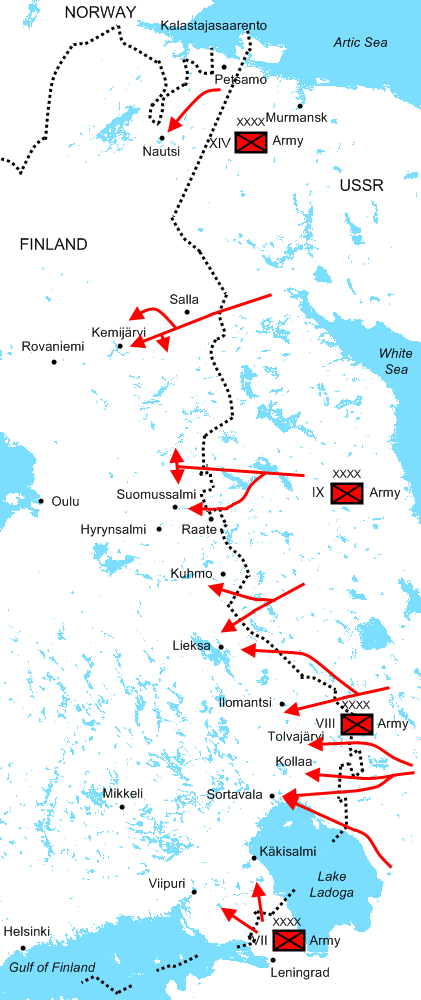
Initially, Soviet attacks along the 800-mile border from Ladoga to the Arctic Sea meet little resistance. Eighth Army advances north of Lake Ladoga. Ninth Army strikes into central Finland for the Gulf of Bothnia to cut Finland in half. Fourteenth Army aims to capture the Arctic port of Petsamo.
http://upload.wikimedia.org/wikipedia/commons/5/51/Winterwar-december1939-soviet-attacks.png
Monday, November 23, 2009


Day 90 November 29, 1939
Battle of the Atlantic. U-35 is brought to the surface in the North Sea by a concerted depth charge attack involving British destroyers HMS Kingston, Icarus and Kashmir. The submarine crew scuttles U-35 but all 43 men survive and are interred briefly at the Tower of London and before going to P.O.W. camps.
Winter war. The Finnish government vainly tries to restart negotiations with the Soviets, suggesting conciliation or arbitration, in accord with the non-aggression treaty. The Finns even offer to withdraw their troops from the border unilaterally. At midnight, Soviet Foreign Minister Molotov orders the invasion of Finland.
Winter war. The Finnish government vainly tries to restart negotiations with the Soviets, suggesting conciliation or arbitration, in accord with the non-aggression treaty. The Finns even offer to withdraw their troops from the border unilaterally. At midnight, Soviet Foreign Minister Molotov orders the invasion of Finland.
Day 89 November 28, 1939
Winter War. To observe the correct diplomatic etiquette before declaring war, USSR withdraws from its non-aggression pact with Finland, amid further Finnish protests. The Soviets maintain that Finland is the aggressor, despite a Finnish investigation revealing that Finnish border guards witnessed the shelling of Mainila by Soviet mortars.
Battle of the Atlantic. In the North Sea, Royal Navy trawler HMS Kingston Beryl scuttles the stern section of SS Gustaf E. Reuter which was torpedoed by U-48 on November 27.
Battle of the Atlantic. In the North Sea, Royal Navy trawler HMS Kingston Beryl scuttles the stern section of SS Gustaf E. Reuter which was torpedoed by U-48 on November 27.
Day 88 November 27, 1939
Winter War. Following the shelling of Mainila and the Soviet accusation of Finnish aggression, the Finns naively reply with a diplomatic note. They claim they could not have fired the shots, having previously withdrawn their guns out of range to avoid just such an incident. Ignorant of the coming storm, the Finns suggest both sides withdraw from the border areas to avoid further incidents.
Battle of the Atlantic. U-48 torpedoes the Swedish tanker SS Gustaf E. Reuter near Fair Isle off the Northeast coast of Scotland but fails to sink her. One man is killed but 32 others are rescued by the Royal Navy trawler HMS Kingston Beryl. SS Gustaf E. Reuter is taken under tow but she breaks up in a gale overnight.
Battle of the Atlantic. U-48 torpedoes the Swedish tanker SS Gustaf E. Reuter near Fair Isle off the Northeast coast of Scotland but fails to sink her. One man is killed but 32 others are rescued by the Royal Navy trawler HMS Kingston Beryl. SS Gustaf E. Reuter is taken under tow but she breaks up in a gale overnight.
Day 87 November 26, 1939
At 2.30 PM, Red Army stages a border incident to justify the coming invasion of Finland. They fire 7 mortar shells into a field near the village of Mainila on the Karelian Isthmus, half a mile inside Soviet territory. Fortunately, they clear the area beforehand and no one is hurt. Unfortunately, they are observed by Finnish border guards.
At 9 PM in Moscow, Finnish ambassador Yrjo-Koskinen is summoned to the Kremlin to be informed that “Finnish artillery shelled the area, killing 4 Soviet border guards and wounding 7 more”. The Finns are asked to withdraw their forces 20 – 25 km from the border.
This flimsy pretext does not fool international observers. John Colville, Prime Minister Neville Chamberlain’s private secretary, calls it “a technique which does not gain in dignity for being second-hand”, noting the similarity with Hitler's excuse for invading Poland.
At 9 PM in Moscow, Finnish ambassador Yrjo-Koskinen is summoned to the Kremlin to be informed that “Finnish artillery shelled the area, killing 4 Soviet border guards and wounding 7 more”. The Finns are asked to withdraw their forces 20 – 25 km from the border.
This flimsy pretext does not fool international observers. John Colville, Prime Minister Neville Chamberlain’s private secretary, calls it “a technique which does not gain in dignity for being second-hand”, noting the similarity with Hitler's excuse for invading Poland.
Day 86 November 25, 1939
At 1.19 PM, U-28 hits the British merchant ship SS Royston Grange (carrying general cargo and grain) with one torpedo. Royston Grange, sailing from Buenos Aires to Liverpool with convoy SL-8B, sinks about 50 miles southwest of Lands End. The crew are rescued by the trawler Romilly and taken to Swansea. U-28 also lays mines in the Bristol Channel on this patrol, which cause the sinking of the 9,577 ton SS Protesilaus on 21 January 1940.
Between 10 PM and midnight, U-43 repeatedly attacks British steamer SS Uskmouth about 120 miles northwest of Cape Finisterre, Spain. Her first 2 torpedoes malfunction and then U-43 shells Uskmouth with her deck gun. At 11 PM, U-43 fires another torpedo which misses. They continue shelling (firing 149 rounds in total) until Uskmouth sinks at midnight. Two men die but the captain and 22 crew are rescued by Italian merchant vessel SS Juventus and landed at Ramsgate on 30 November.
Between 10 PM and midnight, U-43 repeatedly attacks British steamer SS Uskmouth about 120 miles northwest of Cape Finisterre, Spain. Her first 2 torpedoes malfunction and then U-43 shells Uskmouth with her deck gun. At 11 PM, U-43 fires another torpedo which misses. They continue shelling (firing 149 rounds in total) until Uskmouth sinks at midnight. Two men die but the captain and 22 crew are rescued by Italian merchant vessel SS Juventus and landed at Ramsgate on 30 November.
Day 85 November 24, 1939
Finnish Prime Minister Aimo Cajander has refused to believe that USSR would attack Finland, relying instead on existing treaties, diplomacy and Finnish neutrality. In a speech to the nation, he makes an about face. He reviews Soviet actions in Poland and the Baltic nations, then again rebuffs Soviet demands for bases. He warns that each Finn “has his own guard post” and “must learn to plow carrying rifles”. Commander-in-Chief Field Marshall Mannerheim spreads the woefully under strength Finnish Army of 200,000 across the Karelian Isthmus (40 miles).
The Soviets, however, prepare to cross the entire Finish border and deploys 800,000 men from the Gulf of Finland to the Arctic Circle. Red Army supplements the supply of troops by sending press gangs out in St. Petersburg. One middle-aged man with no military training is ‘recruited” while out shopping for shoes for his wife. He still has her shoes in his kitbag when he is captured by the Finns weeks later.
The Soviets, however, prepare to cross the entire Finish border and deploys 800,000 men from the Gulf of Finland to the Arctic Circle. Red Army supplements the supply of troops by sending press gangs out in St. Petersburg. One middle-aged man with no military training is ‘recruited” while out shopping for shoes for his wife. He still has her shoes in his kitbag when he is captured by the Finns weeks later.
Sunday, November 22, 2009
Day 84 November 23, 1939
Between 1 - 3.30 PM, LtCmdr Ouvry and CPO Charles Baldwin defuse and recover a 7 ft long German magnetic mine (660 lbs of explosive) using specially-designed non-magnetic brass tools. Churchill hosts a party at the Admiralty. Ouvry, Lewis and Baldwin will receive medals from King George VI; the first Royal Naval decorations of the war.
Photos of Ouvry and his mine http://www.worldnavalships.com/forums/showthread.php?t=4927
A nice summary of the disarming and recovery of the magnetic mine by Ouvry, Lewis, Baldwin and others. Also the subsequent discovery of the mechanism of these mines and ways to combat their threat.http://www.capdantifer.org.uk/sweepers/textLMNO.html
In a David and Goliath battle near Iceland, merchant cruiser HMS Rawalpindi (armed with only four 6 inch guns) is sunk by battleships Scharnhorst and Gneisenau (265 lives lost). The Germans rescue 37 survivors and HMS Chitral saves 11. As Rawalpindi radioed their position, Scharnhorst and Gneisenau terminate their raiding mission.
U-33 torpedoes German merchant ship Borkum (captured by HMS California, Nov 18), killing 4 German sailors but none of the British prize crew. U-33’s commander von Dresky finds no glory on this sortie; in addition to Borkum, he has sunk only 5 tiny trawlers, picking up no survivors.
Photos of Ouvry and his mine http://www.worldnavalships.com/forums/showthread.php?t=4927
A nice summary of the disarming and recovery of the magnetic mine by Ouvry, Lewis, Baldwin and others. Also the subsequent discovery of the mechanism of these mines and ways to combat their threat.http://www.capdantifer.org.uk/sweepers/textLMNO.html
In a David and Goliath battle near Iceland, merchant cruiser HMS Rawalpindi (armed with only four 6 inch guns) is sunk by battleships Scharnhorst and Gneisenau (265 lives lost). The Germans rescue 37 survivors and HMS Chitral saves 11. As Rawalpindi radioed their position, Scharnhorst and Gneisenau terminate their raiding mission.
U-33 torpedoes German merchant ship Borkum (captured by HMS California, Nov 18), killing 4 German sailors but none of the British prize crew. U-33’s commander von Dresky finds no glory on this sortie; in addition to Borkum, he has sunk only 5 tiny trawlers, picking up no survivors.
Day 83 November 22, 1939
Between 8 and 9 PM, a low-flying Heinkel He111 is seen dropping magnetic mines by parachute in the Thames Estuary at Shoeburyness. 2 mines land on mud flats that are very shallow and uncovered at low tide. Two officers with the Render Mines Safe group (HMS Vernon), Lieutenant Commanders John Ouvry and Roger Lewis, are summoned to the Admiralty and dispatched by Churchill himself to recover the mines. These mines have caused the loss of 50,000 tons of shipping since October 16 and countermeasures are crucial.
In the Bay of Biscay, U-43 torpedoes French merchant ship SS Arijon, en route from Antwerp for Buenos Aires (cargo of steel bars).
In the Bay of Biscay, U-43 torpedoes French merchant ship SS Arijon, en route from Antwerp for Buenos Aires (cargo of steel bars).
Friday, November 20, 2009
Day 82 November 21, 1939
U-33’s captain has developed a taste for small fry. After sinking 3 fishing boats yesterday, he sinks 2 more. SS Sulby is sunk at 8:30 AM after a warning shot, 50 miles north of Ireland in heavy seas. A lifeboat with 7 survivors is rescued the following day but the captain and 4 men are lost. SS William Humphreys is sunk at 9:30 AM; 13 crew take to the lifeboat but they are never found.
Brand-new British cruiser Belfast strikes a magnetic mine in the Firth of Forth. The mine makes only a small hole in the hull but causes severe internal damage, injures 21 crew and keeps her out of action until 3 Nov 1942. Destroyer HMS Gypsy is sunk by a mine in the English Channel off Harwich (30 lives lost).
Battleships Scharnhorst & Gneisenau sail into the Iceland-Faroes passage on their first wartime sortie, with light cruisers Köln & Leipzig.
After 18 days in the Indian Ocean, Graf Spee passes The Cape of Good Hope seeking better hunting back to the Atlantic.
At 12.50 PM, French trawler Les Barges II is sunk by U-41 in the Bay of Biscay. The crew escapes and are picked up by a Spanish trawler. U-41 stops 17 other trawlers; all are neutral Spanish vessels.
Brand-new British cruiser Belfast strikes a magnetic mine in the Firth of Forth. The mine makes only a small hole in the hull but causes severe internal damage, injures 21 crew and keeps her out of action until 3 Nov 1942. Destroyer HMS Gypsy is sunk by a mine in the English Channel off Harwich (30 lives lost).
Battleships Scharnhorst & Gneisenau sail into the Iceland-Faroes passage on their first wartime sortie, with light cruisers Köln & Leipzig.
After 18 days in the Indian Ocean, Graf Spee passes The Cape of Good Hope seeking better hunting back to the Atlantic.
At 12.50 PM, French trawler Les Barges II is sunk by U-41 in the Bay of Biscay. The crew escapes and are picked up by a Spanish trawler. U-41 stops 17 other trawlers; all are neutral Spanish vessels.
Thursday, November 19, 2009
Day 81 November 20, 1939


Battleships Scharnhorst and Gneisenau are the pride of the German fleet. They are the largest (32,000 tons, 235 m long, 30 m beam) and best armed (9 11-inch guns, 12 6-inch guns, 14 4-inch guns, 6 torpedo tubes, 3 Arado seaplanes) ships in the Kriegsmarine. Gneisenau was built at Kiel, Germany, launched on December 8, 1936 and commissioned on May 21, 1938. Scharnhorst was built at Wilhelmshaven, Germany, launched on 3 October 1936, and commissioned on 7 January 1939. After months of sea trials, they are finally ready to face the Royal Navy.
The commander of U-33 Kapitänleutnant Hans-Wilhelm von Dresky has a busy, if undistinguished, day. U-33 sinks 3 tiny unarmed British trawlers off Tory Island on the northwest coast of Northern Ireland. SS Thomas Hankins is sunk at 10:30 AM. The crew take to the lifeboat and is rescued by another trawler 10 hours later. They report being hit with 5 shells from U-33’s deck gun without warning. SS Delphine is sunk at 4 PM and the crew of 13 makes land the following day after the chief engineer blocks a hole in their lifeboat with his foot for 22 hours. SS Sea Sweeper is sunk at 5 PM and the crew is rescued by the trawler Lois.
Wednesday, November 18, 2009
Day 80 November 19, 1939
In response to Germany laying magnetic mines in the English Channel, First Lord of the Admiralty Winston Churchill wants mines dropped by air into the Rhine in the Ruhr area to disrupt river shipping. He also proposes launching time-activated mines into the Rhine along the French/German border between Strasbourg and the Lauter River, to float downstream.
A deadly game of cat and mouse in the Bay of Biscay. U-41 hunts the British steamer SS Darino. Over 8 hours U-41 misses with 3 torpedoes. At 1:50 AM, Darino is sunk by a fourth torpedo (16 lives lost). 11 crew are picked up by U-41, transferred to an Italian merchant ship and later landed at Dover. Nearby, U-49 stalks Convoy HG-7 from Durban to Dunkirk via for 3 hours. U-49 fires 2 torpedoes that miss the British steamer SS Pensilva (cargo of maize) but a third torpedo sinks her at 12.19 PM. The Captain and crew are rescued by the destroyers HMS Echo and Wanderer and returned to England.
A deadly game of cat and mouse in the Bay of Biscay. U-41 hunts the British steamer SS Darino. Over 8 hours U-41 misses with 3 torpedoes. At 1:50 AM, Darino is sunk by a fourth torpedo (16 lives lost). 11 crew are picked up by U-41, transferred to an Italian merchant ship and later landed at Dover. Nearby, U-49 stalks Convoy HG-7 from Durban to Dunkirk via for 3 hours. U-49 fires 2 torpedoes that miss the British steamer SS Pensilva (cargo of maize) but a third torpedo sinks her at 12.19 PM. The Captain and crew are rescued by the destroyers HMS Echo and Wanderer and returned to England.
Tuesday, November 17, 2009
Day 79 November 18, 1939
At 10.30 AM Dutch liner Simon Bolivar hits a German magnetic mine laid yesterday in the English Channel, 10 miles east of Harwich. Out of 400 onboard, including 30 children, 86 are killed. International law requires notification of mine-laying in shipping lanes, leading to widespread public outrage in England and Holland. Holland protests to Germany in vain.
German merchant ship SS Borkum, running supplies to Germany through the British blockade, is stopped in the Denmark Strait by the British armed merchant cruiser HMS California. A British prize crew is put on board and sails Borkum towards Kirkwall in the Orkney Islands.
Hitler receives a memo from General Blaskowitz, Wehrmacht Commander in Poland, complaining about SS and Einsatzgruppen atrocities and the effects on ordinary soldiers. The memo annoys everyone from Hitler and Himmler to Chief of Staff Alfred Jodl. Blaskowitz is blacklisted from command in the invasion of France.
German merchant ship SS Borkum, running supplies to Germany through the British blockade, is stopped in the Denmark Strait by the British armed merchant cruiser HMS California. A British prize crew is put on board and sails Borkum towards Kirkwall in the Orkney Islands.
Hitler receives a memo from General Blaskowitz, Wehrmacht Commander in Poland, complaining about SS and Einsatzgruppen atrocities and the effects on ordinary soldiers. The memo annoys everyone from Hitler and Himmler to Chief of Staff Alfred Jodl. Blaskowitz is blacklisted from command in the invasion of France.
Monday, November 16, 2009
Day 78 November 17, 1939
USSR-German collaboration. As part of the Molotov-Ribbontrop pact extension following the partition of Poland, USSR offers Germany a northern base ‘Basis Nord’ to support their blockade of Britain. Naval High Command sends U-36 and U-38 to scout the proposed location at Zapadnaya Litsa on the Kola Peninsula, 25 miles from Mumansk.
Anglo-French Collaboration. Supreme War Council meets in Paris. They agree to an immediate advance to the River Dyle between Antwerp Line and Brussels if the Germans invade (the Dyle Plan or "Plan D"). However, the French turned down proposals to bomb industrial targets in the Ruhr fearing Luftwaffe retaliation against Britain and France.
German destroyers, Z11 Berndt von Arnim, Z19 Herman Künne and Z21 Wilhelm Heidkamp lay magnetic mines in major shipping lanes in the English Channel. No notification is made, contravening International law and leading to catastrophic results the next day.
Anglo-French Collaboration. Supreme War Council meets in Paris. They agree to an immediate advance to the River Dyle between Antwerp Line and Brussels if the Germans invade (the Dyle Plan or "Plan D"). However, the French turned down proposals to bomb industrial targets in the Ruhr fearing Luftwaffe retaliation against Britain and France.
German destroyers, Z11 Berndt von Arnim, Z19 Herman Künne and Z21 Wilhelm Heidkamp lay magnetic mines in major shipping lanes in the English Channel. No notification is made, contravening International law and leading to catastrophic results the next day.
Sunday, November 15, 2009
Day 77 November 16, 1939
German pocket battleship Admiral Graf Spee stops the Dutch vessel SS Mapia about 350 miles Southwest of Madagascar. Graf Spee’s captain, Hans Langsdorff, permits Mapia to proceed due to Dutch neutrality, allowing her to report his identity and position upon reaching port. His goal is to confuse Allied warships hunting him as to the number and location of German sea raiders. Langsdorff decides that, given the lack of targets, his work is done in the Indian Ocean and he sets sail for The Cape of Good Hope to go back to the Atlantic.
King Carol of Romania’s offer to mediate is rejected by Germany and the Allies.
King Carol of Romania’s offer to mediate is rejected by Germany and the Allies.
Day 76 November 15, 1939
Following rejection of appeals for peace by King Leopold of Belgium and Queen Wilhelmina of the Netherlands, German Foreign Minister von Ribbentrop announces that the German peace offer to Britain and France is now withdrawn.
Graf Spee has been cruising trade routes in the Indian Ocean since Nov 3 and needs a kill to register her presence. However, the expected prey does not materialise as wool clipping season in Australia is late and cargo ships await loading in Australia. Graf Spee sights SS Africa Shell, a tiny British oil tanker belonging to the Shell Company of East Africa, 6 miles off Zabora Point Mozambique (at the southern end of the channel between Madagascar and Mozambique). Africa Shell is empty, sailing to port in Delagoa Bay (now the capital Maputo). Africa Shell’s crew are taken off by Graf Spee’s launch and she is sunk by shell fire (see photo and link). The Allies will soon know that a raider is at large in the Indian Ocean.
http://www.maritimequest.com/freighters/02_pages/a/africa_shell_1938_page_1.htmVery nice account of the stopping and sinking of the SS Africa Shell by German pocket battleship Admiral Graf Spee on November 15, 1939, including a series of photographs taken from Graf Spee. Notably, one photo shows a launch taking the crew off Africa Star before she is sunk. This gentlemanly behaviour ensured that no lives were lost on any of the ships sunk by Graf Spee.
Graf Spee has been cruising trade routes in the Indian Ocean since Nov 3 and needs a kill to register her presence. However, the expected prey does not materialise as wool clipping season in Australia is late and cargo ships await loading in Australia. Graf Spee sights SS Africa Shell, a tiny British oil tanker belonging to the Shell Company of East Africa, 6 miles off Zabora Point Mozambique (at the southern end of the channel between Madagascar and Mozambique). Africa Shell is empty, sailing to port in Delagoa Bay (now the capital Maputo). Africa Shell’s crew are taken off by Graf Spee’s launch and she is sunk by shell fire (see photo and link). The Allies will soon know that a raider is at large in the Indian Ocean.
http://www.maritimequest.com/freighters/02_pages/a/africa_shell_1938_page_1.htmVery nice account of the stopping and sinking of the SS Africa Shell by German pocket battleship Admiral Graf Spee on November 15, 1939, including a series of photographs taken from Graf Spee. Notably, one photo shows a launch taking the crew off Africa Star before she is sunk. This gentlemanly behaviour ensured that no lives were lost on any of the ships sunk by Graf Spee.
Day 75 November 14, 1939
The Phony War is in full swing. Not much happens in mainland Europe but men are still dying in the Battle of the Atlantic. While the Finnish Army of 175,000 – 200,000 troop dig in on the Karelian Isthmus in anticipation of a Soviet invasion, the Red Army musters about 4 times as many along the entire Finnish border.
Hitler also rejects peace appeals by Queen Wilhelmina of the Netherlands and King Leopold of Belgium, previously rejected by the Allies on November 12.
Hitler also rejects peace appeals by Queen Wilhelmina of the Netherlands and King Leopold of Belgium, previously rejected by the Allies on November 12.
Thursday, November 12, 2009
Day 74 November 13, 1939
Battle of the Atlantic. During the night, 4 German destroyers (Zerstörer Z20, Z18, Z19, Z21) lay magnetic mines in mouth of the river Thames. 5.26 AM Cruiser HMS Adventure and destroyers HMS Basilisk and Blanche sail into the minefield; Adventure detonates a mine (23 lives lost) but safely reaches harbor. 8.20AM Blanche, escorting Adventure, is badly damaged by another mine (1 dead, 12 injured). She is towed by tugboat Fabia but capsizes, becoming the first British destroyer lost to enemy action. Two merchant vessels SS Ponzano and SS Matra are also sunk by these mines.
http://www.carlson.eclipse.co.uk/charles-voyage/charles-voyage.html
An excellent website dedicated to the mining of HMS Adventure and HMS Blanche, maintained by the grandson of a casualty on HMS Adventure. Includes photographs of the damage to HMS Adventure and accounts from the captains of both HMS Adventure and HMS Blanche.
Winter War. Finnish diplomacy has failed. Paasikivi and Tanner leave Moscow for the last time before the outbreak of hostilities. Paasikivi will return to surrender in March 1940. Tanner is tried in 1946 for war crimes and spends 3 years in jail.
King Carol of Romania offers to mediate peace after the Allies rebuff Dutch and Belgian royalty. He too is viewed as acting for Hitler.
http://www.carlson.eclipse.co.uk/charles-voyage/charles-voyage.html
An excellent website dedicated to the mining of HMS Adventure and HMS Blanche, maintained by the grandson of a casualty on HMS Adventure. Includes photographs of the damage to HMS Adventure and accounts from the captains of both HMS Adventure and HMS Blanche.
Winter War. Finnish diplomacy has failed. Paasikivi and Tanner leave Moscow for the last time before the outbreak of hostilities. Paasikivi will return to surrender in March 1940. Tanner is tried in 1946 for war crimes and spends 3 years in jail.
King Carol of Romania offers to mediate peace after the Allies rebuff Dutch and Belgian royalty. He too is viewed as acting for Hitler.
Wednesday, November 11, 2009
Day 73 November 12, 1939
At 7 AM, U-41 (Kapitänleutnant Gustav-Adolf Mugler in command) shells and sinks the British steam trawler Cresswell off the Outer Hebrides, Scotland (6 lives lost). U-41 picks up 8 survivors, At 10 AM, U-41 sinks Norwegian tanker Arne Kjøde (cargo of gas oil, en route to Denmark) with one torpedo. Note that both Denmark and Norway are neutral at this time. The crew takes to 2 lifeboats but one capsizes with 5 lives lost, including the captain. 34 survivors will be picked up on Nov 14 by the British trawler Night Hawk and the Royal Navy destroyer HMS Isis.
British and French governments politely refuse offers of mediation by Queen Wilhelmina of the Netherlands and King Leopold of Belgium, suspecting they are acting for Hitler. First Lord of the Admiralty Churchill broadcasts a speech on the first 10 weeks of the war, emphasising the continued threat to Europe from Nazi Germany. “If words could kill, we should be dead already.”
British and French governments politely refuse offers of mediation by Queen Wilhelmina of the Netherlands and King Leopold of Belgium, suspecting they are acting for Hitler. First Lord of the Admiralty Churchill broadcasts a speech on the first 10 weeks of the war, emphasising the continued threat to Europe from Nazi Germany. “If words could kill, we should be dead already.”
Tuesday, November 10, 2009
Day 72 November 11, 1939
British, French, Belgian and German troops mark the twenty-first anniversary of the Armistice, at 11 AM on November 11 1918, on the very battlefields where their fathers fought The Great War (World War One, as it would soon be known). Many in Britain hope that Germany’s expansion in Europe will not bring another general war. Others, including Churchill, believe the storm has not passed and that Hitler will continue his plans for European domination. As Armistice Day falls on a Saturday, the two-minute silence of remembrance in Britain is moved to Sunday to avoid disrupting war production. This begins the new tradition of Remembrance Day on the Sunday closest to November 11. Sales of the symbolically pacifist white poppies drop from 85,000 in 1938 to almost nil.
Monday, November 9, 2009
Day 71 November 10, 1939
The Phony War on the Western Front continues. The Dutch believe the date of the invasion is November 12, due to Hans Oster’s leak to their military attaché. They cancel Army leave, reinforce the border and prepare to flood strategic areas. On the French border, German troops reinforce the Siegfried Line. German probing attacks stimulate French rifle and artillery fire.
In Paris, French Prime Minister Édouard Daladier and Commander-in-Chief General Maurice Gamelin receive Anthony Eden, British Secretary of State for Dominion Affairs (a British cabinet post handling British relations with the Dominions), and delegates from Australia, New Zealand, South Africa and India. British Prime Minister Neville Chamberlain stays home in London suffering badly from gout. Chamberlain will recover from gout but things only get worse for him. Six months from now he will resign as Prime Minister and in a year he will be dead from cancer.
In Paris, French Prime Minister Édouard Daladier and Commander-in-Chief General Maurice Gamelin receive Anthony Eden, British Secretary of State for Dominion Affairs (a British cabinet post handling British relations with the Dominions), and delegates from Australia, New Zealand, South Africa and India. British Prime Minister Neville Chamberlain stays home in London suffering badly from gout. Chamberlain will recover from gout but things only get worse for him. Six months from now he will resign as Prime Minister and in a year he will be dead from cancer.
Sunday, November 8, 2009
Day 70 November 9, 1939
The Finnish government responds to continued Soviet demands for land concessions and military bases by rescinding their offer to yield the Gulf of Finland islands. Their embarrassed delegates, Paasikivi and Tanner, still in Moscow, are left to communicate this. At 6 PM they meet Molotov and Stalin for the final time; “Finland cannot grant to a foreign state military bases on its own territory”. Before they leave, Stalin, incredulous, asks “Nothing doing”? At midnight, Molotov enquires whether Finland will sell the Hanko peninsula to get around this impasse. The Finns pack their bags for the last time. Nothing doing.
Hitler issues directive No. 9. German aircraft and submarines are directed to mine British sea lanes and to target attacks on British merchant shipping, ports and storage depots. His goal is to starve Britain out of the war, reflecting on the blockade that crippled Germany in the First World War.
Hitler issues directive No. 9. German aircraft and submarines are directed to mine British sea lanes and to target attacks on British merchant shipping, ports and storage depots. His goal is to starve Britain out of the war, reflecting on the blockade that crippled Germany in the First World War.
Day 69 November 8, 1939
An assassination attempt is made on Hitler, on the 16th anniversary of his attempt to seize power on Nov 8, 1923 (the Beer Hall Putsch). Hitler makes his annual speech to the surviving veterans of the Putsch at the Bürgerbräukeller in Munich. A time bomb has been planted by German carpenter Georg Elser in a hollowed out pillar behind the speaker's rostrum. Hitler cuts short his speech to catch the train back to Berlin as it is too foggy for him to fly. The bomb explodes at 21:20, exactly as Elser planned, but Hitler had left 13 minutes earlier. Eight people die and sixty-three are injured, sixteen of them seriously.
Elser is arrested in Konstanz, trying to cross the border into Switzerland. He is transferred to Gestapo headquarters in Berlin where he confesses under torture. He will eventually be held at the Sachsenhausen and Dachau concentration camps until April 1945, when Hitler orders his death to prevent liberation by the advancing Allies.
Elser is arrested in Konstanz, trying to cross the border into Switzerland. He is transferred to Gestapo headquarters in Berlin where he confesses under torture. He will eventually be held at the Sachsenhausen and Dachau concentration camps until April 1945, when Hitler orders his death to prevent liberation by the advancing Allies.
Day 68 November 7, 1939
The invasion of France “Case Yellow”, set for Nov 12, is cancelled due to bad weather. This pattern - planned launch of the attack then postponement by the weather - is repeated many times through November and December 1939 and into January 1940. Hitler does not get his early pressure on the Allies and the Phony War continues.
Queen Wilhelmina of the Netherlands and King Leopold of Belgium appeal for peace and offer themselves as mediators.
Queen Wilhelmina of the Netherlands and King Leopold of Belgium appeal for peace and offer themselves as mediators.
Day 67 November 6, 1939
Western Front. In the first large air battle over the Saar in northwestern France, 9 French Curtiss P-36 Hawk fighters shoot down 4 out of 27 German Messerschmitt Bf 109E. French losses are not recorded. The P-36 Hawk with four 7.5 mm Browning machine guns does well early in the war, despite being outgunned by the Bf 109E with two 7.92 mm MG 17s plus 2 wing-mounted 20 mm cannon.
Around 1830, General Carl von Clausewitz, director of the Prussian War Academy and a military historian and theorist, wrote his book “On War”. His famous line "Der Krieg ist eine bloße Fortsetzung der Politik mit anderen Mitteln" is liberally translated as "War is merely a continuation of diplomacy (politics) by other means". If this is true, then a declaration of war requires certain preliminary diplomatic maneuvers. In Moscow, these diplomatic niceties continue, with the Finns hoping to avert or at least delay war while the Soviets lay the final touches to their invasion plans.
Around 1830, General Carl von Clausewitz, director of the Prussian War Academy and a military historian and theorist, wrote his book “On War”. His famous line "Der Krieg ist eine bloße Fortsetzung der Politik mit anderen Mitteln" is liberally translated as "War is merely a continuation of diplomacy (politics) by other means". If this is true, then a declaration of war requires certain preliminary diplomatic maneuvers. In Moscow, these diplomatic niceties continue, with the Finns hoping to avert or at least delay war while the Soviets lay the final touches to their invasion plans.
Wednesday, November 4, 2009
Day 66 November 5, 1939
The invasion of France, Belgium and the Netherlands “Case Yellow” is set for November 12. Commander-in-Chief, General von Brauchitsch, warns Hitler that the Army is unprepared for an immediate invasion and also reminds him of the risks of a Winter campaign. In addition, von Brauchitsch asks Hitler to allow Oberkommando des Heeres (OKH) to supervise military operations without interference. Hitler loses his temper, asserts that the General Staff are disloyal and cowards, and insists the attack goes ahead.
Colonel Hans Oster of German military intelligence (Abwehr) learns of the plans. He informs his friend Colonel Bert Sas, the Dutch military attaché in Berlin, of the exact date of the planed invasion of the Netherlands. He will do this more than twenty times as the invasion is repeatedly delayed and rescheduled.
Colonel Hans Oster of German military intelligence (Abwehr) learns of the plans. He informs his friend Colonel Bert Sas, the Dutch military attaché in Berlin, of the exact date of the planed invasion of the Netherlands. He will do this more than twenty times as the invasion is repeatedly delayed and rescheduled.
Day 65 November 4, 1939
Captain Hector Boyes, British Naval Attaché in Oslo, receives an anonymous letter offering German technical secrets. He is requested to signal interest by changing the BBC World Service's German broadcast announcement to "Hullo, hier ist London". He arranges this and a week later receives a parcel with a 7-page typewritten report (which becomes known as the "Oslo Report") and components of a prototype proximity fuse. They come from physicist Hans Mayer, director of the Siemens communications laboratory, who hopes to weaken the Nazi regime by revealing details of military secrets. Mayer arrived in Oslo on October 30, on a business trip, and typed the letter and report on a typewriter borrowed from his hotel.
The Oslo Report is initially considered a fake by British intelligence but is ultimately accepted. Mayer is sent to a concentration camp in 1943 for criticising the Nazi regime but never suspected of spying. He survives the war.
The Oslo Report is initially considered a fake by British intelligence but is ultimately accepted. Mayer is sent to a concentration camp in 1943 for criticising the Nazi regime but never suspected of spying. He survives the war.
Monday, November 2, 2009
Days 53 - 64 (October 23 - November 3, 1939)
Day 64 November 3, 1939
The Finnish delegates Paasikivi and Tanner again meet with Molotov and Stalin at the Kremlin. The Finnish position has not changed since Oct 23; they offer islands in the Gulf of Finland but the Hanko peninsula (guarding the mouth of the Gulf) is not for discussion. The Soviet position has not changed either; Molotov warns “now is the turn of the military to have their say”.
USA neutrality law, preventing trade in arms and war materials, loans or credits to belligerent parties in a war, is an isolationist policy to insulate America from oversees wars. This is revised in the Neutrality Act of 1939 to allow arms trade with belligerent nations on a cash and carry basis.
German Commander-in-Chief von Brauchitsch rejects Manstein’s first memorandum on the invasion of France; however, he does allocate more tanks to General Rundstedt’s Army group A (Manstein’s superior). Undaunted, Manstein will revise his plan and submit more memos to Brauchitsch.
Day 63 November 2, 1939
As Finnish diplomats try to avert war by extending negotiations, the Soviet leadership has a clearer view of the situation. Unlike Estonia, Lithuania and Latvia, which quickly granted Soviet access to bases, the Finnish government has resisted both subtle and direct threats of invasion and seems unlikely to change tack now.
Stalin has rejected Chief of the General Staff Boris Shaposhnikov’s plan for a direct but prolonged charge up the Karelian Isthmus to the Finnish capital Helsinki. Instead, he prefers the plan of Kirill Meretskov (Commander of the Leningrad Military District) to cross the entire 800 mile border. He believes blitzkrieg tactics and the desire of the Finnish people to be liberated by their Soviet neighbours will lead to a swift victory. The Finnish terrain (lakes, forests and marshes) and the will of the Finnish people prove both assumptions to be incorrect.
Day 62 November 1, 1939
The Finnish delegates Paasikivi and Tanner leave by train for Moscow to negotiate again with the Soviets. The Finnish position has not changed and they do not intend to give up any more territory than the Gulf islands already offered on October 23. Their goal is to keep the negotiations alive, in order to delay military action by the USSR, as they have been informed by Field Marshall Carl Gustav Mannerheim (Commander-in-Chief of the Finnish army) that the Finnish army is not ready to fight. Political belief in Finnish neutrality has blinded them to Soviet ambitions to reclaim ‘lost Russian’ territory and the antebellum Army is grossly under prepared. The Finnish army numbers about 200,000 men, with no tanks, little heavy artillery (except coastal batteries on the Gulf of Finland and Lake Lagoda), about 100 Bofors anti-tank guns and precious little ammunition for any of these weapons.
Day 61 October 31, 1939
Erich von Manstein’s first memorandum on the invasion of France arrives at Army High Command (Oberkommando des Heeres or OKH). It will be quickly rejected but 5 more memoranda will follow. He has been working on an armored thrust through the Ardennes Forest and along the River Somme, to isolate the Allied forces in Northern France and Belgium. Although Manstein does not know it, his plan is completely in line with Hitler's thinking.
To increase pressure on Finland, Molotov makes a speech to the Supreme Soviet publicly announcing negotiations which have so far been secret. This successfully isolates Finland from potential international support (e.g. Sweden) but fails to cause the expected uprising of the Finnish public against their government. Instead the Finns are proud of their hard-won independence and rally behind their leaders. This is not the last time the Soviets miscalculate the Finnish people.
Day 60 October 30, 1939
Hitler is impatient with Halder’s lack of progress for an aggressive plan to invade France. He suggests to Generaloberst Alfred Jodl (Chief of Operation Staff, Oberkommando der Wehrmacht) that a tank force should advance through the Ardennes Forest. Although this is initially deemed impractical, Hitler's idea will find form in the plans being developed by Manstein.
Battle of the Atlantic. Royal Navy battleships HMS Nelson and Rodney, cruiser HMS Hood and destroyers HMS Icarus, Impulsive, Ivanhoe, Intrepid and Kelly are escorting iron ore ships from Narvik to the Firth of Forth. The battle group, under Admiral Charles Morton Forbes (Commander-in-Chief, Home Fleet), encounters German U-boats west of the Orkney Islands. U-56 hits HMS Nelson, the flagship of the Home Fleet, with three torpedoes but none explode. However, U-57, U-58 and U-59 do not engage the British ships.
Day 59 October 29, 1939
The first Luftwaffe plane is shot down over the British mainland at Haddington, East Lothian, on The Firth of Forth. The aircraft is a Heinkel He 111, part of Luftflotte 2 based in Northern Germany to attack shipping off the coast of Scotland and the Royal Navy Home Fleet at Rosyth (Firth of Forth) and Scapa Flow. RAF Spitfires of both 602 and 603 Squadrons claim the kill. Two survivors, from the crew of 4, become among the first German POWs held in Britain, at Grizedale Hall in Lancashire (Camp 1) or Glen Mill Camp also in Lancashire (Camp 176).
Soviet troops begin occupying bases in Latvia. Soviet troops continue mobilizing and Finnish troops dig in along their shared borders.
Day 58 October 28, 1939
Graf Spee has been ordered out of the Atlantic to avoid British warships. She meets up with her support ship Altmark west of The Cape of Good Hope, refuels and transfers the prisoners from her last victim, SS Trevanion. At midnight, Graf Spee sets sail for the Indian Ocean.
Captain Brown of SS Huntsman, already a prisoner on Altmark, records in his diary - “"Graf Spee returned after nine days absence. We were not allowed on deck as she was oiling from the Altmark and storing by motor boats. Fine weather, sea smooth. Capt Edwards, Chief Officer and Ch. Engineer of Trevanion were ushered into our quarters. Now thirteen in our quarters & thirty-four in the Officers deck.”
Day 57 October 27, 1939
Although technically unnecessary, King Leopold III of Belgium declares his commitment to Belgian neutrality. The Treaty of London, signed on 19 April 1839 by the United Kingdom, Austria, France, Prussia, Russia and the Netherlands, guaranteed the independence and neutrality of Belgium and committed the signatories to guard that neutrality in the event of invasion.
Erwin Rommel has commanded Hitler's personal protection detail (FührerBegleitbataillon) since 1938. Promoted to Generalmajor in August 1939, he protected Hitler's field headquarters in Poland. During the Polish campaign and afterwards in Germany, Rommel takes advantage of staff meetings and meals with Hitler to lobby for a field command. A proponent of mobile armored warfare, he naturally has his eyes on a Panzer division. It has taken Rommel 21 years to rise from Captain to the lowest rank of General; in less than three years his rank will be Generalfeldmarschall.
Day 56 October 26, 1939
Hans Frank, a dedicated Nazi, is given rank of SS Obergruppenführer and appointed Governor-General of the General Government for the occupied Polish territories “Generalgouvernement für die besetzten polnischen Gebiete” (or simply General Government). A decree imposes compulsory labour on all Jews aged 16 -60.
General Government is a German police state “colony”, with no Polish representation, and Hitler plans for complete Germanification within 15-20 years. This area (approximately 95,000 square km with a population of 12 million) lies between Western Poland, annexed into Germany, and Eastern Poland, now occupied by USSR. Frank is responsible for segregating Jews into city ghettos and exporting Polish civilians to Germany as forced labour. He will eventually be found guilty of war crimes at the Nuremberg trials and hung on October 16, 1946.
Day 55 October 25, 1939
Paasikivi and Tanner change trains in Leningrad. Ominously, they see significant concentrations of Red Army troops around Leningrad. North of the city, on the Soviet portion of the Karelian Isthmus, construction of additional road and rail connections is underway. While it might seem careless for the Soviets to allow their preparations to be observed, the obvious route of Soviet attack into Finland is across the Karelian Isthmus (a 30 mile wide strip between the Gulf of Finland and Lake Lagoda) and the Finns are already fortifying the Mannerheim Line to defend against this. Unknown to the Finns, the Red Army is also planning to attack along the entire 800 mile border running North from Lake Lagoda to the Barents Sea.
Battle of the Atlantic. U-16 is sunk by HMS Cayton Wyke, a requisitioned trawler converted for minesweeping, and patrol vessel HMS Puffin.
Day 54 October 24, 1939
Paasikivi and Tanner, the Finnish delegation to negotiate the border dispute with USSR, leave Moscow by train for Leningrad and then Helsinki. The talks are public knowledge but the topic of acquisition of bases and territory by USSR is top secret. The New York Times speculates that either the Finns are negotiating a loan to make up for trade revenues with Britain lost as a result of German sinking of neutral vessels, or that Tanner as head of the Finnish Socialist party is reporting to Moscow on the attitude of finish workers. This secrecy will not be maintained for long.
82,000 kg of Polish gold has traveled from the Romania port of Constanţa on Sept. 16 to Istanbul in Turkey on Sept. 19, and then on to Beirut, Lebanon where it was loaded on French warships bound from France. It finally arrives in Paris.
Day 53 October 23, 1939
The Finnish delegates Paasikivi and Tanner arrive in Moscow by train and go to the Kremlin to negotiate with Molotov and Stalin. The Finns are prepared to give up 6 islands in the Gulf of Finland and they offer to move the border near Leningrad 13 km North, giving some protection to USSR’s second city. Stalin continues to demand a border move of 70 km, as well as a ‘lease’ on the entire Hanko peninsula to station 5000 troops and a naval base. He adds ominously that there will be no haggling but the Finns are not authorized to make these concessions and the meeting breaks up acrimoniously, with each side accusing the other of provoking war. Paasikivi and Tanner return to the Kremlin at 11 p.m. to hear Stalin’s final offer to reduce the Hanko garrison to 4000 but conceding this is still beyond their remit. They agree to take the Soviet terms (which, in reality, are not much different from those presented Oct 12) back to Helsinki for discussion by the Finnish government. While the Finns engage in more diplomacy, USSR prepares for war.
The Finnish delegates Paasikivi and Tanner again meet with Molotov and Stalin at the Kremlin. The Finnish position has not changed since Oct 23; they offer islands in the Gulf of Finland but the Hanko peninsula (guarding the mouth of the Gulf) is not for discussion. The Soviet position has not changed either; Molotov warns “now is the turn of the military to have their say”.
USA neutrality law, preventing trade in arms and war materials, loans or credits to belligerent parties in a war, is an isolationist policy to insulate America from oversees wars. This is revised in the Neutrality Act of 1939 to allow arms trade with belligerent nations on a cash and carry basis.
German Commander-in-Chief von Brauchitsch rejects Manstein’s first memorandum on the invasion of France; however, he does allocate more tanks to General Rundstedt’s Army group A (Manstein’s superior). Undaunted, Manstein will revise his plan and submit more memos to Brauchitsch.
Day 63 November 2, 1939
As Finnish diplomats try to avert war by extending negotiations, the Soviet leadership has a clearer view of the situation. Unlike Estonia, Lithuania and Latvia, which quickly granted Soviet access to bases, the Finnish government has resisted both subtle and direct threats of invasion and seems unlikely to change tack now.
Stalin has rejected Chief of the General Staff Boris Shaposhnikov’s plan for a direct but prolonged charge up the Karelian Isthmus to the Finnish capital Helsinki. Instead, he prefers the plan of Kirill Meretskov (Commander of the Leningrad Military District) to cross the entire 800 mile border. He believes blitzkrieg tactics and the desire of the Finnish people to be liberated by their Soviet neighbours will lead to a swift victory. The Finnish terrain (lakes, forests and marshes) and the will of the Finnish people prove both assumptions to be incorrect.
Day 62 November 1, 1939
The Finnish delegates Paasikivi and Tanner leave by train for Moscow to negotiate again with the Soviets. The Finnish position has not changed and they do not intend to give up any more territory than the Gulf islands already offered on October 23. Their goal is to keep the negotiations alive, in order to delay military action by the USSR, as they have been informed by Field Marshall Carl Gustav Mannerheim (Commander-in-Chief of the Finnish army) that the Finnish army is not ready to fight. Political belief in Finnish neutrality has blinded them to Soviet ambitions to reclaim ‘lost Russian’ territory and the antebellum Army is grossly under prepared. The Finnish army numbers about 200,000 men, with no tanks, little heavy artillery (except coastal batteries on the Gulf of Finland and Lake Lagoda), about 100 Bofors anti-tank guns and precious little ammunition for any of these weapons.
Day 61 October 31, 1939
Erich von Manstein’s first memorandum on the invasion of France arrives at Army High Command (Oberkommando des Heeres or OKH). It will be quickly rejected but 5 more memoranda will follow. He has been working on an armored thrust through the Ardennes Forest and along the River Somme, to isolate the Allied forces in Northern France and Belgium. Although Manstein does not know it, his plan is completely in line with Hitler's thinking.
To increase pressure on Finland, Molotov makes a speech to the Supreme Soviet publicly announcing negotiations which have so far been secret. This successfully isolates Finland from potential international support (e.g. Sweden) but fails to cause the expected uprising of the Finnish public against their government. Instead the Finns are proud of their hard-won independence and rally behind their leaders. This is not the last time the Soviets miscalculate the Finnish people.
Day 60 October 30, 1939
Hitler is impatient with Halder’s lack of progress for an aggressive plan to invade France. He suggests to Generaloberst Alfred Jodl (Chief of Operation Staff, Oberkommando der Wehrmacht) that a tank force should advance through the Ardennes Forest. Although this is initially deemed impractical, Hitler's idea will find form in the plans being developed by Manstein.
Battle of the Atlantic. Royal Navy battleships HMS Nelson and Rodney, cruiser HMS Hood and destroyers HMS Icarus, Impulsive, Ivanhoe, Intrepid and Kelly are escorting iron ore ships from Narvik to the Firth of Forth. The battle group, under Admiral Charles Morton Forbes (Commander-in-Chief, Home Fleet), encounters German U-boats west of the Orkney Islands. U-56 hits HMS Nelson, the flagship of the Home Fleet, with three torpedoes but none explode. However, U-57, U-58 and U-59 do not engage the British ships.
Day 59 October 29, 1939
The first Luftwaffe plane is shot down over the British mainland at Haddington, East Lothian, on The Firth of Forth. The aircraft is a Heinkel He 111, part of Luftflotte 2 based in Northern Germany to attack shipping off the coast of Scotland and the Royal Navy Home Fleet at Rosyth (Firth of Forth) and Scapa Flow. RAF Spitfires of both 602 and 603 Squadrons claim the kill. Two survivors, from the crew of 4, become among the first German POWs held in Britain, at Grizedale Hall in Lancashire (Camp 1) or Glen Mill Camp also in Lancashire (Camp 176).
Soviet troops begin occupying bases in Latvia. Soviet troops continue mobilizing and Finnish troops dig in along their shared borders.
Day 58 October 28, 1939
Graf Spee has been ordered out of the Atlantic to avoid British warships. She meets up with her support ship Altmark west of The Cape of Good Hope, refuels and transfers the prisoners from her last victim, SS Trevanion. At midnight, Graf Spee sets sail for the Indian Ocean.
Captain Brown of SS Huntsman, already a prisoner on Altmark, records in his diary - “"Graf Spee returned after nine days absence. We were not allowed on deck as she was oiling from the Altmark and storing by motor boats. Fine weather, sea smooth. Capt Edwards, Chief Officer and Ch. Engineer of Trevanion were ushered into our quarters. Now thirteen in our quarters & thirty-four in the Officers deck.”
Day 57 October 27, 1939
Although technically unnecessary, King Leopold III of Belgium declares his commitment to Belgian neutrality. The Treaty of London, signed on 19 April 1839 by the United Kingdom, Austria, France, Prussia, Russia and the Netherlands, guaranteed the independence and neutrality of Belgium and committed the signatories to guard that neutrality in the event of invasion.
Erwin Rommel has commanded Hitler's personal protection detail (FührerBegleitbataillon) since 1938. Promoted to Generalmajor in August 1939, he protected Hitler's field headquarters in Poland. During the Polish campaign and afterwards in Germany, Rommel takes advantage of staff meetings and meals with Hitler to lobby for a field command. A proponent of mobile armored warfare, he naturally has his eyes on a Panzer division. It has taken Rommel 21 years to rise from Captain to the lowest rank of General; in less than three years his rank will be Generalfeldmarschall.
Day 56 October 26, 1939
Hans Frank, a dedicated Nazi, is given rank of SS Obergruppenführer and appointed Governor-General of the General Government for the occupied Polish territories “Generalgouvernement für die besetzten polnischen Gebiete” (or simply General Government). A decree imposes compulsory labour on all Jews aged 16 -60.
General Government is a German police state “colony”, with no Polish representation, and Hitler plans for complete Germanification within 15-20 years. This area (approximately 95,000 square km with a population of 12 million) lies between Western Poland, annexed into Germany, and Eastern Poland, now occupied by USSR. Frank is responsible for segregating Jews into city ghettos and exporting Polish civilians to Germany as forced labour. He will eventually be found guilty of war crimes at the Nuremberg trials and hung on October 16, 1946.
Day 55 October 25, 1939
Paasikivi and Tanner change trains in Leningrad. Ominously, they see significant concentrations of Red Army troops around Leningrad. North of the city, on the Soviet portion of the Karelian Isthmus, construction of additional road and rail connections is underway. While it might seem careless for the Soviets to allow their preparations to be observed, the obvious route of Soviet attack into Finland is across the Karelian Isthmus (a 30 mile wide strip between the Gulf of Finland and Lake Lagoda) and the Finns are already fortifying the Mannerheim Line to defend against this. Unknown to the Finns, the Red Army is also planning to attack along the entire 800 mile border running North from Lake Lagoda to the Barents Sea.
Battle of the Atlantic. U-16 is sunk by HMS Cayton Wyke, a requisitioned trawler converted for minesweeping, and patrol vessel HMS Puffin.
Day 54 October 24, 1939
Paasikivi and Tanner, the Finnish delegation to negotiate the border dispute with USSR, leave Moscow by train for Leningrad and then Helsinki. The talks are public knowledge but the topic of acquisition of bases and territory by USSR is top secret. The New York Times speculates that either the Finns are negotiating a loan to make up for trade revenues with Britain lost as a result of German sinking of neutral vessels, or that Tanner as head of the Finnish Socialist party is reporting to Moscow on the attitude of finish workers. This secrecy will not be maintained for long.
82,000 kg of Polish gold has traveled from the Romania port of Constanţa on Sept. 16 to Istanbul in Turkey on Sept. 19, and then on to Beirut, Lebanon where it was loaded on French warships bound from France. It finally arrives in Paris.
Day 53 October 23, 1939
The Finnish delegates Paasikivi and Tanner arrive in Moscow by train and go to the Kremlin to negotiate with Molotov and Stalin. The Finns are prepared to give up 6 islands in the Gulf of Finland and they offer to move the border near Leningrad 13 km North, giving some protection to USSR’s second city. Stalin continues to demand a border move of 70 km, as well as a ‘lease’ on the entire Hanko peninsula to station 5000 troops and a naval base. He adds ominously that there will be no haggling but the Finns are not authorized to make these concessions and the meeting breaks up acrimoniously, with each side accusing the other of provoking war. Paasikivi and Tanner return to the Kremlin at 11 p.m. to hear Stalin’s final offer to reduce the Hanko garrison to 4000 but conceding this is still beyond their remit. They agree to take the Soviet terms (which, in reality, are not much different from those presented Oct 12) back to Helsinki for discussion by the Finnish government. While the Finns engage in more diplomacy, USSR prepares for war.
Wednesday, October 21, 2009
Day 52 October 22, 1939
Battle of the Atlantic. Graf Spee, still cruising around in the mid-Atlantic, stops the British steamer Trevanion (cargo of ore concentrates) and machineguns her bridge and upper deck when she radios a distress message. Trevanion’s crew is taken on board before she is scuttled. German Naval Command is aware of British warships massing in the mid-Atlantic to hunt Graf Spee and orders her into the Indian Ocean. This will keep Graf Spee out of contact with British warships and add to British confusion about the number and location of German raiders.
Hitler wants preemptive action in France before the French and British have time to improve and man their defenses. Despite his lack of enthusiasm for Halder’s “Case Yellow”, he knows that time is on the Allies side and he demands that the attack is launched by Nov 12.
Hitler wants preemptive action in France before the French and British have time to improve and man their defenses. Despite his lack of enthusiasm for Halder’s “Case Yellow”, he knows that time is on the Allies side and he demands that the attack is launched by Nov 12.
Day 51 October 21, 1939
Von Rundstedt and his chief of staff, Erich von Manstein, prepare an alternative to Halder's plan for the invasion of France. They find fault with Halder's lack of manoeuver and encirclement of the main Allied forces. They propose an alternative plan to achieve these goals by attacking through the Ardennes forest which, coincidentally, lies in von Rundstedt's sector, strengthening his Army Group A at the expense of von Bock’s Army Group B advancing into the Low Countries. Because of Manstein’s hand in this plan and his advocacy of the strategy to Hitler at a later meeting, it becomes known as the Manstein Plan.
Juho Kusti Paasikivi (Ambassador to Sweden) and Väinö Tanner (leader of the Social Democratic Party) lead the second finish delegation to discuss Soviet territorial demands, leaving Helsinki by train for Moscow.
Juho Kusti Paasikivi (Ambassador to Sweden) and Väinö Tanner (leader of the Social Democratic Party) lead the second finish delegation to discuss Soviet territorial demands, leaving Helsinki by train for Moscow.
Day 50 October 20, 1939
While diplomacy continues between Finland and USSR, both countries’ armies mobilize. The Finns prepare proposals which they hope will placate USSR, although falling far short of the Soviet demands. Stalin, in contrast, is going through the motions of diplomacy only as a prelude to war. He hopes to acquire the Baltic republics and Finland to reestablish the pre-1918 Tsarist borders, which he now views as best providing security to Russia’s Northwest corner, with the twin goals of protecting Leningrad and preventing German access to launching points for a land attack. He intends to conquer Finland all the way to the Swedish border - and possibly beyond to take the valuable Swedish iron ore mines, only 50-70 miles the Finnish border. The Red Army begins assembling 450,000 men along the Finnish border.
Britain and France conclude a Treaty of Mutual Assistance with Turkey, designed to keep Turkey out of the war and prevent a repeat of WWI.
Britain and France conclude a Treaty of Mutual Assistance with Turkey, designed to keep Turkey out of the war and prevent a repeat of WWI.
Sunday, October 18, 2009
Day 49 October 19, 1939
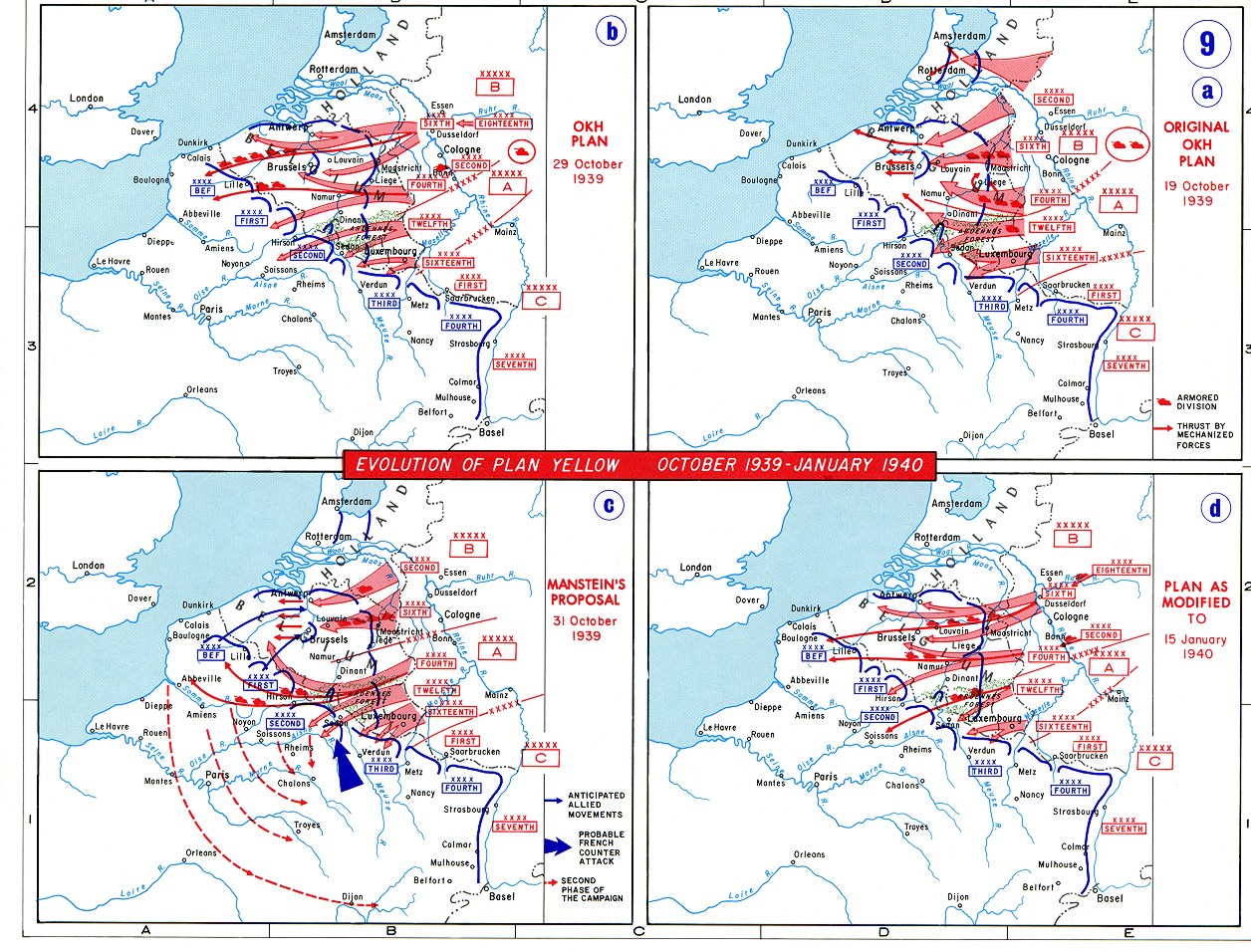
General Halder (German High Command chief of staff) responds to Hitler's Directive for an invasion of France and presents his plan. “Case yellow” is a pedestrian drive through Belgium to the North Sea (based on WWI’s Schleiffen plan) designed to separate the British Expeditionary Force from the French army. Halder is possibly trying to deter Hitler from attacking at all and he estimates this will cost hundreds of thousands of German casualties and not deliver a full invasion of France until 1942. This is not the quick mechanized thrust into France that Hitler wants, with the element of surprise limiting German casualties. Hitler is not pleased; however, his impatience will quickly lead him to endorse this plan and order its execution. Generals von Rundstedt and von Manstein soon get wind of this and devise their own plan.
Day 1 - Day 48 (September 1 - October 18 1939)
Sept. 1 1939
WORLD WAR II STARTS! At 4.45 AM on Sept. 1 1939, Germany invades Poland on the pretext of Polish aggression on German soil (dead "Poles" are German prisoners dressed in Polish uniforms & shot). The German battleship Schleswig-Holstein fires the first shots of WWII and shells the fortress guarding the port of Danzig. At dawn, 53 German divisions cross into Poland. Classic blitzkrieg tactics of dive bombers, fast moving panzers and armored infantry divisions decimate the unsuspecting Polish forces on the borders. Heavy bombers damage major Polish cities (panicking the citizens) and destroy airfields, railways and bridges, plus railway stations full of mobilizing Polish soldiers. The Polish Air Force is mostly destroyed on the ground.
While most of the WWII combatants (Britain, France, USA, Russia) are not directly involved, this action is widely held to start the global conflict that follows. After years of appeasement, Britain & France quickly declare war on Germany...and we're off.
Day 2 Sept. 2 1939
Using new tactics developed by Heinz Guderian, German forces advance 50 miles into Poland in 36 hours, threatening Krakow, Lodz and other cities.
The term BLITZKRIEG has not been coined yet. Large fast-moving group of tanks, tracked artillery and troop carriers (supported by dive bombers) penetrate the front lines and fan out deep in the enemy's rear. They attack supply dumps and HQ companies unprepared for combat, while enemy front line units are isolated, surrounded and destroyed. The undermanned Polish army is not fully mobilized and equipped with ancient weapons and horse-drawn artillery. It is outmatched and quickly overwhelmed despite brave resistance.
Following earlier assurances of Poland’s security, France and Britain are committed to war with Germany but diplomatic and strategic questions delay an immediate response on this day. However, the evacuation of children from London begins.
Day 3 Sunday September 3, 1939
The German advance into Poland continues but the main action on this day is diplomatic. Honoring their promise to protect Poland if invaded, Britain issues an ultimatum to Germany at 9 AM and declares war 2 hours later. France, Australia, New Zealand and India follow suit. Germany does not expect this intervention, after British and French appeasement following German annexation of Austria and occupation of Czechoslovakia in the previous 18 months. On hearing of the British ultimatum, Hitler asks his Foreign Minister Ribbontrop “'What now?"
KEY FIGURES Winston Churchill is appointed to Chamberlain's War Cabinet as Lord of the Admiralty. Churchill has long warned of German aggression but has been kept at bay to appease Hitler. The Admiralty signals all ships and naval bases: "WINSTON IS BACK."
Britain declares a naval blockade of Germany. The German sub U30 sinks the British passenger ship Athenia, mistaking her for a cargo ship. 122 lives are lost.
Day 4, Monday, September 4, 1939. German advance into Poland continues.
Sometime in these first days, a clash between the Polish cavalry and German armour showed the superiority of the new German method of mobile warfare. Although much of their artillery was horse-drawn, the Germans took no horsed cavalry into WWII.
Conflicting accounts have the 18th Lancers regiment of the Pomorske Brigade (who had raided successfully out of wooded areas) either
A) mounting a direct charge with lances on enemy tanks OR
B) caught in the cross-fire between German infantry in front and armored cars blocking their path of retreat to a forest.
In either event, the horrific results of machine guns and cannon engaging mounted horsemen at close range signaled the beginning of the end for traditional horse cavalry, although similar encounters were to come in France next Spring.
Day 5, Tuesday, September 5, 1939
The German advance into Poland continues. Kluge’s 4th Army reaches the River Vistula in the North. Meanwhile, Reichenau’s 10th Army makes good progress towards Warsaw from Southern Germany. The German attack on Poland was a massive double encirclement with Kluge and Reichnau as the inner pincers targeted on the Vistula west of Warsaw. This was designed to trap Polish forces on the German border as they withdrew east, as well as the massive reserve army near Warsaw waiting on orders to ride out to attack Berlin. This pincer is about to close encircling the bulk of the Polish army.
The outer pincer, comprising Kuchler’s 3rd Army from East Prussia and List’s 14th Army from Slovakia in the South, is intended to shut several days later further East on the Bug River (as Germany and Russia had secretly agreed to divide Poland along the line of the Bug).
Day 6, Wednesday, September 6, 1939 Sunday
List’s 14th Army attacking from Slovakia takes Krakow.
Kluge’s 4th Army and Kuchler’s 3rd Army from the North and Reichenau’s 10th Army from the South advance on Warsaw. Polish high command orders a general retreat of its Western forces to the River Vistula and its tributary rivers (the Narew and the San), falling right into the German trap. The high command then leaves Warsaw later that night, following the government which left on September 4th.
South Africa declares war on Germany
Day 7, Thursday, September 7, 1939
The ‘phony’ war in the West begins. French patrols cross the border into Germany; however, the French and British are nowhere near ready to attack. British troops have to be assembled and shipped to France. The French are hamstrung by outdated political and military policies. First, they still have a WW One reliance on heavy artillery which has to be brought out of storage and trundled by horse to the German border. Second, the French peacetime standing army is small, due to the policies of appeasement, and relies on conscription to mobilize. Therefore, men have to be called up, equipped and trained before they can ship out to attack Germany.
There is no relief in sight for the Poles and German advances into Poland continue.
Day 8, Friday, September 8, 1939
The noose is beginning to tighten on Warsaw and Polish troop across the Vistula, to the West. Leading elements of Reichenau’s 10th Army from the South reach the outskirts of Warsaw, having covered a remarkable 140 miles in 7 days. This rate of advance is almost unheard of and illustrates the power of the new Blitzkreig tactics. The weather is unseasonably dry and favours Hitler’s mobile troops. Typical autumn rain in Poland would turn the roads and fields to mud and swell rivers like the Vistula into mighty defensive barriers, slowing the German advance. This does not happen and the Poles start talking about “Hitler’s weather”.
Britain revives the convoy system to protect merchant ships carrying vital supplies, in response to attacks by German submarines. The Battle of the Atlantic has begun.
Day 9, Saturday, September 9, 1939
The German troops advance on Warsaw.
On the French/German border, the French patrols make little ground. The French only maneuver in a 90-mile corridor between the Rhine and Moselle rivers, in order to respect the neutrality of Luxembourg, Holland and Belgium (which is more than Hitler will do next Spring). The Germans expect this and have constructed the intensely fortified Seigfried line in this area. The Seigfried line, however, is poorly manned to allow Hitler to concentrate his armour, infantry, artillery and air support to attack Poland. If France had been able to mobilize quickly and penetrate the Seigfried line, the Ruhr valley (the heart of the German armament industry) would have been overrun, Berlin threatened and WWII would likely have been stillborn.
Day 10, Sunday, September 10, 1939
As they close on Warsaw, the German High Command suffers doubt and confusion, almost letting Polish forces out of the bag. Polish troop movements stir up clouds of dust on the hot, dry plains, obscuring aerial observation by the Luftwaffe. German Command believes the Polish armies are retreating into Southeast Poland, across the Vistula, and they order Rundstedt’s Army Group South to follow. General Rundstedt is not fooled and sends his troops North towards Warsaw instead, capturing 60,000 Polish soldiers at Radom.
Western Front: Despite a notable lack of progress, the French Chief of Staff (Gamelin) declares that his army is in contact with the Germans and can do no more to save Poland. The British Expeditionary Force (BEF) starts to sail for France. Canada declares war on Germany.
Day 11, Monday, September 11, 1939
The German double encirclement becomes apparent. Kluge’s 4th Army and Reichenau’s 10th Army tighten the inner pincers, capturing the coal- and industry-rich area of Upper Silesia and encircling the Polish defensive forces West of the Vistula River.
Meanwhile, the outer pincer is forming well to the East of the Vistula and Warsaw. List’s 14th Army sweeps through the Carpathian region and approaches the Bug River in the South of Poland. Guderian, the architect of mobile armoured warfare, spearheading Kuchler’s 3rd Army, crosses the Bug River in the North of Poland and turns South. The outer pincers now begin to close on the rest of the Polish army.
Day 12, September 12, 1939
The destruction of the Polish armies begins. The Polish Posnan and Pomorze Armies were stationed on the border during the initial German attack and were bypassed by the German forces in the first few days. As they retreat East, they merge and attack the flank of Blaskowitz’s 8th Army and Reichenau’s 10th Army (part of Rundstedt’s Army Group South). This begins the first great “pocket” battle of the war around the River Bzura. Over the next few days, the Polish troops are surrounded and the mobile German armour makes mincemeat of the unmechanised Polish infantry and its horse-drawn artillery.
Western Front: After initial French patrols into Germany are repelled, the French decide to halt advances and go on the defensive. The British Expeditionary Force, now on French soil, is put to use defending France. The British and French have done more or less nothing to distract Germany from its effort in Poland.
Day 13, September 13, 1939
The Battle of the Bzura, between the Polish Posnan and Pomorze Armies and Rundstedt’s Army Group South, continues. The Germans are initially surprised by the attack on 8th Army flanks and the Polish forces push them back about 12 miles. Notably, Polish cavalry brigades make considerable inroads through the vulnerable flanks and disrupt the German rear, illustrating the potential of cavalry against unmechanised foot infantry. The Germans now recognize the threat and divert elements of Army Group South, including panzer divisions, from the attack on Warsaw to deal with this threat. This slows the advance on Warsaw, allowing the defenders additional time to prepare.
The French set up a war cabinet, after 10 days of war with Germany.
Day 14, September 14, 1939
The Battle of the Bzura rages West of Warsaw, while Warsaw is surrounded and the wider German flanking advances deep into Poland continue.
Battle of the Atlantic. Since August, about 8-10 U-boats (roughly half of Germany's long-range U-boat fleet) have taken up positions off the British Atlantic coast, sinking over 65,000 tons of shipping in the first week of the war alone. HMS Ark Royal, Britain’s most modern aircraft carrier, is hunting U-boats off the Atlantic coast with a flotilla of destroyers and other anti-submarine vessels when she is attacked by U-39. U-39 fires two torpedoes which are spotted by Ark Royal’s lookouts. Ark Royal turns towards the torpedoes causing them to miss and explode harmlessly. Ark Royal’s escorting destroyers chase the sub and depth charges bring the damaged U-39 to the surface. The submarine’s crew abandons ship and is captured before U-39 sinks, becoming Germany‘s first U-boat loss of the war.
Day 15, September 15, 1939
The encirclement and destruction of the 19 divisions in the Polish Posnan and Pomorze Armies in the Battle of the Bzura continues. Polish forces further back between the Vistula and Bug Rivers consist of an additional 38 infantry divisions and 11 cavalry brigades. But they are also now surrounded by Kuchler’s 3rd Army from East Prussia and List’s 14th Army from Slovakia, comprising the outer pincers of the German encirclement, and their destruction also begins.
To add to the Polish agony, Warsaw is also surrounded. Germans High Command proposes starving the besieged city into submission but Hitler demands that the city be subjected to artillery and aerial bombardment.
Day 16, September 16, 1939
The destruction of the two pockets West of Warsaw and between the Vistula and Bug Rivers continues, representing the vast majority of the Polish armies. Warsaw is surrounded with the exception of a small corridor to the West, ironically allowing retreating soldiers and fleeing civilians into the city that is already overcrowded and short of food. German High Command demands the surrender of Warsaw, probably to avoid the high-explosive slaughter that Hitler has ordered. Stoically, the demand is rejected, starting the bombing and shelling of the city.
However, the Poles’ dire situation will soon get much worse. The Molotov/Ribbentrop pact of August 23 1939 contained a Secret Protocol for dividing Poland. Germany has been pressing for Soviet action, probably fearing the French and British build up, while Stalin is content to let Germans do most of the fighting. Now, some 3 million Soviet troops prepare to invade Poland from the East.
Day 17, September 17, 1939
USSR invades Poland at 5.40 AM “to protect Ukrainian and Belarusian minorities of eastern Poland” (Foreign minister Molotov). A million Soviet troops advance, crushing 30-40,000 Polish border defenders. Surprisingly, France and Britain do not declare war on USSR, as their pact with Poland only applies to German attack. A French/British invasion might still force the Germans, who are not ready to conduct a war in the West, to sue for peace but the spirit of appeasement continues. France and Britain see that Poland is finished, fearing that an attack now will not only be futile but direct German aggression against France.
In the Atlantic, the British aircraft carrier HMS Courageous is the first naval victim of German U-boats. She turns into the wind to launch her aircraft off the coast Ireland when torpedoed by U-29 (518 dead). Britain removes aircraft carriers from submarine patrol after torpedo attacks on HMS Ark Royal on September 14 and Courageous.
Day 18, September 18, 1939
The German noose tightens on the Polish forces in the Battle of the Bzura. A few thousand Polish troops retreat over the Vistula River into Warsaw, although Warsaw is surrounded, suggesting the Germans allow this to happen to increase the misery and starvation in the city. This is consistent with reports that civilians fleeing Warsaw are refused passage out and turned back. Shelling and bombing of Warsaw continues.
In the face of the Soviet invasion, the commander of the Polish Army Marshal Edward Rydz-Śmigły orders his troops in central and Eastern Poland to fall back and not engage the Red Army. He plans a last stand of all remaining Polish forces at the Romanian bridgehead in Southeast Poland. The Polish government and High Command, including Rydz-Śmigły, cross into Romania as refugees. Romania promptly interns them under pressure from Germany.
Day 19, September 19, 1939
The Battle of the Bzura finally ends with the surrender of the Polish Posnan and Pomorze Armies west of Warsaw. Germans forces have destroyed 19 Polish divisions and they take 100,000 -170,000 prisoners. The bombardment of Warsaw continues.
The Soviet advance into the Eastern Poland meets little resistance. The division of Poland in the Soviet-German pact is so secret that a few hostile encounters occur between surprised German and Red Army troops. German 137th Regiment attacks a reconnaissance detachment of the Soviet 24th Tank Brigade near Lwow, leading to a few casualties on each side before realizing the situation. Another secret also becomes clear. Hitler meets with his General Staff to announce his policy of “Housecleaning” (elimination of ethnic minorities, Jews, clergy, nobility). Army regulations and morals forbid murdering civilians, so the army refuses and these atrocities do not start until a civilian German administration is in place.
Day 20, September 20, 1939
The Red Army advances into Eastern Poland at a very rapid pace mainly along marked roads (35-40 miles per day). Very little cross-country maneuver is attempted, leaving isolated pockets of Polish troops and civilians. The opportunity for defensive insurrection is lost as the Poles do not know of Soviet collaboration with the Germans and they believe Soviet promises of freedom if they surrender. 230,000 – 450,000 Polish soldiers are taken prisoner and most are shipped to camps in Russia. Stalin’s secret police (Lavrentiy Beria’s NKVD) follow the Red Army and are responsible for ethnic and political cleansing of the ‘liberated’ civilian populations - prisoner and execution numbers are not known.
Some practical deficiencies appear in the original Secret Protocol for Polish territory to be divided. Soviet Foreign Minister Molotov contacts German Foreign Minister Ribbentrop for further talks in Moscow to renegotiate their pact.
Day 21, September 21, 1939
The Siege of Warsaw continues. Polish defenses amount to approximately 120 000 soldiers plus civilians, including women and children. The German forces preparing to storm the city number about 175 000 soldiers. The Germans continue shelling the city with artillery, including heavy railway guns and mortars, and aerial bombardment. Two air fleets take part in frequent raids against Warsaw; 1st Air Fleet (under General der Flieger Albert Kesselring, later Generalfeldmarschall Kesselring of North Africa and Italy fame) and 4th Air Fleet.
Day 22, September 22, 1939
In preparation for the final assault on Warsaw, German forces cross the Vistula River at Modlin, isolating the garrison in the Fortress Modlin and cutting the last lines of communication with Warsaw. They begin attacks on the Warsaw district of Praga on the Eastern bank of the Vistula.
German troops hand over Brest-Litovsk to the Soviets under strange circumstances. German General Heinz Guderian is moving part of the 19th Panzer Corps forward on a train into the Soviet zone when the commander of the Soviet 29th Tank Brigade Semyon Krivoshein blocks the tracks, claiming his tanks have run out of gas. They negotiate a joint victory parade in Brest-Litovsk before a German withdrawal back to the West. 100 miles South, Red Army troops take Lwow (now the city of Lviv in the Ukraine) with false promises to the defenders of safe passage to neutral countries to continue fighting the Germans. Most Polish soldiers ended up in Soviet camps instead.
Day 23, September 23, 1939
Warsaw is out of food and water after 8 days of siege, plus artillery shelling and aerial bombing. The citizens are staving, reduced to carving flesh from horses killed by the German bombardment, and there is little available drinking water as the main water pumping station has been destroyed by bombing. Fires burn out of control as there is no water to extinguish them.
Further East between the Vistula and Bug Rivers, fighting continues between the outer pincers of the German encirclement (Kuchler’s 3rd Army from East Prussia and List’s 14th Army from Slovakia) and the trapped Polish forces. The Battle of Tomaszów Lubelski is the second largest engagement, after the Battle of Bzura, and the largest tank battle of the war in Poland as Polish troops try to follow Marshal Rydz-Śmigły’s orders and break out of the German pocket towards the Romanian bridgehead in Southeast Poland.
Day 24, September 24, 1939
Siege of Warsaw. In preparation for the final assault, General Johannes Blaskowitz Commander-in-Chief East (Oberbefehlshaber Ost) takes command of all German units. 1,150 German planes bomb Warsaw to soften up the city.
SS-Obergruppenführer Reinhard Heydrich’s Special Task Force (Einsatzgruppen) begins eliminating Polish civilians. They round up and execute 800 intellectuals and civic leaders in the city of Bydgoszcz. This pattern is to be repeated in many German-occupied countries.
Britain’s naval blockade of Germany causes limited food rationing in Germany.
USSR exploits aggression in Poland to gain land and other concessions from the Baltic States, to improve its defense of the Baltic coastline. Soviet aircraft fly in Estonian airspace (following blockade of the harbor of Tallinn, the capital on 19 September). Soviet Foreign Minister Molotov warns Estonian negotiators in Moscow that USSR will use "more radical actions" to obtain military bases.
Day 25, 25 September 1939
Siege of Warsaw. Shelling continues and 420 planes Luftwaffe again bomb Warsaw, “softening up” for the main ground attack. Reservoirs and water works, granaries and flourmills, natural gas tanks and power plants have been destroyed by now, depriving the city of water, food and power. Incendiary bombs create havoc in residential areas. Casualties in the city are now estimated at 40,000 dead. Although military defenses are well prepared for the German ground attack, the civilian situation is so dire that it is clear the city cannot hold out much longer.
North Sea. Aircraft carrier HMS Ark Royal and battleship HMS Nelson rescue the submarine HMS Spearfish (damaged by German warships on 24 September off Horns Reef, Denmark and unable to dive) and escort her back to Rosyth, Scotland.
Western Front. The French dust off their WWI-era heavy artillery and exchange a few rounds with the Germans on the Siegfried Line.
Day 26, 26 Sept 1939,
Siege of Warsaw. Early morning German assault; 5 divisions attack Western Warsaw across the Vistula, 4 divisions advance from the East. 70 field artillery batteries, 80 heavy artillery batteries plus 1st and 4th Air Fleets pound Warsaw continuously. However, the German forces are repelled and retreat to the starting point.
Battle of the Atlantic. Pocket battleships Deutschland and Graf Spee, in the Atlantic since August, receive orders to sink British merchant ships but avoid combat with superior forces.
North Sea. 3 Dornier Do18 seaplanes spot HMS Ark Royal, returning to Rosyth with the damaged submarine HMS Spearfish. One Do18 is shot down by 3 Blackburn Skuas from Ark Royal, makes a water landing and is sunk by destroyer HMS Somali. It is the first British aerial kill. 4 Ju 88 bombers are called in by the Do18s; one drops a 2,200 lb bomb, missing Ark Royal by 100 feet. German reconnaissance flights later fail to find Ark Royal; they presume her sunk.
Day 27, Sept 27, 1939
Warsaw capitulates after 26 days of bombardment and 11 days of siege. The Germans renew the barrage and ground attack this morning but again this is repelled by Polish military and civilian defenders. However, the inhabitants of Warsaw are starving to death making a defense of Warsaw untenable. Talks on the surrender of Warsaw began on September 26 and continue in parallel with the German ground assault on the city. At 12.00, General Blaskowitz accepts the surrender of the Polish garrison and a cease fire agreement is signed in a railway car on the edge of Warsaw. Polish commanders order all fighting halted, in some cases visiting fighting units in person. 160,000 men, soldiers and civilians, are taken prisoner.
Hitler informs the German General Staff of his plans for a war in the West and instructs them to plan an attack on France. The initial response from the German military professional is that this is beyond current German military capabilities.
Day 28, September 28, 1939
The Soviet occupation of Eastern Poland is almost complete. Approximately 9000 Polish troops, trapped between the Soviets and Germans, offer battle with the Red Army and rout the Soviets (Battle of Szack). In the aftermath, armored troops of the Soviet 4th Army under General Vassili Chuikov surprise the Polesie Brigade near the village of Mielnik. The Poles surrender but, in a sign of things to come, all the Polesie officers and NCOs (about 500) are then executed by the Red Army.
A week of German/Soviet diplomacy leads to the final division of Poland and Lithuania. Foreign Ministers Molotov and Ribbentrop meet in Moscow to renegotiate their pact. At Soviet insistence, Lithuania is transferred from the German zone to the USSR. In exchange, Germany acquires land East of Warsaw, to the Bug River. The Red Army will withdraw behind the new line of the Narew, Bug and San Rivers.
Day 29 September 29, 1939
Polish resistance fades. As Warsaw is subdued, the garrison of the massive Fortress at Modlin (under attack by the Germans since Sept 13 but bypassed in favor of besieging Warsaw) sees no point to continue fighting. The last Polish holdouts from the Battle of Bzura around the town of Kutno also surrender. Another 10 Polish divisions in total go into the German bag.
Fearing USSR aggression, the Baltic States begin caving in to Soviet demands. The Estonian Foreign Minister, in Moscow to discuss commercial cooperation, is bullied by Stalin into a military “alliance’ which allows the Soviets to occupy Estonian naval bases. Latvia and Lithuania will soon follow but Finland resists, leading the “Winter war” with USSR.
Day 30, September 30, 1939
German pocket battleship Graf Spee, in the Atlantic prior to the invasion of Poland and ordered September 26 to attack British merchant vessels, makes her first kill off Pernambuco, Brazil.
The British steamer Clement (bearing 20000 cases of kerosene from New York to Salvador, Brazil) is fired on by an Arado seaplane from Graf Spee and radioed to stop. After taking to the lifeboats, Clement’s Captain is rescued by Graf Spee while the crew is given bearings for Brazil. Although torpedoes are embarrassingly ineffective, fire from Graf Spee’s 6 and 11 inch guns sinks Clement. Later in the day, Clement’s Captain is transferred to the neutral Greek steamer Papalemos. As a final gentlemanly gesture, the Graf Spee radios a message to Pernambuco “to save the lifeboats of the Clement” and their location.
Graf Spee is quickly repainted and sails East to seek further quarry, disguised under a French flag.
Day 31, October 1, 1939
Garrison of Hel Peninsula, Poland, surrenders. This tiny sandbar poking 10 miles into Gdansk Bay, 100 meters wide at the narrowest point, is defended by 3000 Polish soldiers and sailors with various coastal and anti-air batteries plus ships guns. They have held out against a larger German force since September 20, separating the Peninsula from the mainland by blowing up the narrows with torpedo warheads. They resisted shelling by German battleships, inflicting damage to SMS Schleswig-Holstein in return, and shot down about 50 German planes. However, running out of supplies and with no reinforcements now likely, they now surrender.
Battle of the Atlantic. So far, the Germans have sunk 41 merchant vessels for a total of 153-185,000 tons. Like most figures in this war, estimates vary.
Day 32, October 2, 1939
The last major battle in Poland begins near the town of Kock, 50 miles Southeast of Warsaw. About 18,000 Polish troops under General Franciszek Kleeberg have been harried by Guderian’s Panzers for two weeks in a fighting retreat towards the Romanian bridgehead in Southeast Poland. On September 30, Kleeberg’s light cavalry (Uhlan) captured the town of Kock from the Germans.
General Paul Otto (commander of the German 13th Motorised Infantry Division) is under orders from 10th Army’s General von Reichenau to destroy Polish force between the Bug and Vistula Rivers. Otto believes the Polish forces are demoralized to the point of surrender and sends a single German battalion to take them to a prisoner but the Poles mount a spirited counterattack, starting the Battle of Kock. Over the next 5 days, two German divisions (29th and13th Motorised Infantry) numbering 30,000 men assault the Polish positions.
Day 33, October 3, 1939
Operation Tannenberg, the elimination of Polish intellectuals, activists, scholars, actors, former officers, and civic leaders by Reinhard Heydrich’s SS-Einsatzgruppen, is in full swing. From mid-September to the end of October, 20,000 Polish civilians are killed in over 750 mass executions. This is the beginning of a ruthless slaughter of Polish civilians, particularly Jews. 6 million Poles will die between 1939 and 1945 (over 20% of Poland's population).
Day 34, October 4, 1939
While the Battle of Kock continues in the middle of Poland, the German army mops up remaining pockets of resistance. Of most significance is the withdrawal of Polish troops, fighting German and Soviet forces in the South of Poland, to the Romanian Bridgehead.
At this stage, Romania provides substantial aid to the Poles, despite later alliances with Hitler and Stalin. Up to 120,000 Polish troops escape through neutral Romania and Hungary to France and Britain where they form the Polish Armed Forces in the West. This is larger than the armies of France and Britain, an embarrassing indication of their current lack of preparation. Ships from the Romanian Navy escort the shipment of 82,000 kg of gold from the port of Constanţa on the Black Sea to Western Europe, to prevent interception by Soviet Navy. The Romanian National Bank also hid the remaining treasury of the National Bank of Poland, totaling 3,057,450 kg, which was returned to Poland in September 1947.
Day 35, October 5, 1939
Poland. The Battle of Kock continues with attack and counterthrust in villages and dense forest leading to heavy casualties, although this is the last day of fighting. Hitler enters Warsaw in triumph and warns that the same will happen to the cities of other countries that resist Germany. This is high bravado; a show of force designed to intimidate other European leaders, paid for in the lives of the soldiers and civilians of Warsaw.
Latvian and Lithuanian Foreign Ministers are both in Moscow, under pressure from the Soviet Union to establish military and naval bases. Stalin threatens Vilhelms Munter, the Latvian, and warns him to expect no help from Germany. They sign a treaty to allow Red Navy bases in Latvia’s Baltic harbors.
Battle of the Atlantic. The British steamer Newton Beach (with a cargo of maize) is taken as a prison ship by Graf Spee near the British-owned island of St. Helena, about 1200 miles off the coast of Africa.
Day 36, October 6, 1939
Speaking at the Reichstag in Berlin, Hitler appeals for peace in Europe. He claims to have no designs on France, wants friendship with Britain and proposes recognition of new boundaries in Eastern Europe without further conflict. His warped logic implies that since Poland no longer exists, France and Britain have no need to go to war in Poland’s defense.
The Battle of Kock is over, effectively ending the war in Poland. At 10 AM, General Kleeberg surrenders his Polsie Independent Group, surrounded and out of ammunition and food. His captors, with peculiarly German logic, believe he should be shot for prolonging the fighting, since Warsaw has already fallen. He is imprisoned, isolated from other inmates, refused medical help and fed starvation food rations. He loses his sight and is given a dog. He loses the ability to walk and is allowed to make short walks with crutches. He dies a humiliating death for an honorable soldier, in prison, in April 1941.
Day 37, October 7, 1939
Hitler’s antagonism of communism is well known (see Mein Kampf) and Stalin fears attack despite their non-aggression pact. He moves to shore up his Baltic borders to protect the city of Leningrad (St. Petersburg) exposed on the Gulf of Finland, close to the Finnish border. He uses success in Poland to cow Estonia, Latvia, Lithuania and Finland into giving up territory and access to key strategic bases. Molotov, in fury at the discourtesy of receiving no reply to his Oct 5 negotiation invitation to the Finns, threatens the Finnish ambassador Yrjo-Koskinen with ‘other means’ if they do not negotiate terms.
Battle of the Atlantic. British steamer Ashlea (with a cargo of sugar) is stopped by Graf Spee, disguised as a French merchant ship, again near the British island of St. Helena 1200 miles off Africa. Ashlea’s crew is taken on board the prison ship Newton Beach (captured two days before) and Ashlea is sunk by scuttling charges.
Day 38, October 8, 1939
Fighting in Poland is over. The country ceases to exist although Poland never officially surrenders. A Government-in-Exile (in Paris, then Angers France, finally in London) under Prime Minister (also General) Władysław Sikorski commands Polish armed forces operating outside Poland. 100,000 Polish troops escape via Romania and Lithuania, but 70,000 are dead and 130,000 wounded. Civilian losses are estimated at 150,000–200,000. 694,000 Polish troops become German prisoners of war. 217,000 go into Soviet captivity, most never to return. German losses are modest and more accurately recorded; 10,572 dead, 30,322 wounded, 3409 missing. Soviet casualties are minimal; 1000 dead, 2400 wounded.
Battle of the Atlantic. British steamer Newton Beach, captured by Graf Spee Oct 5, is found to be too slow for use as a prison ship and sunk, after her prisoners are transferred to Graf Spee.
Day 39, October 9, 1939
Hitler issues Führer Directive 6 (Plans for Offensive in the West) after receiving no response to peace overtures in his Oct 6 Reichstag speech. He determines to defeat the French army and their allies, by striking before the arrival of large numbers of British troops, while French border defenses are not fully organized. He knows the British army is currently weak from the Soviets, who negotiated with the British before their pact with Germany. Hitler plans to occupy as much territory in France, Belgium and Holland as possible, then launch an air and sea war to bring Britain to terms. He orders General von Brauchitsch, Commander-in-Chief of the German Army, and General Halder, chief of staff of the High Command, to prepare a plan for invasion before the end of 1939.
Juho Kusti Paasikivi leaves Helsinki for Moscow to negotiate Soviet territorial demands. As an architect of Finnish independence, he won concessions from Stalin in the 1920 Treaty of Tartu.
Day 40 October 10, 1939
Stalin and Molotov threaten Juozas Urbšys, Lithuanian Minister of Foreign Affairs, with invasion to force the signature of a “mutual assistance pact” allowing Soviet army, air and naval bases in Lithuania. Stalin wants 50,000 soldiers there; Urbšys concedes 28,000 Red troops. In return, Lithuania gets the city of Vilnius, annexed by Poland in 1920 and recently taken by USSR. These are cynical gestures by Molotov and Stalin, as Lithuania will be annexed by USSR in 1940.
Battle of the Atlantic. Graf Spee captures the British liner Huntsman (with a cargo of tea) near the British island of St. Helena, 1200 miles off the coast of Africa. Huntsman, with sleeping and galley facilities, is well suited to replace Newton Beach as a prison ship. Huntsman’s passengers are now joined by Graf Spee’s other prisoners. Graf Spee uses Huntsman’s radio to deceptively report attack by a submarine at a false location and both boats steam off to meet Graf Spee’s support ship Altmark.
Day 41 October 11, 1939
Édouard Daladier (Prime Minister of France) dismisses Hitler’s Oct 6 peace proposal, saying "We took up arms against aggression. We shall not put them down until we have guarantees for a real peace and security, a security which is not threatened every six months." This closes the door on any diplomatic moves by Britain and France to negotiate with Germany to buy time to prepare for war. However, Hitler is in no mood to wait as Germany currently has the strategic initiative, numerical supremacy and better weaponry to overrun the undermanned and poorly organized Allied defenses. He is already planning to invade France (Führer Directive 6, October 9).
British Expeditionary Force finishes initial landings in France. They deploy a total of about 158,000 troops.
Day 42 October 12, 1939
The Finnish delegation arrives in Moscow by train and meets with Stalin and Molotov. Soviet demands include Finnish territory in the Karelian Isthmus, moving the border away from Leningrad to safeguard the city from attack by land (the expected enemy is Germany, not the Finns). In addition, Finland is asked to cede several small islands in the Gulf of Finland and lease the Hanko peninsula (on the Northern mouth of the Gulf) to USSR for 30 years, with the goal of sealing off the Gulf of Finland to protect Leningrad from sea attack. USSR offers some land and a “mutual assistance pact” in return. Molotov issues vague threats of military action, which have previously worked with Estonia, Latvia and Lithuania. The Finns, however, refuse. Negotiations will continue but the Finnish army is mobilized and children are evacuated from Finnish cities.
Britain follows suit with France in formally rejecting Hitler’s peace proposals.
Day 43 October 13, 1939
Hans Frank is appointed German "supreme chief administrator" for all occupied territories in Poland. Following the division of Poland, 2 million Jews reside in German-controlled areas and 1.3 million in Soviet areas. Western Poland (roughly West of Danzig) is incorporated into Germany and over 1 million Poles are expelled; many are taken to Germany as forced labor but most are sent East into the German-controlled centre of Poland which will become the General Government (a German puppet state). Jews are forced to live in ghettos or deported to concentration camps. In their place, German nationals and Estonian, Latvian and Lithuanian Volkdeutsche (Balts of German descendent) are settled in Western Poland. They are given homes and businesses by the German administration.
Admiral Donitz attempts his first 'wolf pack' deployment of U-boat tactics. Groups of submarines engage in sustained attacks on a convoy, but without success.
Day 44 October 14, 1939
Germany brings the war to the British Isles. Scapa Flow in the Orkney Islands is base to Britain’s Home Fleet, protected by mines, nets, sunken ships and Royal Navy patrols. However, U-47 penetrates Scapa Flow’s defenses, prowls for targets (see link below) and, at 1 AM, sinks the WWI-era battleship HMS Royal Oak. The first torpedoes miss or fail to explode. A second salvo blows a 30 ft hole in Royal Oak. She capsizes and sinks within 15 minutes (833 lives lost). U-47’s commander Günther Prien wins the Knight's Cross of the Iron Cross.
In Moscow, the Finns again negotiate Soviets territorial demands. Finland offers three small Gulf islands to protect its borders won at Finnish independence in 1920. Stalin instead threatens a return to Russian Tsarist borders, eliminating Finland, saying presciently of Germany “we now have good relations, but everything in this world can change”. The Finns beg for more time and take the train home.
Day 45 October 15, 1939
Battle of the Atlantic. Since Sept 26, Graf Spee has sailed 2000 miles east from the coast of Brazil to the African side of the Atlantic, sinking 3 British merchant ships and taking several prisoners. She now sails west back into the middle of the Atlantic to rendezvous with her waiting support ship Altmark and refuel. Almark, disguised as a Norwegian merchant ship "Sogne", is readied for the transfer of prisoners.
Graf Spee’s captain, Hans Langsdorff, is prevented from hunting convoys by orders to avoid confrontation with the Royal Navy (a lesson learned from WWI when German vessels were thrown into battle with superior British forces). He aims to sow confusion and tie up as many Royal Navy ships as possible by acting in widely dispersed locations, in addition to disrupting Britain’s supply lines. Graf Spee will sail into the Indian Ocean and back to South America in the next few weeks (see link below).
Day 46 October 16, 1939
Battle of the Atlantic - unrestricted submarine warfare begins. Following the success of U-47’s raid in Scapa Flow, German Grand Admiral Erich Raeder orders the torpedoing of “all merchant ships definitely identified as enemy”. This also frees the surface raiders to attack French ship; previously they have been restricted to British vessels.
First strategic bombing of British mainland. Junkers Ju 88s attack British warships at Rosyth on the Firth of Forth, damaging the cruisers HMS Southampton and Edinburgh, plus the destroyer HMS Mohawk. Spitfires of No. 602 and No. 603 Squadrons shoot down two Ju 88s and a Heinkel He 111.
Day 47 October 17, 1939
Four Junkers Ju 88 bombers raid Scapa Flow and badly damage an old base ship, the battleship HMS Iron Duke which served as flagship of the Grand Fleet during WWI including the Battle of Jutland. One Ju 88 shot down by an anti-aircraft battery on the island of Hoy.
Battle of the Atlantic. British liner SS Huntsman (see link below has been used as a prison ship since her capture by Graf Spee on Oct 10. About 35 prisoners are transferred to Altmark (Graf Spee’s supply ship) and Huntsman is sunk. ‘Late this night we heard six explosions & then another much heavier one which we presumed was a torpedo sinking my ship. I was pleased it was done at night so I could not see her go as I was very fond of her and very much attached to her. Our Prison Officer confirmed "She died hard."’ - Diary of Captain Albert Horace Brown of SS Huntsman.
http://www.youtube.com/watch?v=-G1YDLmfRQo
Day 48 October 18, 1939
The first Soviet forces enter Estonia and the Baltic Germans start leaving. Eventually 12-13,000 will migrate by ship from ports in Estonia to Danzig, for resettlement (Umsiedlung) in Polish territory annexed by Germany (see link below). They occupy homes and businesses left by deported Poles. This is part of the Nazi plan for Germanisation or cultural and economic assimilation of Polish regions into greater Germany to provide living space (Lebensraum) in the East.
http://upload.wikimedia.org/wikipedia/commons/f/f3/Bundesarchiv_Bild_137-066679%2C_Karte_zur_Umsiedlung_Baltendeutscher.jpg
The Finnish government and other Scandinavian diplomats discuss Soviet demands for territory on the Gulf of Finland to defend Leningrad. The Finnish army continues mobilizing, utilizing limited resources to fortify the Red Army’s most likely route of attack across the Karelian Isthmus. Concrete bocks and boulders are placed to slow tank movements. They clear paths in the forests to corral infantry into fields of fire that are ranged by artillery, strung with barbed wire and then densely sown with mines (which are cheap and plentiful). This will prove deadly to advancing Red Army troops.
WORLD WAR II STARTS! At 4.45 AM on Sept. 1 1939, Germany invades Poland on the pretext of Polish aggression on German soil (dead "Poles" are German prisoners dressed in Polish uniforms & shot). The German battleship Schleswig-Holstein fires the first shots of WWII and shells the fortress guarding the port of Danzig. At dawn, 53 German divisions cross into Poland. Classic blitzkrieg tactics of dive bombers, fast moving panzers and armored infantry divisions decimate the unsuspecting Polish forces on the borders. Heavy bombers damage major Polish cities (panicking the citizens) and destroy airfields, railways and bridges, plus railway stations full of mobilizing Polish soldiers. The Polish Air Force is mostly destroyed on the ground.
While most of the WWII combatants (Britain, France, USA, Russia) are not directly involved, this action is widely held to start the global conflict that follows. After years of appeasement, Britain & France quickly declare war on Germany...and we're off.
Day 2 Sept. 2 1939
Using new tactics developed by Heinz Guderian, German forces advance 50 miles into Poland in 36 hours, threatening Krakow, Lodz and other cities.
The term BLITZKRIEG has not been coined yet. Large fast-moving group of tanks, tracked artillery and troop carriers (supported by dive bombers) penetrate the front lines and fan out deep in the enemy's rear. They attack supply dumps and HQ companies unprepared for combat, while enemy front line units are isolated, surrounded and destroyed. The undermanned Polish army is not fully mobilized and equipped with ancient weapons and horse-drawn artillery. It is outmatched and quickly overwhelmed despite brave resistance.
Following earlier assurances of Poland’s security, France and Britain are committed to war with Germany but diplomatic and strategic questions delay an immediate response on this day. However, the evacuation of children from London begins.
Day 3 Sunday September 3, 1939
The German advance into Poland continues but the main action on this day is diplomatic. Honoring their promise to protect Poland if invaded, Britain issues an ultimatum to Germany at 9 AM and declares war 2 hours later. France, Australia, New Zealand and India follow suit. Germany does not expect this intervention, after British and French appeasement following German annexation of Austria and occupation of Czechoslovakia in the previous 18 months. On hearing of the British ultimatum, Hitler asks his Foreign Minister Ribbontrop “'What now?"
KEY FIGURES Winston Churchill is appointed to Chamberlain's War Cabinet as Lord of the Admiralty. Churchill has long warned of German aggression but has been kept at bay to appease Hitler. The Admiralty signals all ships and naval bases: "WINSTON IS BACK."
Britain declares a naval blockade of Germany. The German sub U30 sinks the British passenger ship Athenia, mistaking her for a cargo ship. 122 lives are lost.
Day 4, Monday, September 4, 1939. German advance into Poland continues.
Sometime in these first days, a clash between the Polish cavalry and German armour showed the superiority of the new German method of mobile warfare. Although much of their artillery was horse-drawn, the Germans took no horsed cavalry into WWII.
Conflicting accounts have the 18th Lancers regiment of the Pomorske Brigade (who had raided successfully out of wooded areas) either
A) mounting a direct charge with lances on enemy tanks OR
B) caught in the cross-fire between German infantry in front and armored cars blocking their path of retreat to a forest.
In either event, the horrific results of machine guns and cannon engaging mounted horsemen at close range signaled the beginning of the end for traditional horse cavalry, although similar encounters were to come in France next Spring.
Day 5, Tuesday, September 5, 1939
The German advance into Poland continues. Kluge’s 4th Army reaches the River Vistula in the North. Meanwhile, Reichenau’s 10th Army makes good progress towards Warsaw from Southern Germany. The German attack on Poland was a massive double encirclement with Kluge and Reichnau as the inner pincers targeted on the Vistula west of Warsaw. This was designed to trap Polish forces on the German border as they withdrew east, as well as the massive reserve army near Warsaw waiting on orders to ride out to attack Berlin. This pincer is about to close encircling the bulk of the Polish army.
The outer pincer, comprising Kuchler’s 3rd Army from East Prussia and List’s 14th Army from Slovakia in the South, is intended to shut several days later further East on the Bug River (as Germany and Russia had secretly agreed to divide Poland along the line of the Bug).
Day 6, Wednesday, September 6, 1939 Sunday
List’s 14th Army attacking from Slovakia takes Krakow.
Kluge’s 4th Army and Kuchler’s 3rd Army from the North and Reichenau’s 10th Army from the South advance on Warsaw. Polish high command orders a general retreat of its Western forces to the River Vistula and its tributary rivers (the Narew and the San), falling right into the German trap. The high command then leaves Warsaw later that night, following the government which left on September 4th.
South Africa declares war on Germany
Day 7, Thursday, September 7, 1939
The ‘phony’ war in the West begins. French patrols cross the border into Germany; however, the French and British are nowhere near ready to attack. British troops have to be assembled and shipped to France. The French are hamstrung by outdated political and military policies. First, they still have a WW One reliance on heavy artillery which has to be brought out of storage and trundled by horse to the German border. Second, the French peacetime standing army is small, due to the policies of appeasement, and relies on conscription to mobilize. Therefore, men have to be called up, equipped and trained before they can ship out to attack Germany.
There is no relief in sight for the Poles and German advances into Poland continue.
Day 8, Friday, September 8, 1939
The noose is beginning to tighten on Warsaw and Polish troop across the Vistula, to the West. Leading elements of Reichenau’s 10th Army from the South reach the outskirts of Warsaw, having covered a remarkable 140 miles in 7 days. This rate of advance is almost unheard of and illustrates the power of the new Blitzkreig tactics. The weather is unseasonably dry and favours Hitler’s mobile troops. Typical autumn rain in Poland would turn the roads and fields to mud and swell rivers like the Vistula into mighty defensive barriers, slowing the German advance. This does not happen and the Poles start talking about “Hitler’s weather”.
Britain revives the convoy system to protect merchant ships carrying vital supplies, in response to attacks by German submarines. The Battle of the Atlantic has begun.
Day 9, Saturday, September 9, 1939
The German troops advance on Warsaw.
On the French/German border, the French patrols make little ground. The French only maneuver in a 90-mile corridor between the Rhine and Moselle rivers, in order to respect the neutrality of Luxembourg, Holland and Belgium (which is more than Hitler will do next Spring). The Germans expect this and have constructed the intensely fortified Seigfried line in this area. The Seigfried line, however, is poorly manned to allow Hitler to concentrate his armour, infantry, artillery and air support to attack Poland. If France had been able to mobilize quickly and penetrate the Seigfried line, the Ruhr valley (the heart of the German armament industry) would have been overrun, Berlin threatened and WWII would likely have been stillborn.
Day 10, Sunday, September 10, 1939
As they close on Warsaw, the German High Command suffers doubt and confusion, almost letting Polish forces out of the bag. Polish troop movements stir up clouds of dust on the hot, dry plains, obscuring aerial observation by the Luftwaffe. German Command believes the Polish armies are retreating into Southeast Poland, across the Vistula, and they order Rundstedt’s Army Group South to follow. General Rundstedt is not fooled and sends his troops North towards Warsaw instead, capturing 60,000 Polish soldiers at Radom.
Western Front: Despite a notable lack of progress, the French Chief of Staff (Gamelin) declares that his army is in contact with the Germans and can do no more to save Poland. The British Expeditionary Force (BEF) starts to sail for France. Canada declares war on Germany.
Day 11, Monday, September 11, 1939
The German double encirclement becomes apparent. Kluge’s 4th Army and Reichenau’s 10th Army tighten the inner pincers, capturing the coal- and industry-rich area of Upper Silesia and encircling the Polish defensive forces West of the Vistula River.
Meanwhile, the outer pincer is forming well to the East of the Vistula and Warsaw. List’s 14th Army sweeps through the Carpathian region and approaches the Bug River in the South of Poland. Guderian, the architect of mobile armoured warfare, spearheading Kuchler’s 3rd Army, crosses the Bug River in the North of Poland and turns South. The outer pincers now begin to close on the rest of the Polish army.
Day 12, September 12, 1939
The destruction of the Polish armies begins. The Polish Posnan and Pomorze Armies were stationed on the border during the initial German attack and were bypassed by the German forces in the first few days. As they retreat East, they merge and attack the flank of Blaskowitz’s 8th Army and Reichenau’s 10th Army (part of Rundstedt’s Army Group South). This begins the first great “pocket” battle of the war around the River Bzura. Over the next few days, the Polish troops are surrounded and the mobile German armour makes mincemeat of the unmechanised Polish infantry and its horse-drawn artillery.
Western Front: After initial French patrols into Germany are repelled, the French decide to halt advances and go on the defensive. The British Expeditionary Force, now on French soil, is put to use defending France. The British and French have done more or less nothing to distract Germany from its effort in Poland.
Day 13, September 13, 1939
The Battle of the Bzura, between the Polish Posnan and Pomorze Armies and Rundstedt’s Army Group South, continues. The Germans are initially surprised by the attack on 8th Army flanks and the Polish forces push them back about 12 miles. Notably, Polish cavalry brigades make considerable inroads through the vulnerable flanks and disrupt the German rear, illustrating the potential of cavalry against unmechanised foot infantry. The Germans now recognize the threat and divert elements of Army Group South, including panzer divisions, from the attack on Warsaw to deal with this threat. This slows the advance on Warsaw, allowing the defenders additional time to prepare.
The French set up a war cabinet, after 10 days of war with Germany.
Day 14, September 14, 1939
The Battle of the Bzura rages West of Warsaw, while Warsaw is surrounded and the wider German flanking advances deep into Poland continue.
Battle of the Atlantic. Since August, about 8-10 U-boats (roughly half of Germany's long-range U-boat fleet) have taken up positions off the British Atlantic coast, sinking over 65,000 tons of shipping in the first week of the war alone. HMS Ark Royal, Britain’s most modern aircraft carrier, is hunting U-boats off the Atlantic coast with a flotilla of destroyers and other anti-submarine vessels when she is attacked by U-39. U-39 fires two torpedoes which are spotted by Ark Royal’s lookouts. Ark Royal turns towards the torpedoes causing them to miss and explode harmlessly. Ark Royal’s escorting destroyers chase the sub and depth charges bring the damaged U-39 to the surface. The submarine’s crew abandons ship and is captured before U-39 sinks, becoming Germany‘s first U-boat loss of the war.
Day 15, September 15, 1939
The encirclement and destruction of the 19 divisions in the Polish Posnan and Pomorze Armies in the Battle of the Bzura continues. Polish forces further back between the Vistula and Bug Rivers consist of an additional 38 infantry divisions and 11 cavalry brigades. But they are also now surrounded by Kuchler’s 3rd Army from East Prussia and List’s 14th Army from Slovakia, comprising the outer pincers of the German encirclement, and their destruction also begins.
To add to the Polish agony, Warsaw is also surrounded. Germans High Command proposes starving the besieged city into submission but Hitler demands that the city be subjected to artillery and aerial bombardment.
Day 16, September 16, 1939
The destruction of the two pockets West of Warsaw and between the Vistula and Bug Rivers continues, representing the vast majority of the Polish armies. Warsaw is surrounded with the exception of a small corridor to the West, ironically allowing retreating soldiers and fleeing civilians into the city that is already overcrowded and short of food. German High Command demands the surrender of Warsaw, probably to avoid the high-explosive slaughter that Hitler has ordered. Stoically, the demand is rejected, starting the bombing and shelling of the city.
However, the Poles’ dire situation will soon get much worse. The Molotov/Ribbentrop pact of August 23 1939 contained a Secret Protocol for dividing Poland. Germany has been pressing for Soviet action, probably fearing the French and British build up, while Stalin is content to let Germans do most of the fighting. Now, some 3 million Soviet troops prepare to invade Poland from the East.
Day 17, September 17, 1939
USSR invades Poland at 5.40 AM “to protect Ukrainian and Belarusian minorities of eastern Poland” (Foreign minister Molotov). A million Soviet troops advance, crushing 30-40,000 Polish border defenders. Surprisingly, France and Britain do not declare war on USSR, as their pact with Poland only applies to German attack. A French/British invasion might still force the Germans, who are not ready to conduct a war in the West, to sue for peace but the spirit of appeasement continues. France and Britain see that Poland is finished, fearing that an attack now will not only be futile but direct German aggression against France.
In the Atlantic, the British aircraft carrier HMS Courageous is the first naval victim of German U-boats. She turns into the wind to launch her aircraft off the coast Ireland when torpedoed by U-29 (518 dead). Britain removes aircraft carriers from submarine patrol after torpedo attacks on HMS Ark Royal on September 14 and Courageous.
Day 18, September 18, 1939
The German noose tightens on the Polish forces in the Battle of the Bzura. A few thousand Polish troops retreat over the Vistula River into Warsaw, although Warsaw is surrounded, suggesting the Germans allow this to happen to increase the misery and starvation in the city. This is consistent with reports that civilians fleeing Warsaw are refused passage out and turned back. Shelling and bombing of Warsaw continues.
In the face of the Soviet invasion, the commander of the Polish Army Marshal Edward Rydz-Śmigły orders his troops in central and Eastern Poland to fall back and not engage the Red Army. He plans a last stand of all remaining Polish forces at the Romanian bridgehead in Southeast Poland. The Polish government and High Command, including Rydz-Śmigły, cross into Romania as refugees. Romania promptly interns them under pressure from Germany.
Day 19, September 19, 1939
The Battle of the Bzura finally ends with the surrender of the Polish Posnan and Pomorze Armies west of Warsaw. Germans forces have destroyed 19 Polish divisions and they take 100,000 -170,000 prisoners. The bombardment of Warsaw continues.
The Soviet advance into the Eastern Poland meets little resistance. The division of Poland in the Soviet-German pact is so secret that a few hostile encounters occur between surprised German and Red Army troops. German 137th Regiment attacks a reconnaissance detachment of the Soviet 24th Tank Brigade near Lwow, leading to a few casualties on each side before realizing the situation. Another secret also becomes clear. Hitler meets with his General Staff to announce his policy of “Housecleaning” (elimination of ethnic minorities, Jews, clergy, nobility). Army regulations and morals forbid murdering civilians, so the army refuses and these atrocities do not start until a civilian German administration is in place.
Day 20, September 20, 1939
The Red Army advances into Eastern Poland at a very rapid pace mainly along marked roads (35-40 miles per day). Very little cross-country maneuver is attempted, leaving isolated pockets of Polish troops and civilians. The opportunity for defensive insurrection is lost as the Poles do not know of Soviet collaboration with the Germans and they believe Soviet promises of freedom if they surrender. 230,000 – 450,000 Polish soldiers are taken prisoner and most are shipped to camps in Russia. Stalin’s secret police (Lavrentiy Beria’s NKVD) follow the Red Army and are responsible for ethnic and political cleansing of the ‘liberated’ civilian populations - prisoner and execution numbers are not known.
Some practical deficiencies appear in the original Secret Protocol for Polish territory to be divided. Soviet Foreign Minister Molotov contacts German Foreign Minister Ribbentrop for further talks in Moscow to renegotiate their pact.
Day 21, September 21, 1939
The Siege of Warsaw continues. Polish defenses amount to approximately 120 000 soldiers plus civilians, including women and children. The German forces preparing to storm the city number about 175 000 soldiers. The Germans continue shelling the city with artillery, including heavy railway guns and mortars, and aerial bombardment. Two air fleets take part in frequent raids against Warsaw; 1st Air Fleet (under General der Flieger Albert Kesselring, later Generalfeldmarschall Kesselring of North Africa and Italy fame) and 4th Air Fleet.
Day 22, September 22, 1939
In preparation for the final assault on Warsaw, German forces cross the Vistula River at Modlin, isolating the garrison in the Fortress Modlin and cutting the last lines of communication with Warsaw. They begin attacks on the Warsaw district of Praga on the Eastern bank of the Vistula.
German troops hand over Brest-Litovsk to the Soviets under strange circumstances. German General Heinz Guderian is moving part of the 19th Panzer Corps forward on a train into the Soviet zone when the commander of the Soviet 29th Tank Brigade Semyon Krivoshein blocks the tracks, claiming his tanks have run out of gas. They negotiate a joint victory parade in Brest-Litovsk before a German withdrawal back to the West. 100 miles South, Red Army troops take Lwow (now the city of Lviv in the Ukraine) with false promises to the defenders of safe passage to neutral countries to continue fighting the Germans. Most Polish soldiers ended up in Soviet camps instead.
Day 23, September 23, 1939
Warsaw is out of food and water after 8 days of siege, plus artillery shelling and aerial bombing. The citizens are staving, reduced to carving flesh from horses killed by the German bombardment, and there is little available drinking water as the main water pumping station has been destroyed by bombing. Fires burn out of control as there is no water to extinguish them.
Further East between the Vistula and Bug Rivers, fighting continues between the outer pincers of the German encirclement (Kuchler’s 3rd Army from East Prussia and List’s 14th Army from Slovakia) and the trapped Polish forces. The Battle of Tomaszów Lubelski is the second largest engagement, after the Battle of Bzura, and the largest tank battle of the war in Poland as Polish troops try to follow Marshal Rydz-Śmigły’s orders and break out of the German pocket towards the Romanian bridgehead in Southeast Poland.
Day 24, September 24, 1939
Siege of Warsaw. In preparation for the final assault, General Johannes Blaskowitz Commander-in-Chief East (Oberbefehlshaber Ost) takes command of all German units. 1,150 German planes bomb Warsaw to soften up the city.
SS-Obergruppenführer Reinhard Heydrich’s Special Task Force (Einsatzgruppen) begins eliminating Polish civilians. They round up and execute 800 intellectuals and civic leaders in the city of Bydgoszcz. This pattern is to be repeated in many German-occupied countries.
Britain’s naval blockade of Germany causes limited food rationing in Germany.
USSR exploits aggression in Poland to gain land and other concessions from the Baltic States, to improve its defense of the Baltic coastline. Soviet aircraft fly in Estonian airspace (following blockade of the harbor of Tallinn, the capital on 19 September). Soviet Foreign Minister Molotov warns Estonian negotiators in Moscow that USSR will use "more radical actions" to obtain military bases.
Day 25, 25 September 1939
Siege of Warsaw. Shelling continues and 420 planes Luftwaffe again bomb Warsaw, “softening up” for the main ground attack. Reservoirs and water works, granaries and flourmills, natural gas tanks and power plants have been destroyed by now, depriving the city of water, food and power. Incendiary bombs create havoc in residential areas. Casualties in the city are now estimated at 40,000 dead. Although military defenses are well prepared for the German ground attack, the civilian situation is so dire that it is clear the city cannot hold out much longer.
North Sea. Aircraft carrier HMS Ark Royal and battleship HMS Nelson rescue the submarine HMS Spearfish (damaged by German warships on 24 September off Horns Reef, Denmark and unable to dive) and escort her back to Rosyth, Scotland.
Western Front. The French dust off their WWI-era heavy artillery and exchange a few rounds with the Germans on the Siegfried Line.
Day 26, 26 Sept 1939,
Siege of Warsaw. Early morning German assault; 5 divisions attack Western Warsaw across the Vistula, 4 divisions advance from the East. 70 field artillery batteries, 80 heavy artillery batteries plus 1st and 4th Air Fleets pound Warsaw continuously. However, the German forces are repelled and retreat to the starting point.
Battle of the Atlantic. Pocket battleships Deutschland and Graf Spee, in the Atlantic since August, receive orders to sink British merchant ships but avoid combat with superior forces.
North Sea. 3 Dornier Do18 seaplanes spot HMS Ark Royal, returning to Rosyth with the damaged submarine HMS Spearfish. One Do18 is shot down by 3 Blackburn Skuas from Ark Royal, makes a water landing and is sunk by destroyer HMS Somali. It is the first British aerial kill. 4 Ju 88 bombers are called in by the Do18s; one drops a 2,200 lb bomb, missing Ark Royal by 100 feet. German reconnaissance flights later fail to find Ark Royal; they presume her sunk.
Day 27, Sept 27, 1939
Warsaw capitulates after 26 days of bombardment and 11 days of siege. The Germans renew the barrage and ground attack this morning but again this is repelled by Polish military and civilian defenders. However, the inhabitants of Warsaw are starving to death making a defense of Warsaw untenable. Talks on the surrender of Warsaw began on September 26 and continue in parallel with the German ground assault on the city. At 12.00, General Blaskowitz accepts the surrender of the Polish garrison and a cease fire agreement is signed in a railway car on the edge of Warsaw. Polish commanders order all fighting halted, in some cases visiting fighting units in person. 160,000 men, soldiers and civilians, are taken prisoner.
Hitler informs the German General Staff of his plans for a war in the West and instructs them to plan an attack on France. The initial response from the German military professional is that this is beyond current German military capabilities.
Day 28, September 28, 1939
The Soviet occupation of Eastern Poland is almost complete. Approximately 9000 Polish troops, trapped between the Soviets and Germans, offer battle with the Red Army and rout the Soviets (Battle of Szack). In the aftermath, armored troops of the Soviet 4th Army under General Vassili Chuikov surprise the Polesie Brigade near the village of Mielnik. The Poles surrender but, in a sign of things to come, all the Polesie officers and NCOs (about 500) are then executed by the Red Army.
A week of German/Soviet diplomacy leads to the final division of Poland and Lithuania. Foreign Ministers Molotov and Ribbentrop meet in Moscow to renegotiate their pact. At Soviet insistence, Lithuania is transferred from the German zone to the USSR. In exchange, Germany acquires land East of Warsaw, to the Bug River. The Red Army will withdraw behind the new line of the Narew, Bug and San Rivers.
Day 29 September 29, 1939
Polish resistance fades. As Warsaw is subdued, the garrison of the massive Fortress at Modlin (under attack by the Germans since Sept 13 but bypassed in favor of besieging Warsaw) sees no point to continue fighting. The last Polish holdouts from the Battle of Bzura around the town of Kutno also surrender. Another 10 Polish divisions in total go into the German bag.
Fearing USSR aggression, the Baltic States begin caving in to Soviet demands. The Estonian Foreign Minister, in Moscow to discuss commercial cooperation, is bullied by Stalin into a military “alliance’ which allows the Soviets to occupy Estonian naval bases. Latvia and Lithuania will soon follow but Finland resists, leading the “Winter war” with USSR.
Day 30, September 30, 1939
German pocket battleship Graf Spee, in the Atlantic prior to the invasion of Poland and ordered September 26 to attack British merchant vessels, makes her first kill off Pernambuco, Brazil.
The British steamer Clement (bearing 20000 cases of kerosene from New York to Salvador, Brazil) is fired on by an Arado seaplane from Graf Spee and radioed to stop. After taking to the lifeboats, Clement’s Captain is rescued by Graf Spee while the crew is given bearings for Brazil. Although torpedoes are embarrassingly ineffective, fire from Graf Spee’s 6 and 11 inch guns sinks Clement. Later in the day, Clement’s Captain is transferred to the neutral Greek steamer Papalemos. As a final gentlemanly gesture, the Graf Spee radios a message to Pernambuco “to save the lifeboats of the Clement” and their location.
Graf Spee is quickly repainted and sails East to seek further quarry, disguised under a French flag.
Day 31, October 1, 1939
Garrison of Hel Peninsula, Poland, surrenders. This tiny sandbar poking 10 miles into Gdansk Bay, 100 meters wide at the narrowest point, is defended by 3000 Polish soldiers and sailors with various coastal and anti-air batteries plus ships guns. They have held out against a larger German force since September 20, separating the Peninsula from the mainland by blowing up the narrows with torpedo warheads. They resisted shelling by German battleships, inflicting damage to SMS Schleswig-Holstein in return, and shot down about 50 German planes. However, running out of supplies and with no reinforcements now likely, they now surrender.
Battle of the Atlantic. So far, the Germans have sunk 41 merchant vessels for a total of 153-185,000 tons. Like most figures in this war, estimates vary.
Day 32, October 2, 1939
The last major battle in Poland begins near the town of Kock, 50 miles Southeast of Warsaw. About 18,000 Polish troops under General Franciszek Kleeberg have been harried by Guderian’s Panzers for two weeks in a fighting retreat towards the Romanian bridgehead in Southeast Poland. On September 30, Kleeberg’s light cavalry (Uhlan) captured the town of Kock from the Germans.
General Paul Otto (commander of the German 13th Motorised Infantry Division) is under orders from 10th Army’s General von Reichenau to destroy Polish force between the Bug and Vistula Rivers. Otto believes the Polish forces are demoralized to the point of surrender and sends a single German battalion to take them to a prisoner but the Poles mount a spirited counterattack, starting the Battle of Kock. Over the next 5 days, two German divisions (29th and13th Motorised Infantry) numbering 30,000 men assault the Polish positions.
Day 33, October 3, 1939
Operation Tannenberg, the elimination of Polish intellectuals, activists, scholars, actors, former officers, and civic leaders by Reinhard Heydrich’s SS-Einsatzgruppen, is in full swing. From mid-September to the end of October, 20,000 Polish civilians are killed in over 750 mass executions. This is the beginning of a ruthless slaughter of Polish civilians, particularly Jews. 6 million Poles will die between 1939 and 1945 (over 20% of Poland's population).
Day 34, October 4, 1939
While the Battle of Kock continues in the middle of Poland, the German army mops up remaining pockets of resistance. Of most significance is the withdrawal of Polish troops, fighting German and Soviet forces in the South of Poland, to the Romanian Bridgehead.
At this stage, Romania provides substantial aid to the Poles, despite later alliances with Hitler and Stalin. Up to 120,000 Polish troops escape through neutral Romania and Hungary to France and Britain where they form the Polish Armed Forces in the West. This is larger than the armies of France and Britain, an embarrassing indication of their current lack of preparation. Ships from the Romanian Navy escort the shipment of 82,000 kg of gold from the port of Constanţa on the Black Sea to Western Europe, to prevent interception by Soviet Navy. The Romanian National Bank also hid the remaining treasury of the National Bank of Poland, totaling 3,057,450 kg, which was returned to Poland in September 1947.
Day 35, October 5, 1939
Poland. The Battle of Kock continues with attack and counterthrust in villages and dense forest leading to heavy casualties, although this is the last day of fighting. Hitler enters Warsaw in triumph and warns that the same will happen to the cities of other countries that resist Germany. This is high bravado; a show of force designed to intimidate other European leaders, paid for in the lives of the soldiers and civilians of Warsaw.
Latvian and Lithuanian Foreign Ministers are both in Moscow, under pressure from the Soviet Union to establish military and naval bases. Stalin threatens Vilhelms Munter, the Latvian, and warns him to expect no help from Germany. They sign a treaty to allow Red Navy bases in Latvia’s Baltic harbors.
Battle of the Atlantic. The British steamer Newton Beach (with a cargo of maize) is taken as a prison ship by Graf Spee near the British-owned island of St. Helena, about 1200 miles off the coast of Africa.
Day 36, October 6, 1939
Speaking at the Reichstag in Berlin, Hitler appeals for peace in Europe. He claims to have no designs on France, wants friendship with Britain and proposes recognition of new boundaries in Eastern Europe without further conflict. His warped logic implies that since Poland no longer exists, France and Britain have no need to go to war in Poland’s defense.
The Battle of Kock is over, effectively ending the war in Poland. At 10 AM, General Kleeberg surrenders his Polsie Independent Group, surrounded and out of ammunition and food. His captors, with peculiarly German logic, believe he should be shot for prolonging the fighting, since Warsaw has already fallen. He is imprisoned, isolated from other inmates, refused medical help and fed starvation food rations. He loses his sight and is given a dog. He loses the ability to walk and is allowed to make short walks with crutches. He dies a humiliating death for an honorable soldier, in prison, in April 1941.
Day 37, October 7, 1939
Hitler’s antagonism of communism is well known (see Mein Kampf) and Stalin fears attack despite their non-aggression pact. He moves to shore up his Baltic borders to protect the city of Leningrad (St. Petersburg) exposed on the Gulf of Finland, close to the Finnish border. He uses success in Poland to cow Estonia, Latvia, Lithuania and Finland into giving up territory and access to key strategic bases. Molotov, in fury at the discourtesy of receiving no reply to his Oct 5 negotiation invitation to the Finns, threatens the Finnish ambassador Yrjo-Koskinen with ‘other means’ if they do not negotiate terms.
Battle of the Atlantic. British steamer Ashlea (with a cargo of sugar) is stopped by Graf Spee, disguised as a French merchant ship, again near the British island of St. Helena 1200 miles off Africa. Ashlea’s crew is taken on board the prison ship Newton Beach (captured two days before) and Ashlea is sunk by scuttling charges.
Day 38, October 8, 1939
Fighting in Poland is over. The country ceases to exist although Poland never officially surrenders. A Government-in-Exile (in Paris, then Angers France, finally in London) under Prime Minister (also General) Władysław Sikorski commands Polish armed forces operating outside Poland. 100,000 Polish troops escape via Romania and Lithuania, but 70,000 are dead and 130,000 wounded. Civilian losses are estimated at 150,000–200,000. 694,000 Polish troops become German prisoners of war. 217,000 go into Soviet captivity, most never to return. German losses are modest and more accurately recorded; 10,572 dead, 30,322 wounded, 3409 missing. Soviet casualties are minimal; 1000 dead, 2400 wounded.
Battle of the Atlantic. British steamer Newton Beach, captured by Graf Spee Oct 5, is found to be too slow for use as a prison ship and sunk, after her prisoners are transferred to Graf Spee.
Day 39, October 9, 1939
Hitler issues Führer Directive 6 (Plans for Offensive in the West) after receiving no response to peace overtures in his Oct 6 Reichstag speech. He determines to defeat the French army and their allies, by striking before the arrival of large numbers of British troops, while French border defenses are not fully organized. He knows the British army is currently weak from the Soviets, who negotiated with the British before their pact with Germany. Hitler plans to occupy as much territory in France, Belgium and Holland as possible, then launch an air and sea war to bring Britain to terms. He orders General von Brauchitsch, Commander-in-Chief of the German Army, and General Halder, chief of staff of the High Command, to prepare a plan for invasion before the end of 1939.
Juho Kusti Paasikivi leaves Helsinki for Moscow to negotiate Soviet territorial demands. As an architect of Finnish independence, he won concessions from Stalin in the 1920 Treaty of Tartu.
Day 40 October 10, 1939
Stalin and Molotov threaten Juozas Urbšys, Lithuanian Minister of Foreign Affairs, with invasion to force the signature of a “mutual assistance pact” allowing Soviet army, air and naval bases in Lithuania. Stalin wants 50,000 soldiers there; Urbšys concedes 28,000 Red troops. In return, Lithuania gets the city of Vilnius, annexed by Poland in 1920 and recently taken by USSR. These are cynical gestures by Molotov and Stalin, as Lithuania will be annexed by USSR in 1940.
Battle of the Atlantic. Graf Spee captures the British liner Huntsman (with a cargo of tea) near the British island of St. Helena, 1200 miles off the coast of Africa. Huntsman, with sleeping and galley facilities, is well suited to replace Newton Beach as a prison ship. Huntsman’s passengers are now joined by Graf Spee’s other prisoners. Graf Spee uses Huntsman’s radio to deceptively report attack by a submarine at a false location and both boats steam off to meet Graf Spee’s support ship Altmark.
Day 41 October 11, 1939
Édouard Daladier (Prime Minister of France) dismisses Hitler’s Oct 6 peace proposal, saying "We took up arms against aggression. We shall not put them down until we have guarantees for a real peace and security, a security which is not threatened every six months." This closes the door on any diplomatic moves by Britain and France to negotiate with Germany to buy time to prepare for war. However, Hitler is in no mood to wait as Germany currently has the strategic initiative, numerical supremacy and better weaponry to overrun the undermanned and poorly organized Allied defenses. He is already planning to invade France (Führer Directive 6, October 9).
British Expeditionary Force finishes initial landings in France. They deploy a total of about 158,000 troops.
Day 42 October 12, 1939
The Finnish delegation arrives in Moscow by train and meets with Stalin and Molotov. Soviet demands include Finnish territory in the Karelian Isthmus, moving the border away from Leningrad to safeguard the city from attack by land (the expected enemy is Germany, not the Finns). In addition, Finland is asked to cede several small islands in the Gulf of Finland and lease the Hanko peninsula (on the Northern mouth of the Gulf) to USSR for 30 years, with the goal of sealing off the Gulf of Finland to protect Leningrad from sea attack. USSR offers some land and a “mutual assistance pact” in return. Molotov issues vague threats of military action, which have previously worked with Estonia, Latvia and Lithuania. The Finns, however, refuse. Negotiations will continue but the Finnish army is mobilized and children are evacuated from Finnish cities.
Britain follows suit with France in formally rejecting Hitler’s peace proposals.
Day 43 October 13, 1939
Hans Frank is appointed German "supreme chief administrator" for all occupied territories in Poland. Following the division of Poland, 2 million Jews reside in German-controlled areas and 1.3 million in Soviet areas. Western Poland (roughly West of Danzig) is incorporated into Germany and over 1 million Poles are expelled; many are taken to Germany as forced labor but most are sent East into the German-controlled centre of Poland which will become the General Government (a German puppet state). Jews are forced to live in ghettos or deported to concentration camps. In their place, German nationals and Estonian, Latvian and Lithuanian Volkdeutsche (Balts of German descendent) are settled in Western Poland. They are given homes and businesses by the German administration.
Admiral Donitz attempts his first 'wolf pack' deployment of U-boat tactics. Groups of submarines engage in sustained attacks on a convoy, but without success.
Day 44 October 14, 1939
Germany brings the war to the British Isles. Scapa Flow in the Orkney Islands is base to Britain’s Home Fleet, protected by mines, nets, sunken ships and Royal Navy patrols. However, U-47 penetrates Scapa Flow’s defenses, prowls for targets (see link below) and, at 1 AM, sinks the WWI-era battleship HMS Royal Oak. The first torpedoes miss or fail to explode. A second salvo blows a 30 ft hole in Royal Oak. She capsizes and sinks within 15 minutes (833 lives lost). U-47’s commander Günther Prien wins the Knight's Cross of the Iron Cross.
In Moscow, the Finns again negotiate Soviets territorial demands. Finland offers three small Gulf islands to protect its borders won at Finnish independence in 1920. Stalin instead threatens a return to Russian Tsarist borders, eliminating Finland, saying presciently of Germany “we now have good relations, but everything in this world can change”. The Finns beg for more time and take the train home.
Day 45 October 15, 1939
Battle of the Atlantic. Since Sept 26, Graf Spee has sailed 2000 miles east from the coast of Brazil to the African side of the Atlantic, sinking 3 British merchant ships and taking several prisoners. She now sails west back into the middle of the Atlantic to rendezvous with her waiting support ship Altmark and refuel. Almark, disguised as a Norwegian merchant ship "Sogne", is readied for the transfer of prisoners.
Graf Spee’s captain, Hans Langsdorff, is prevented from hunting convoys by orders to avoid confrontation with the Royal Navy (a lesson learned from WWI when German vessels were thrown into battle with superior British forces). He aims to sow confusion and tie up as many Royal Navy ships as possible by acting in widely dispersed locations, in addition to disrupting Britain’s supply lines. Graf Spee will sail into the Indian Ocean and back to South America in the next few weeks (see link below).
Day 46 October 16, 1939
Battle of the Atlantic - unrestricted submarine warfare begins. Following the success of U-47’s raid in Scapa Flow, German Grand Admiral Erich Raeder orders the torpedoing of “all merchant ships definitely identified as enemy”. This also frees the surface raiders to attack French ship; previously they have been restricted to British vessels.
First strategic bombing of British mainland. Junkers Ju 88s attack British warships at Rosyth on the Firth of Forth, damaging the cruisers HMS Southampton and Edinburgh, plus the destroyer HMS Mohawk. Spitfires of No. 602 and No. 603 Squadrons shoot down two Ju 88s and a Heinkel He 111.
Day 47 October 17, 1939
Four Junkers Ju 88 bombers raid Scapa Flow and badly damage an old base ship, the battleship HMS Iron Duke which served as flagship of the Grand Fleet during WWI including the Battle of Jutland. One Ju 88 shot down by an anti-aircraft battery on the island of Hoy.
Battle of the Atlantic. British liner SS Huntsman (see link below has been used as a prison ship since her capture by Graf Spee on Oct 10. About 35 prisoners are transferred to Altmark (Graf Spee’s supply ship) and Huntsman is sunk. ‘Late this night we heard six explosions & then another much heavier one which we presumed was a torpedo sinking my ship. I was pleased it was done at night so I could not see her go as I was very fond of her and very much attached to her. Our Prison Officer confirmed "She died hard."’ - Diary of Captain Albert Horace Brown of SS Huntsman.
http://www.youtube.com/watch?v=-G1YDLmfRQo
Day 48 October 18, 1939
The first Soviet forces enter Estonia and the Baltic Germans start leaving. Eventually 12-13,000 will migrate by ship from ports in Estonia to Danzig, for resettlement (Umsiedlung) in Polish territory annexed by Germany (see link below). They occupy homes and businesses left by deported Poles. This is part of the Nazi plan for Germanisation or cultural and economic assimilation of Polish regions into greater Germany to provide living space (Lebensraum) in the East.
http://upload.wikimedia.org/wikipedia/commons/f/f3/Bundesarchiv_Bild_137-066679%2C_Karte_zur_Umsiedlung_Baltendeutscher.jpg
The Finnish government and other Scandinavian diplomats discuss Soviet demands for territory on the Gulf of Finland to defend Leningrad. The Finnish army continues mobilizing, utilizing limited resources to fortify the Red Army’s most likely route of attack across the Karelian Isthmus. Concrete bocks and boulders are placed to slow tank movements. They clear paths in the forests to corral infantry into fields of fire that are ranged by artillery, strung with barbed wire and then densely sown with mines (which are cheap and plentiful). This will prove deadly to advancing Red Army troops.
Subscribe to:
Posts (Atom)