Battle of Britain Day 44. At 3.30 AM, first bombing of London (specifically Harrow, marginally within the London Civil Defence Area). Gale force winds and heavy rain again preclude large raids. At 9 AM, German artillery at Cape Gris Nez, France shells convoy "Totem" in the Straits of Dover for 80 minutes (no ships are hit). At 1 PM, Junkers Ju88s and Bf109s attack the convoy and are engaged by Spitfires of 54 Squadron and Hurricanes of 610 Squadron (shot down; 1 Ju88, 1 Spitfire, 1 Hurricane by friendly fire). At 6.30 PM, 30 German aircraft bomb coastal towns in Kent. In the evening, there is an artillery duel across the Straits of Dover between the German battery at Cape Gris Nez and a British 14-inch naval gun (named Winnie after Prime Minister Churchill, who has personally insisted that artillery be placed there to counter the German threat). Overnight, there is bombing of Aberdeen, Bristol, Pontefract, Bradford and Hull. In total, 6 German aircraft and 5 RAF fighters are lost. http://en.wikipedia.org/wiki/Cross-Channel_guns_in_the_Second_World_War
Fairey Swordfish of 812 Squadron from HMS Peregrine (Royal Navy air station at Ford, Sussex) bomb German invasion barges at Daedereide on the Dutch coast. 1 Swordfish is shot down and 2 aircrew are taken prisoner.
3 Swordfish of 824 Squadron from aircraft carrier HMS Eagle sink Italian submarine Iride (killing most of the 45 crew) and depot ship Monte Gargano in the Gulf of Bomba, Libya. Italian torpedo boat Calypso is also damaged. This prevents a planned attack on Alexandria by Iride using manned “human torpedoes”.
Saturday, August 21, 2010


Friday, August 20, 2010
Day 356 August 21, 1940
Battle of Britain Day 43. Clouds, wind and rain prevent large raids but Luftwaffe continues the tactics of small raids (1-2 aircraft) flying at most 20 miles inland. RAF airfields on the South and Southeast of England are bombed with little damage (2 RAF personnel killed, 40 wounded). Some coastal towns are also bombed (4 civilians killed, 178 wounded) and many merchant ships are sunk or damaged. 13 German bombers are destroyed and 1 RAF Hurricane is shot down.
In the mid-Atlantic 1000 miles off the West coast of Africa, German armed merchant cruiser Widder sinks British collier Anglo Saxon and machineguns the lifeboats (34 crew killed, 7 men escape in one lifeboat). After drifting 2500 miles in 71 days, only 2 survivors make land at Eleuthera Island in the Bahamas. Widder’s Captain Ruckteschell will be convicted as a War Criminal for this attack in May 1947 (dying in jail in 1948), following the testimony of survivor Able Seaman Robert Tapscott. http://www.amazon.com/All-Brave-Sailors-Sinking-Anglo-Saxon/dp/0743238370
The Anglo Saxon’s Jolly Boat which carried the survivors 2500 miles is preserved at the Mystic Seaport Museum http://www.iwm.org.uk/upload/package/7/anglosaxon/attack.htm
Italian submarine Dandolo damages Dutch tanker Hermes, 200 miles West of Lisbon, Portugal.
In the mid-Atlantic 1000 miles off the West coast of Africa, German armed merchant cruiser Widder sinks British collier Anglo Saxon and machineguns the lifeboats (34 crew killed, 7 men escape in one lifeboat). After drifting 2500 miles in 71 days, only 2 survivors make land at Eleuthera Island in the Bahamas. Widder’s Captain Ruckteschell will be convicted as a War Criminal for this attack in May 1947 (dying in jail in 1948), following the testimony of survivor Able Seaman Robert Tapscott. http://www.amazon.com/All-Brave-Sailors-Sinking-Anglo-Saxon/dp/0743238370
The Anglo Saxon’s Jolly Boat which carried the survivors 2500 miles is preserved at the Mystic Seaport Museum http://www.iwm.org.uk/upload/package/7/anglosaxon/attack.htm
Italian submarine Dandolo damages Dutch tanker Hermes, 200 miles West of Lisbon, Portugal.
Thursday, August 19, 2010
Day 355 August 20, 1940
Battle of Britain Day 42. Clouds and rain again restrict the morning to reconnaissance flights, although the English Channel is clear and convoys are attacked. At 2.45 PM, 190 German aircraft fly up the Thames Estuary and circle back without dropping any bombs. They are intercepted and 5 shot down. In the afternoon, Marston airfield is again bombed & strafed and 1 Spitfire is shot down. The still-burning oil tanks at Llanreath near Pembroke Dock, South Wales, are bombed again. In total, 7 German aircraft and 3 RAF fighters are lost. Churchill makes a speech in the House of Commons in praise of the RAF fighter pilots. "Never in the field of human conflict was so much owed by so many to so few." He also announces leasing of bases in Newfoundland and the West Indies to USA. He does not mention that this is in exchange for old US Navy destroyers to be loaned to Britain to defend against the anticipated German invasion. http://www.fiftiesweb.com/usa/winston-churchill-so-few.htm
At 00.27, 400 miles West of Ireland, UA sinks Panamanian collier Tuira (2 killed).At 9.50 PM, U-46 torpedoes Greek steamer Leonidas M. Valmas 50 miles Northwest of Ireland. The ship does not sink due to its cargo of wood but 16 crew die in the fire. 2 survivors are rescued by British destroyer HMS Arrow and landed in the Clyde, Scotland on August 27.
British submarine HMS Cachalot torpedoes U-51 in the Bay of Biscay 100 miles West of St. Nazaire, France. U-51 sinks with all 43 hands lost.
350 miles East of New Plymouth, New Zealand, German armed merchant cruiser Orion chases British steamer Turakina (carrying 4000 tons of lead, 1500 tons of grain, 7000 tons of wool) and sinks her with prolonged shellfire. 38 crew are killed. Risking attack from the New Zealand Navy (which has been alerted by radio signals from Turakina), Orion spends 5 hours rescuing 21 survivors from the sea. They will be released 2000 miles North on Emirau Island, near Papua New Guinea, on 21 December. http://www.bismarck-class.dk/hilfskreuzer/orion.html
At 00.27, 400 miles West of Ireland, UA sinks Panamanian collier Tuira (2 killed).At 9.50 PM, U-46 torpedoes Greek steamer Leonidas M. Valmas 50 miles Northwest of Ireland. The ship does not sink due to its cargo of wood but 16 crew die in the fire. 2 survivors are rescued by British destroyer HMS Arrow and landed in the Clyde, Scotland on August 27.
British submarine HMS Cachalot torpedoes U-51 in the Bay of Biscay 100 miles West of St. Nazaire, France. U-51 sinks with all 43 hands lost.
350 miles East of New Plymouth, New Zealand, German armed merchant cruiser Orion chases British steamer Turakina (carrying 4000 tons of lead, 1500 tons of grain, 7000 tons of wool) and sinks her with prolonged shellfire. 38 crew are killed. Risking attack from the New Zealand Navy (which has been alerted by radio signals from Turakina), Orion spends 5 hours rescuing 21 survivors from the sea. They will be released 2000 miles North on Emirau Island, near Papua New Guinea, on 21 December. http://www.bismarck-class.dk/hilfskreuzer/orion.html
Wednesday, August 18, 2010
Day 354 August 19, 1940
Battle of Britain Day 41. As Ju87 Stuka divebombers are susceptible to fighter attack as they pull out of their dive, Göring withdraws the Stukas from bombing British airfields reserving them instead for attacks on shipping convoys in the English Channel. Clouds and rain restrict the morning to reconnaissance flights. As the weather clears in the afternoon, Luftwaffe tries radically different tactics. Single aircraft (mainly Junkers Ju88 twin engine bombers) attack targets along the South coast of England and Wales. Oil storage tanks at Llanreath near Pembroke Dock, South Wales, are bombed. These lone bomber attacks continue overnight, targeting the East coast and Midlands of England. 1 Messerschmitt Bf109 and 4 Ju88’s are shot down. 1 Spitfire is shot down and 1 Blenheim is does not return from reconnaissance over Southern Norway.
U-boats sink 3 steamers off Ireland. Just after midnight, U-48 sinks Belgian passenger ship Ville de Gand (15 killed, 38 survivors). At 1.54 AM, U-101 sinks British SS Ampleforth (9 killed, 29 crew picked up by British destroyer HMS Warwick and landed at Liverpool). At 10 AM, UA sinks SS Hungarian Kelet (6 killed, all of them survivors from Clan Macphee sunk by U-30 on 16 August). 33 crew and 35 other Clan Macphee survivors are picked up by Norwegian merchant Varegg and landed at Galway on 26 August. http://www.uboat.net/allies/merchants/ships/469.html
U-boats sink 3 steamers off Ireland. Just after midnight, U-48 sinks Belgian passenger ship Ville de Gand (15 killed, 38 survivors). At 1.54 AM, U-101 sinks British SS Ampleforth (9 killed, 29 crew picked up by British destroyer HMS Warwick and landed at Liverpool). At 10 AM, UA sinks SS Hungarian Kelet (6 killed, all of them survivors from Clan Macphee sunk by U-30 on 16 August). 33 crew and 35 other Clan Macphee survivors are picked up by Norwegian merchant Varegg and landed at Galway on 26 August. http://www.uboat.net/allies/merchants/ships/469.html
Tuesday, August 17, 2010
Day 353 August 18, 1940
Battle of Britain Day 40. Haze in the morning gives way to good flying weather. At noon, Germans launch staged attacks against key RAF Fighter Command airfields at Kenley and Biggin Hill. However, the plan is too complicated and Luftwaffe formations do not arrive over the target on schedule. Kenley is subjected to devastating bombing, but Hurricanes of 111 Squadron wreak havoc on the bombers which have got ahead of their escorts. Hurricanes of 32 and Spitfires of 610 Squadron break up the attack on Biggin Hill and most bombs miss their target. RAF loses 22 fighters but claims 140 German planes shot down (although this seems unlikely). http://www.battleofbritain1940.net/0028.html
British Somaliland, East Africa. Overnight, troopships Chakdina, Chantala, Laomedon & Akbar and hospital ship Vita leave Berbera carrying British troops across the Gulf of Aden to Aden. In total 7,000 people, including civilians are evacuated. Australian cruiser HMAS Hobart remains to collect stragglers and destroy vehicles, fuel and stores. Somalis of the Somaliland Camel Corps choose to remain instead of evacuating and are allowed to keep their weapons.
British Somaliland, East Africa. Overnight, troopships Chakdina, Chantala, Laomedon & Akbar and hospital ship Vita leave Berbera carrying British troops across the Gulf of Aden to Aden. In total 7,000 people, including civilians are evacuated. Australian cruiser HMAS Hobart remains to collect stragglers and destroy vehicles, fuel and stores. Somalis of the Somaliland Camel Corps choose to remain instead of evacuating and are allowed to keep their weapons.
Monday, August 16, 2010
Day 352 August 17, 1940
Battle of Britain Day 39. Despite perfect flying weather with little wind and cloudless skies, there are only a few German reconnaissance flights. RAF takes the opportunity to rest pilots and make repairs to aircraft, airstrips and radar stations damaged in the recent bombing. 1 German aircraft is shot down by anti-aircraft fire at Southampton. Overnight, there is bombing of the East coast and cities in the Midlands (Coventry, Liverpool, Birmingham, Wolverhampton and Chester) and one small bombing raid on London. Another German aircraft is shot down by a Blenheim. RAF bombs the armament works at Leuna, near Leipzig, Germany. No RAF aircraft are lost.
British Somaliland, East Africa. British troops are evacuated from Berbera. Italian forces are ordered not to attack during the withdrawal, hoping for a future peace settlement with Britain. British cruiser HMS Ceres, covering the evacuation, shells an Italian column advancing along the coast 40 miles West of Berbera at Bulhar. British casualties in the defense of Somaliland are 38 killed, 102 wounded and 120 captured (in contrast, Italians have 465 killed, 1530 wounded). Churchill believes Somaliland has been given up without a fight. Commander-in-Chief Middle East, General Wavell, replies that "A bloody butcher’s bill is not the sign of a good tactician", driving Churchill into a rage. Amazingly, both Wavell and Major-General Godwin-Austen (responsible for defending British Somaliland) are not removed from command.
North Africa. Royal Navy Mediterranean Fleet sails from Alexandria, Egypt, to bombard the Libyan port of Bardia. At 7 AM, battleships HMS Warspite, Malaya & Ramillies and cruiser HMS Kent, supported by 12 destroyers, shell Bardia and Italian troop concentrations 12 miles South at Fort Capuzzo. Light Italian coastal batteries do not have the range to reach the British warships.
British Somaliland, East Africa. British troops are evacuated from Berbera. Italian forces are ordered not to attack during the withdrawal, hoping for a future peace settlement with Britain. British cruiser HMS Ceres, covering the evacuation, shells an Italian column advancing along the coast 40 miles West of Berbera at Bulhar. British casualties in the defense of Somaliland are 38 killed, 102 wounded and 120 captured (in contrast, Italians have 465 killed, 1530 wounded). Churchill believes Somaliland has been given up without a fight. Commander-in-Chief Middle East, General Wavell, replies that "A bloody butcher’s bill is not the sign of a good tactician", driving Churchill into a rage. Amazingly, both Wavell and Major-General Godwin-Austen (responsible for defending British Somaliland) are not removed from command.
North Africa. Royal Navy Mediterranean Fleet sails from Alexandria, Egypt, to bombard the Libyan port of Bardia. At 7 AM, battleships HMS Warspite, Malaya & Ramillies and cruiser HMS Kent, supported by 12 destroyers, shell Bardia and Italian troop concentrations 12 miles South at Fort Capuzzo. Light Italian coastal batteries do not have the range to reach the British warships.
Sunday, August 15, 2010
Day 351 August 16, 1940
Battle of Britain Day 38. Despite fine clear weather, it is a quiet day. Smallish raids attack Thames estuary and Kent in Southwest England at noon and again at 4.30 PM. Many airfields are bombed, yielding many dogfights. Stukas divebomb Tangmere Aerodrome, destroying Hurricanes and Blenheims in the hangars. In one, Pilot Officer W. M. "Billy" Fiske is badly burned. (Billy will die the next day of his wounds; the only American killed during the Battle of Britain. American Ambassador John Winnat will unveil a memorial plaque to Fiske in the crypt of St Paul's Cathedral London on July 4, 1941). Stukas also bomb Ventnor radar station, again putting it out of action. Despite being badly wounded and with his Hurricane on fire, Flight Lieutenant James Nicolson shoots down a Bf109 before bailing out. (Nicolson will win the only VC awarded to a fighter pilot during the Battle of Britain). RAF losses are 22 fighters while Luftwaffe loses 72 aircraft. http://www.battleofbritain1940.net/0027.html
East Africa. Italian troops move cautiously from Tug Argan and do not attack the British rearguard at Barkasan. British troops, arriving back at Berbera, start embarking onto Royal Navy ships, using an all-tide jetty constructed the Navy.
British submarine Osiris sinks Italian steamer Morea 50 miles West of Durrës, Albania.
U-boats start operating in wolfpacks against convoys. 300 miles Northwest of Ireland, convoy OB-197 is attacked by U-30, U-46 and U-48. Swedish steamer Hedrun (3000 tons of coal, 8 killed, 20 rescued) & British steamer Clan Macphee (6700 tons of general cargo, 67 killed, 41 survivors rescued by Hungarian steamer Kelet) are sunk and Dutch MV Alcinous is hit but does not sink (towed to Gourock, Scotland). Additionally, U-100 sinks British MV Empire Merchant (heading to Jamaica with cargo and mail) 150 miles Northwest of Ireland (7 killed, 48 picked up by rescue tug HMS Salvonia and landed at Greenock). http://www.uboat.net/allies/merchants/ships/466.html
Sunderlands of 210 Squadron attack U-51 with depth charges, 170 miles northwest of Ireland. Despite being blown out of the water by one explosion, producing oil and air bubbles, U-51 survived the attack. This was the first successful depth charge attack by a Coastal Command aircraft.
East Africa. Italian troops move cautiously from Tug Argan and do not attack the British rearguard at Barkasan. British troops, arriving back at Berbera, start embarking onto Royal Navy ships, using an all-tide jetty constructed the Navy.
British submarine Osiris sinks Italian steamer Morea 50 miles West of Durrës, Albania.
U-boats start operating in wolfpacks against convoys. 300 miles Northwest of Ireland, convoy OB-197 is attacked by U-30, U-46 and U-48. Swedish steamer Hedrun (3000 tons of coal, 8 killed, 20 rescued) & British steamer Clan Macphee (6700 tons of general cargo, 67 killed, 41 survivors rescued by Hungarian steamer Kelet) are sunk and Dutch MV Alcinous is hit but does not sink (towed to Gourock, Scotland). Additionally, U-100 sinks British MV Empire Merchant (heading to Jamaica with cargo and mail) 150 miles Northwest of Ireland (7 killed, 48 picked up by rescue tug HMS Salvonia and landed at Greenock). http://www.uboat.net/allies/merchants/ships/466.html
Sunderlands of 210 Squadron attack U-51 with depth charges, 170 miles northwest of Ireland. Despite being blown out of the water by one explosion, producing oil and air bubbles, U-51 survived the attack. This was the first successful depth charge attack by a Coastal Command aircraft.
Saturday, August 14, 2010
Day 350 August 15, 1940
Battle of Britain Day 37. Fine weather yields the first day of really big raids on British airfields. German bombers and fighters from Norway and Denmark cross the North Sea to bomb RAF airfields in the North of Britain. At noon, they are met by RAF fighters. Simultaneously, a huge formation of 1100 Luftwaffe aircraft cross the Dover Straits, then splits up heading for various airfields. RAF squadrons scramble, giving rise to dogfights over Kent and the English Channel. Numerous airfields have damage to planes, hangers and runways. Radar stations at Rye, Dover and at Foreness are also knocked out. At 6.50 PM, Messerschmitt Bf110s bomb South London airfield at Croydon by mistake. Many Bf110’s are shot down by RAF fighters, crashing in this suburb of London (60 civilians killed, 120 wounded). Despite taking a heavy toll on RAF installations, Luftwaffe loses 161 aircraft (mostly bombers) while RAF losses are 34 fighters and only 18 pilots killed. http://www.battleofbritain1940.net/0026.html http://www.raf.mod.uk/bob1940/august15.html
British Somaliland. Italians again attack British defenses at Tug Argan and take another hill. Overnight, British forces withdraw towards Berbera. The Black Watch Royal Highlanders along with African and Indian troops hold a rearguard position 10 miles back at Barkasan on the Berbera road.
Greece is neutral, although leaning towards supporting the British. In an act of intimidation on the feast day of Assumption of Mary, Italy attacks the Greek Navy near the tiny Aegean islands of Tinos and Syros. Italian airforce bombs Greek destroyers Vasilissa Olga and Vasilevs Georgios I escorting merchant ships. Italian submarine Delfino sinks WWI-era Greek cruiser Helle at anchor. http://www.sommergibili.com/delfinoe.htm
Kriegsmarine orders the construction of 86 new U-boats. At 8 PM, UA sinks Greek steamer Aspasia (carrying Manganese ore) with 2 torpedoes, 700 miles West of Gibraltar. All 19 crew are killed in the explosion and subsequent fire. http://www.uboat.net/allies/merchants/ships/461.html
U-51 sinks British tanker Sylvafield (7860 tons of fuel oil) 190 miles Northwest of Rockall, Ireland (3 crew killed). 20 survivors are picked up by Belgian trawler Rubens and 16 more by British minesweeping trawler HMS Newland.
http://www.uboat.net/allies/merchants/ships/462.html
British Somaliland. Italians again attack British defenses at Tug Argan and take another hill. Overnight, British forces withdraw towards Berbera. The Black Watch Royal Highlanders along with African and Indian troops hold a rearguard position 10 miles back at Barkasan on the Berbera road.
Greece is neutral, although leaning towards supporting the British. In an act of intimidation on the feast day of Assumption of Mary, Italy attacks the Greek Navy near the tiny Aegean islands of Tinos and Syros. Italian airforce bombs Greek destroyers Vasilissa Olga and Vasilevs Georgios I escorting merchant ships. Italian submarine Delfino sinks WWI-era Greek cruiser Helle at anchor. http://www.sommergibili.com/delfinoe.htm
Kriegsmarine orders the construction of 86 new U-boats. At 8 PM, UA sinks Greek steamer Aspasia (carrying Manganese ore) with 2 torpedoes, 700 miles West of Gibraltar. All 19 crew are killed in the explosion and subsequent fire. http://www.uboat.net/allies/merchants/ships/461.html
U-51 sinks British tanker Sylvafield (7860 tons of fuel oil) 190 miles Northwest of Rockall, Ireland (3 crew killed). 20 survivors are picked up by Belgian trawler Rubens and 16 more by British minesweeping trawler HMS Newland.
http://www.uboat.net/allies/merchants/ships/462.html
Friday, August 13, 2010
Day 349 August 14, 1940
Battle of Britain Day 36. Cloudy weather again frustrates German attempts to send big raids against the British airfields. At noon, 300 aircraft fly over the Dover Straits and attack Dover & Folkestone in Kent. Simultaneously, Manston airfield in Kent is bombed for the second day running. 65 squadron is engaged over Dover, so Manston is undefended apart from 40mm Bofors anti-aircraft guns which shoot down 2 Messerschmitt Bf110’s. At 3.45 PM, RAF Middle Wallop in Hampshire is bombed by Stukas and Heinkels (3 airmen and 1 civilian killed). German bombing damages British sloop HMS Kingfisher and tug Carbon in Portland Harbour. Germans lose 30 aircraft while RAF loses 3 Spitfires and 5 Hurricanes.
British Somaliland. British hold off Italian attacks at Tug Argan but the defenses are crumbling. Major-General Godwin-Austen requests permission from General Wavell (Commander-in-Chief Middle East) to withdraw from British Somaliland.
3 British motor torpedo boats and destroyers HMS Malcolm and Verity engage 3 German motor torpedo boats (Schnellboot) escorting a convoy of 6 trawlers off Texel Island, Holland (1 Schnellboot and 1 trawler are sunk).
At 8.34 PM, 15 miles North of Ireland, U-59 sinks British steamer Betty carrying 2726 tons of rice from China to Liverpool (30 crew killed). 4 survivors are picked up by British anti-submarine trawler HMS Man o´ War and landed at Belfast.
http://www.uboat.net/allies/merchants/ships/460.html
British Somaliland. British hold off Italian attacks at Tug Argan but the defenses are crumbling. Major-General Godwin-Austen requests permission from General Wavell (Commander-in-Chief Middle East) to withdraw from British Somaliland.
3 British motor torpedo boats and destroyers HMS Malcolm and Verity engage 3 German motor torpedo boats (Schnellboot) escorting a convoy of 6 trawlers off Texel Island, Holland (1 Schnellboot and 1 trawler are sunk).
At 8.34 PM, 15 miles North of Ireland, U-59 sinks British steamer Betty carrying 2726 tons of rice from China to Liverpool (30 crew killed). 4 survivors are picked up by British anti-submarine trawler HMS Man o´ War and landed at Belfast.
http://www.uboat.net/allies/merchants/ships/460.html
Thursday, August 12, 2010
Day 348 August 13, 1940
Battle of Britain Day 35. Believing they have crippled British radar warning systems, Luftwaffe launches Adlertag (Eagle Day) to mark the start of large bomber raids against RAF airfields. The objective is to clear the sky over Southern England within 4 days. Despite cloudy weather, there are heavy raids along the South coast of England. As the weather clears through the afternoon, Luftwaffe launches a massive attack of 300 aircraft at 3 PM to bomb RAF airfields, including Detling in Kent where 68 men are killed by a direct hit on the mess hall. However, Eagle Day goes badly for Germany as many bomber raids are beyond the range of their fighter support. Germans lose 40 bombers & 36 fighters, while RAF losses are 2 Spitfires & 11 Hurricanes (remarkably, only 3 pilots are killed). At 7.50 PM, a Spitfire crashes during night flying practice (pilot is killed baling out). Minesweeping trawler HMT Elizabeth Angela is sunk by German bombing off Dover (1 killed). http://www.battleofbritain1940.net/0025.html http://www.raf.mod.uk/bob1940/august13.html
Royal Navy contributes to the defense of British Somaliland. British cruiser HMS Carlisle shoots down an Italian aircraft attacking Berbera. 40 miles West of Berbera, destroyer HMS Kimberley and sloop HMS Auckland shell the port of El Sheikha, now in Italian hands. Italian troops again attack British defenses at Tug Argan but are held off.
At 9.47 PM, 10 miles North of Ireland, U-60 sinks Swedish steamer Nils Gorthon, carrying wood pulp (5 dead, 16 survivors). http://www.uboat.net/allies/merchants/ships/459.html
Royal Navy contributes to the defense of British Somaliland. British cruiser HMS Carlisle shoots down an Italian aircraft attacking Berbera. 40 miles West of Berbera, destroyer HMS Kimberley and sloop HMS Auckland shell the port of El Sheikha, now in Italian hands. Italian troops again attack British defenses at Tug Argan but are held off.
At 9.47 PM, 10 miles North of Ireland, U-60 sinks Swedish steamer Nils Gorthon, carrying wood pulp (5 dead, 16 survivors). http://www.uboat.net/allies/merchants/ships/459.html
Wednesday, August 11, 2010
Day 347 August 12, 1940
Battle of Britain Day 34. With fine weather, Germans try out their new tactics. Numerous coastal radar installations are bombed but most are repaired and operational by the end of the day, although Ventnor (Isle of Wight) is badly damaged and will be out of action for 2 weeks. Luftwaffe mounts heavy raids on British airfields in Kent (Manston, Lympne & Hawkinge). Portsmouth is also bombed, leaving 100 civilians dead. To test the effects of knocking out radar, Germans also attack convoys in the English Channel and Thames Estuary, sinking minesweeping trawlers HMT Pyrope (6 killed) and HMT Tamarisk (7 killed). Despite damage to radar and runways, RAF responds to most attacks and shoots down 55 German aircraft (for the loss of 6 Spitfires & 9 Hurricanes). Lutfwaffe loses 7 more bombers to anti-aircraft fire. http://www.battleofbritain1940.net/0024.html http://www.raf.mod.uk/bob1940/august12.html
British Somaliland. Italians again attack British defenses at Tug Argan. They take another hill, defended by Northern Rhodesian Regiment, and capture 2 British 3.7 inch howitzers (from a total of 4 available). Italians control the South side of the Hargeisa-Berbera road.
In the Atlantic, near the Azores, Italian submarine Malaspina sinks British tanker British Fame with 5 torpedoes. 3 crew are killed but Malaspina risks staying on the surface for a day to tow survivors in lifeboats to safety.
British Somaliland. Italians again attack British defenses at Tug Argan. They take another hill, defended by Northern Rhodesian Regiment, and capture 2 British 3.7 inch howitzers (from a total of 4 available). Italians control the South side of the Hargeisa-Berbera road.
In the Atlantic, near the Azores, Italian submarine Malaspina sinks British tanker British Fame with 5 torpedoes. 3 crew are killed but Malaspina risks staying on the surface for a day to tow survivors in lifeboats to safety.
Tuesday, August 10, 2010
Day 346 August 11, 1940
Battle of Britain Day 33. Although the weather is fine, Luftwaffe does not start its offensive against RAF airfields, instead mounting a carefully prepared feint. Starting at 7.30 AM, Messerschmitt Bf110’s and Bf109’s bomb and strafe Dover Harbour, as a prelude to a larger attack on Portland Naval base and Weymouth, aiming to draw up RAF fighters. Spitfires of 64 and 74 squadrons respond but most RAF units are rested and ready when a large formation of 56 Ju88 heavy bombers, 20 Heinkel He111s & 97 Bf110s is detected from Cherbourg at 9.45 AM. RAF loses 20 Hurricanes and 5 Spitfires. Luftwaffe loses 27 bombers and 10 Messerschmitt fighters.
German bombing damages 4 British destroyers (HMS Windsor in the Thames Estuary, under repairs until the end of October; HMS Esk at Harwich, repaired in 1 week; HMS Scimitar in Portland Harbour, repaired in 4 days; HMS Skate in Portland Harbour, bridge destroyed but no immediate repairs necessary).
Major-General Reade Godwin-Austen arrives in the capital city of Berbera, to command the defense of British Somaliland. British have maintained prepared defenses at Tug Argan on 6 hills overlooking the Hargeisa-Berbera road, knowing that this is the most likely route of attack. Italians attack 3 hills and capture one, defended by 3rd Battalion 15th Punjab Regiment.
General Wavell (Commander-in-Chief Middle East) is in London to discuss the defense of British colonies in Africa and the Middle East. Seeing events in Somaliland and expecting an Italian attack on Egypt, Churchill’s War Cabinet makes a far-reaching decision to send tanks to defend the vital Suez Canal. Despite the ongoing threat of invasion, 150 tanks (about half the total in Britain) plus 48 anti-tank guns, 48 field guns and 20 Bofors anti-aircraft guns are ordered to Egypt.
At 3.19 PM, U-38 sinks British steamer Llanfair (7800 tons of sugar) 125 miles West of Ireland. 3 crew are killed and 30 survivors are picked up by the American merchant vessel California.
German bombing damages 4 British destroyers (HMS Windsor in the Thames Estuary, under repairs until the end of October; HMS Esk at Harwich, repaired in 1 week; HMS Scimitar in Portland Harbour, repaired in 4 days; HMS Skate in Portland Harbour, bridge destroyed but no immediate repairs necessary).
Major-General Reade Godwin-Austen arrives in the capital city of Berbera, to command the defense of British Somaliland. British have maintained prepared defenses at Tug Argan on 6 hills overlooking the Hargeisa-Berbera road, knowing that this is the most likely route of attack. Italians attack 3 hills and capture one, defended by 3rd Battalion 15th Punjab Regiment.
General Wavell (Commander-in-Chief Middle East) is in London to discuss the defense of British colonies in Africa and the Middle East. Seeing events in Somaliland and expecting an Italian attack on Egypt, Churchill’s War Cabinet makes a far-reaching decision to send tanks to defend the vital Suez Canal. Despite the ongoing threat of invasion, 150 tanks (about half the total in Britain) plus 48 anti-tank guns, 48 field guns and 20 Bofors anti-aircraft guns are ordered to Egypt.
At 3.19 PM, U-38 sinks British steamer Llanfair (7800 tons of sugar) 125 miles West of Ireland. 3 crew are killed and 30 survivors are picked up by the American merchant vessel California.
Monday, August 9, 2010
Day 345 August 10, 1940
Battle of Britain Day 32. Göring’s planned offensive against RAF airfields is cancelled due to the weather. Clouds, squalls and thunder storms again preclude much flying. Luftwaffe mounts reconnaissance patrols and sporadic attacks on isolated trawlers and merchant ships. Overnight, Germans drop mines at several points on the coast of Britain. No aircraft are lost by either side.
In mid-Atlantic, 300 miles Southwest of the Azores, German armed merchant cruiser Widder stops Finnish barque Killoran. The steel-hulled 3 mast sailing ship built in 1900 is carrying a British-owned cargo of 2500 tons of maize & 500 tons of sugar from Buenos Aires to Las Palmas. Although most of Widder’s crew is against sinking the old sailing ship, Widder’s surgeon wants a dramatic finale for the Nazi propaganda film of the voyage he is making. He persuades Captain Ruckteschell to blow up Killoran with all sails still set, after taking off Killoran’s 18 crew. http://www.portcities.org.uk/london/server/show/ConGalleryCollection.18/Gustaf-Erikson-and-his-ships.html
British troopship SS Neuralia leaves Gibraltar, escorted by destroyer HMS Gallant, with 2000 civilian evacuees bound for the Portuguese island of Madeira 600 miles West in the Atlantic. http://www.merchantnavyofficers.com/Troopships.html
Just off the North coast of Scotland, Dutch MV Albula and American steamer Crescent City collide in convoy OA-196. MV Albula sinks after the entire crew is taken off by British destroyer HMS Jaguar.
At 1.00 AM, 20 miles North of Ireland, British armed merchant cruiser HMS Transylvania is hit with U-56’s last torpedo but does not sink (36 lives lost). Destroyer HMS Ashanti and several trawlers rescue 300 survivors before Transylvania is taken in tow but later sinks. http://www.uboat.net/allies/merchants/ships/457.html
In mid-Atlantic, 300 miles Southwest of the Azores, German armed merchant cruiser Widder stops Finnish barque Killoran. The steel-hulled 3 mast sailing ship built in 1900 is carrying a British-owned cargo of 2500 tons of maize & 500 tons of sugar from Buenos Aires to Las Palmas. Although most of Widder’s crew is against sinking the old sailing ship, Widder’s surgeon wants a dramatic finale for the Nazi propaganda film of the voyage he is making. He persuades Captain Ruckteschell to blow up Killoran with all sails still set, after taking off Killoran’s 18 crew. http://www.portcities.org.uk/london/server/show/ConGalleryCollection.18/Gustaf-Erikson-and-his-ships.html
British troopship SS Neuralia leaves Gibraltar, escorted by destroyer HMS Gallant, with 2000 civilian evacuees bound for the Portuguese island of Madeira 600 miles West in the Atlantic. http://www.merchantnavyofficers.com/Troopships.html
Just off the North coast of Scotland, Dutch MV Albula and American steamer Crescent City collide in convoy OA-196. MV Albula sinks after the entire crew is taken off by British destroyer HMS Jaguar.
At 1.00 AM, 20 miles North of Ireland, British armed merchant cruiser HMS Transylvania is hit with U-56’s last torpedo but does not sink (36 lives lost). Destroyer HMS Ashanti and several trawlers rescue 300 survivors before Transylvania is taken in tow but later sinks. http://www.uboat.net/allies/merchants/ships/457.html
Sunday, August 8, 2010
Day 344 August 9, 1940
Battle of Britain Day 31. Göring believes Luftwaffe has control of the air having successfully attacked many convoys and excluded Royal Navy ships from the English Channel during daylight. Overestimates of downed RAF planes and underestimated Luftwaffe losses further convince him the RAF is almost beaten (in reality, RAF is stronger than a month ago, with losses [84 fighters] less that half the Luftwaffe’s [227 aircraft]). Göring orders new tactics to destroy RAF’s fighting capacity by attacking their airfields, control centers and radar. These tactics cannot be put into effect, however, as cloudy weather allows only reconnaissance patrols. 1 Heinkel He111 is shot down. At 4.45 PM, R.D. Ritchie of 605 Squadron crashes his Hurricane into the sea and dies off Dunbar, East coast of Scotland.
At 8.32 PM, 70 miles west of Ireland, U-30 sinks Swedish MV Canton carrying 7900 tons of iron, cloth and other cargo from India and South Africa to England (16 dead, 16 survivors). http://www.uboat.net/allies/merchants/ships/456.html
At 8.32 PM, 70 miles west of Ireland, U-30 sinks Swedish MV Canton carrying 7900 tons of iron, cloth and other cargo from India and South Africa to England (16 dead, 16 survivors). http://www.uboat.net/allies/merchants/ships/456.html
Day 343 August 8, 1940
Battle of Britain Day 30. Germans launch continuous attacks on a large convoy (CW9 codenamed Peewit) of 25 merchant ships with Royal Navy escorts moving through the Straits of Dover and heading West to the Atlantic Ocean. Torpedo boats attack before dawn, sinking British steamers Ouse, Holme Force (6 dead) and Fife Coast (5 dead). 300 Stukas escorted by 150 Messerschmitts fight a running battle with RAF fighters as Peewit moves through the English Channel. Dutch steamer Ajax (4 dead) & British steamers Coquetdale and Empire Crusader (5 dead) are sunk. Luftwaffe loses 17 Stukas, 26 Bf109’s and 9 Bf110’s. RAF loses 13 Hurricanes, 4 Spitfires and a Blenheim. http://www.raf.mod.uk/bob1940/august8.html
East Africa. General Archibald Wavell (British Commander-in-Chief Middle East Command), based in Cairo, finally sends regular British Army troops (2nd Battalion of the Black Watch, Royal Highlanders) to British Somaliland, realizing the desperate situation. It is too little, too late. Italians bomb Berbera.
At 1.14 AM, U-37 sinks British MV Upwey Grange (5380 tons of frozen beef from Argentina to Britain) 200 miles West of Ireland. The crew and passengers take to the lifeboats but 1 boats is never seen again (33 crew, 3 passengers lost). 42 crew and 8 passengers are picked up after three days by the British trawler Naniwa 50 miles from the coast, transferred to destroyer HMS Vanquisher and landed at Liverpool. http://www.uboat.net/allies/merchants/ships/455.html
Operation Tube. Another British submarine HMS Proteus reaches Malta from Gibraltar with spares for the newly-arrived Hurricanes.
German armed merchant cruiser Widder sinks Dutch collier Oostplein carrying 5,850 tons of coal from Britain to Buenos Aires (all 34 crew rescued by Widder).
East Africa. General Archibald Wavell (British Commander-in-Chief Middle East Command), based in Cairo, finally sends regular British Army troops (2nd Battalion of the Black Watch, Royal Highlanders) to British Somaliland, realizing the desperate situation. It is too little, too late. Italians bomb Berbera.
At 1.14 AM, U-37 sinks British MV Upwey Grange (5380 tons of frozen beef from Argentina to Britain) 200 miles West of Ireland. The crew and passengers take to the lifeboats but 1 boats is never seen again (33 crew, 3 passengers lost). 42 crew and 8 passengers are picked up after three days by the British trawler Naniwa 50 miles from the coast, transferred to destroyer HMS Vanquisher and landed at Liverpool. http://www.uboat.net/allies/merchants/ships/455.html
Operation Tube. Another British submarine HMS Proteus reaches Malta from Gibraltar with spares for the newly-arrived Hurricanes.
German armed merchant cruiser Widder sinks Dutch collier Oostplein carrying 5,850 tons of coal from Britain to Buenos Aires (all 34 crew rescued by Widder).
Saturday, August 7, 2010
Day 342 August 7, 1940
Battle of Britain Day 29. At 2.45 AM, D.S. Smith of 616 Squadron is killed when his Spitfire crashes during a night flying exercise. It is another fine day but very little Luftwaffe activity allows RAF to rest men and make repairs to aircraft & airstrips. 1 convoy is bombed. Overnight, there is bombing & minelaying all along the East coast of Britain & on the West from Land’s End to Liverpool.
East Africa. Indian troops from Aden (1st Battalion, 2nd Punjab Regiment) reinforce British forces in British Somaliland.
At 9.40 PM, 150 miles off Ireland, British troopship Mohamed Ali El Kebir, carrying 631 troops, 66 naval personnel & 165 crew from England to Gibraltar, is hit with 1 torpedo from U-38. Escort destroyer HMS Griffin depth charges U-38 for 2 hours while Mohamed Ali El Kebir sinks (10 crew members, 86 troops & naval personnel killed). HMS Griffin rescues 155 crew, 611 troops & naval personnel from various lifeboats, rafts and out of the water. http://www.uboat.net/allies/merchants/ships/454.html
http://mohamed.ali.el-kebir.freewebspace.com/
East Africa. Indian troops from Aden (1st Battalion, 2nd Punjab Regiment) reinforce British forces in British Somaliland.
At 9.40 PM, 150 miles off Ireland, British troopship Mohamed Ali El Kebir, carrying 631 troops, 66 naval personnel & 165 crew from England to Gibraltar, is hit with 1 torpedo from U-38. Escort destroyer HMS Griffin depth charges U-38 for 2 hours while Mohamed Ali El Kebir sinks (10 crew members, 86 troops & naval personnel killed). HMS Griffin rescues 155 crew, 611 troops & naval personnel from various lifeboats, rafts and out of the water. http://www.uboat.net/allies/merchants/ships/454.html
http://mohamed.ali.el-kebir.freewebspace.com/
Friday, August 6, 2010
Day 341 August 6, 1940
Battle of Britain Day 28. Another quiet day, with wind and low clouds deterring much flying. At 6.30 AM, Hurricanes of 85 Squadron intercept and shoot down a Dornier Do17 bomber reconnoitering a shipping convoy East of Lowestoft, Suffolk. However, 1 British pilot, H.W.A Britton of 17 Squadron, is killed when his Hurricane crashes on takeoff and catches fire. In a prelude to the coming Phase 2 of the battle, a German aircraft bombs the RAF station at Llandow, South Wales.
British submarine HMS Sealion is rammed by German antisubmarine vessel UJ-123, running at periscope depth attacking a convoy 20 miles off the South coast of Norway. Sealion with return to the Tyne August 15, undergoing repairs until October 23.
Operation Tube. British submarine HMS Pandora reaches Malta from Gibraltar with ground equipment and spare parts for the Hurricanes delivered by aircraft carrier HMS Argus August 2 in Operation Hurry.
British submarine HMS Sealion is rammed by German antisubmarine vessel UJ-123, running at periscope depth attacking a convoy 20 miles off the South coast of Norway. Sealion with return to the Tyne August 15, undergoing repairs until October 23.
Operation Tube. British submarine HMS Pandora reaches Malta from Gibraltar with ground equipment and spare parts for the Hurricanes delivered by aircraft carrier HMS Argus August 2 in Operation Hurry.
Wednesday, August 4, 2010
Day 340 August 5, 1940
Battle of Britain Day 27. Despite fine weather, it is another quiet day. Large Luftwaffe formations patrol the Dover Straits and attack convoys off the East and Southeast coast of England. RAF fighters go up to intercept (4 Messerschmitt Bf109s and 1 Spitfire are shot down). Several other raids approach the coast and convoys but turn back before engaging. There is little activity overnight, with some minelaying. The number of serviceable British fighters has increased by 55 in the last 2 days.
British Somaliland. Italians take the port of Zeila on the coast near the border with French Somaliland, effectively isolating the British colonial forces and advance on Berbera from the West. The main Italian force, going across the mountains towards Berbera, is held up at Hargeisa. Italian light tanks push back Somaliland Camel Corps and other unarmoured British units.
At 9.38 PM 20 miles North of Ireland, U-56 hits British steamer Boma carrying 10,000 tons of coal from Cardiff (3 crew lost). 48 crew and 2 gunners are picked up by Norwegian tanker Vilja, transferred to destroyer HMS and landed at Liverpool. Boma sinks next day. http://www.uboat.net/allies/merchants/ships/453.html
British steamer Cape St. George hits the wreck of steamer Rad (sunk by German submarine UA on August 3) and sinks. All 65 crew are rescued by British steamer Grodno (which already has the Rad’s crew on board) and landed at Freetown, Sierra Leone. British minesweeping trawler HMT River Clyde hits a mine and sinks off Aldeburgh, Suffolk, on the English East coast (12 crew killed, captain J. Grant wounded).
Securing Soviet grip on the Baltic States, Latvian Soviet Socialist Republic is incorporated into the Soviet Union.
British Somaliland. Italians take the port of Zeila on the coast near the border with French Somaliland, effectively isolating the British colonial forces and advance on Berbera from the West. The main Italian force, going across the mountains towards Berbera, is held up at Hargeisa. Italian light tanks push back Somaliland Camel Corps and other unarmoured British units.
At 9.38 PM 20 miles North of Ireland, U-56 hits British steamer Boma carrying 10,000 tons of coal from Cardiff (3 crew lost). 48 crew and 2 gunners are picked up by Norwegian tanker Vilja, transferred to destroyer HMS and landed at Liverpool. Boma sinks next day. http://www.uboat.net/allies/merchants/ships/453.html
British steamer Cape St. George hits the wreck of steamer Rad (sunk by German submarine UA on August 3) and sinks. All 65 crew are rescued by British steamer Grodno (which already has the Rad’s crew on board) and landed at Freetown, Sierra Leone. British minesweeping trawler HMT River Clyde hits a mine and sinks off Aldeburgh, Suffolk, on the English East coast (12 crew killed, captain J. Grant wounded).
Securing Soviet grip on the Baltic States, Latvian Soviet Socialist Republic is incorporated into the Soviet Union.
Tuesday, August 3, 2010
Day 339 August 4, 1940
Battle of Britain Day 26. Despite fine weather over England, there is almost no Luftwaffe activity with just a few reconnaissance missions and half-hearted raids on shipping. However, 1 British pilot, J.P.Walsh of 616 Squadron, is killed when his Spitfire spins out of control during combat practice. There is no bombing overnight due to widespread fog.
East Africa. To reach Berbera (the main port and capital of British Somaliland), 125 miles away from the Ethiopian border, Italians need to cross rugged mountains almost 1 mile high. The main thrust takes the most direct route on the main road via Hargeisa, through the Karrim Pass, its flank protected by a smaller column a few miles to the East. Further West, another column advances along the border with French Somaliland. http://upload.wikimedia.org/wikipedia/commons/6/6c/Somaliland_Italian_invasion.png
At 9.20 PM, U-58 sinks Greek steamer Pindos (carrying 7590 tons of grain from Sierra Leone to Britain) 10 miles from the Irish coast, with 2 torpedoes (3 killed). 29 survivors reach County Donegal, Ireland, in the lifeboats. 300 miles Northwest of Ireland, U-52 sinks 3 British steamers in convoy HX-60 - SS Geraldine Mary (1 passenger and 2 crew killed, 4 passengers and 44 crew rescued and return to Britain), SS Gogovale (all 37 crew picked up by destroyer HMS Vanoc and landed at Liverpool), SS King Alfred (7 dead, 34 crew also picked up by HMS Vanoc). U-52 is then depth charged by Royal Navy escort vessels, causing significant damage. U-52 is able to sail to Kiel, Germany, for repairs and will be out of action until November 17. http://www.uboat.net/allies/merchants/ships/452.html
3 British minesweeping trawlers HMT Drummer (2 killed), Marsona (11 killed) and Oswaldian 12 lives lost, 7 survivors) are sunk on German mines laid at various points around the British coast. German antisubmarine trawler Perseus (UJ-175) hits a mine and sinks off Ameland Island on the Northwest coast of Holland.
A bad day for Norwegian merchant shipping. British submarine HMS Sealion sinks Norwegian steamer Torun 1 mile off the South coast of Norway. After dark, German armed merchant cruiser Widder stops empty Norwegian tanker Beaulieu with her guns (4 killed), in the middle of the North Atlantic 1700 miles East of Florida. 28 survivors take to the lifeboats and will be picked up by British tanker Cymbeline on August 13 and landed at Gibraltar. Widder is threatened by her own torpedo which becomes a circle runner and Beaulieu is finally sunk with scuttling charges. Widder’s Captain Helmuth Ruckteschell will be tried as a War Criminal in May 1947 and found guilty of other charges but acquitted of abandoning these survivors from Beaulieu.
East Africa. To reach Berbera (the main port and capital of British Somaliland), 125 miles away from the Ethiopian border, Italians need to cross rugged mountains almost 1 mile high. The main thrust takes the most direct route on the main road via Hargeisa, through the Karrim Pass, its flank protected by a smaller column a few miles to the East. Further West, another column advances along the border with French Somaliland. http://upload.wikimedia.org/wikipedia/commons/6/6c/Somaliland_Italian_invasion.png
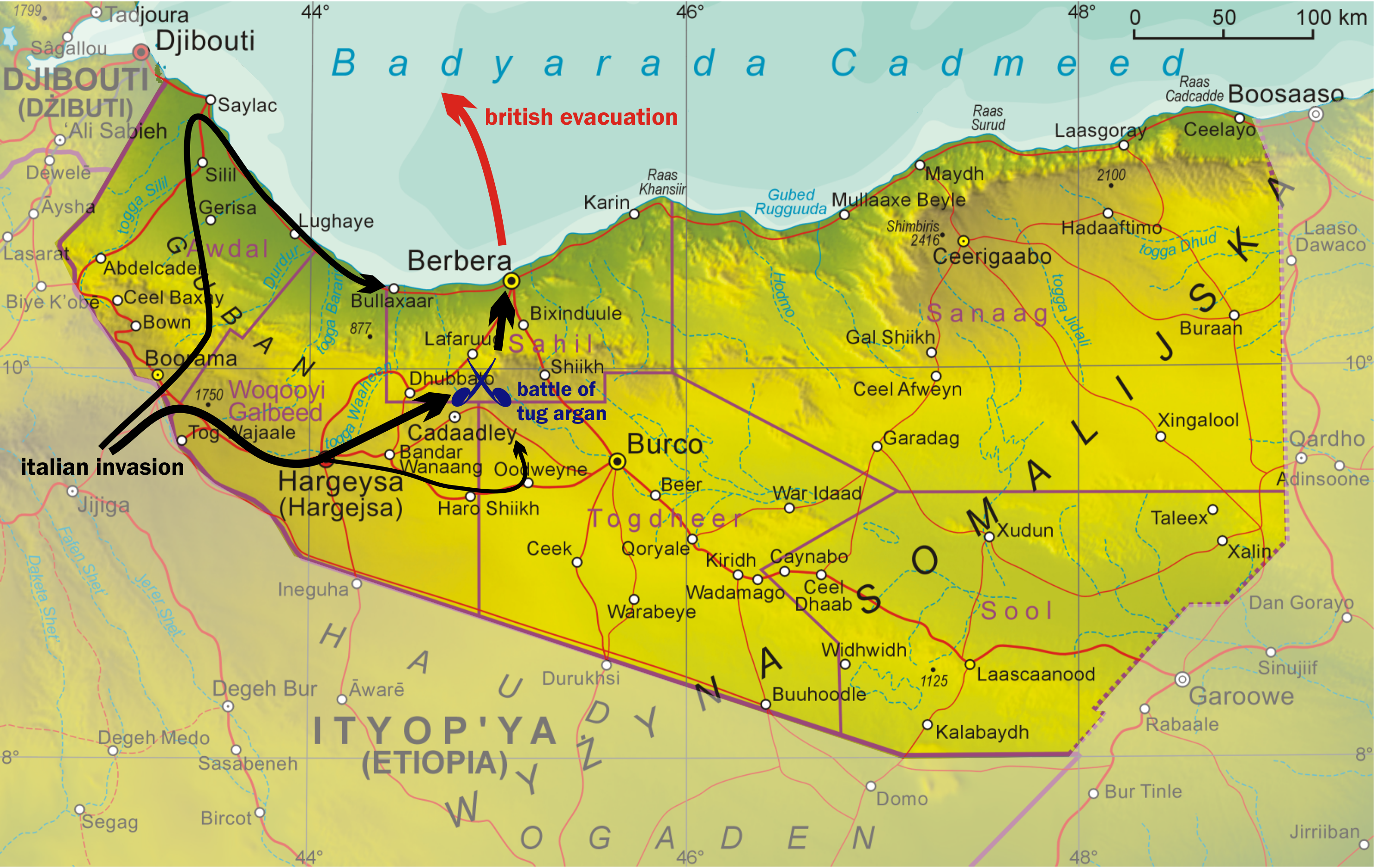
At 9.20 PM, U-58 sinks Greek steamer Pindos (carrying 7590 tons of grain from Sierra Leone to Britain) 10 miles from the Irish coast, with 2 torpedoes (3 killed). 29 survivors reach County Donegal, Ireland, in the lifeboats. 300 miles Northwest of Ireland, U-52 sinks 3 British steamers in convoy HX-60 - SS Geraldine Mary (1 passenger and 2 crew killed, 4 passengers and 44 crew rescued and return to Britain), SS Gogovale (all 37 crew picked up by destroyer HMS Vanoc and landed at Liverpool), SS King Alfred (7 dead, 34 crew also picked up by HMS Vanoc). U-52 is then depth charged by Royal Navy escort vessels, causing significant damage. U-52 is able to sail to Kiel, Germany, for repairs and will be out of action until November 17. http://www.uboat.net/allies/merchants/ships/452.html
3 British minesweeping trawlers HMT Drummer (2 killed), Marsona (11 killed) and Oswaldian 12 lives lost, 7 survivors) are sunk on German mines laid at various points around the British coast. German antisubmarine trawler Perseus (UJ-175) hits a mine and sinks off Ameland Island on the Northwest coast of Holland.
A bad day for Norwegian merchant shipping. British submarine HMS Sealion sinks Norwegian steamer Torun 1 mile off the South coast of Norway. After dark, German armed merchant cruiser Widder stops empty Norwegian tanker Beaulieu with her guns (4 killed), in the middle of the North Atlantic 1700 miles East of Florida. 28 survivors take to the lifeboats and will be picked up by British tanker Cymbeline on August 13 and landed at Gibraltar. Widder is threatened by her own torpedo which becomes a circle runner and Beaulieu is finally sunk with scuttling charges. Widder’s Captain Helmuth Ruckteschell will be tried as a War Criminal in May 1947 and found guilty of other charges but acquitted of abandoning these survivors from Beaulieu.
Monday, August 2, 2010
Day 338 August 3, 1940
Battle of Britain Day 25. Typical British weather comes to the rescue. Widespread fog in the morning and heavy low cloud in the afternoon covers most of Southern England and the Midlands. There are a few German raids on shipping. Overnight, Luftwaffe bombs Bradford, Liverpool, Crewe (Northern England) and the Firth of Forth Scotland.
At 8.10 AM North of Ireland, U-57 sinks Swedish steamer Atos (1 dead, 21 crew and 6 passengers picked up by Icelandic trawler Skutull). 1 passenger is a sailor from Swedish steamer Tilia Gorthon (sunk by U-38 on 20 June) being repatriated from Liverpool to Sweden.
At 7 PM 300 miles off the coast of Senegal, West Africa, UA stops Yugoslavian steamer Rad with gunfire and discovers she is carrying chemicals from USA to Durban, South Africa. The crew takes to the lifeboats and UA sinks Rad at 8.15 with a torpedo. All 29 crew are picked up by British steamer Grodno and landed at Freetown, Sierra Leone. http://www.uboat.net/allies/merchants/ships/448.html
British Somaliland on the East coast of Africa is surrounded by Italian colonies (Italian Somaliland, Ethiopia and Eritrea) and is a tempting target for Mussolini to win an early victory against the British. It is lightly held by about 4,000 colonial soldiers under Brigadier Arthur Reginald Chater, including the Somaliland Camel Corps, with little artillery and no tanks, armoured cars or anti-tank weapons. In the early hours, 25,000 Italian troops commanded by General Guglielmo Nasi (with armoured vehicles including some tanks, artillery and air support) attack British Somaliland from Ethiopia.
At 8.10 AM North of Ireland, U-57 sinks Swedish steamer Atos (1 dead, 21 crew and 6 passengers picked up by Icelandic trawler Skutull). 1 passenger is a sailor from Swedish steamer Tilia Gorthon (sunk by U-38 on 20 June) being repatriated from Liverpool to Sweden.
At 7 PM 300 miles off the coast of Senegal, West Africa, UA stops Yugoslavian steamer Rad with gunfire and discovers she is carrying chemicals from USA to Durban, South Africa. The crew takes to the lifeboats and UA sinks Rad at 8.15 with a torpedo. All 29 crew are picked up by British steamer Grodno and landed at Freetown, Sierra Leone. http://www.uboat.net/allies/merchants/ships/448.html
British Somaliland on the East coast of Africa is surrounded by Italian colonies (Italian Somaliland, Ethiopia and Eritrea) and is a tempting target for Mussolini to win an early victory against the British. It is lightly held by about 4,000 colonial soldiers under Brigadier Arthur Reginald Chater, including the Somaliland Camel Corps, with little artillery and no tanks, armoured cars or anti-tank weapons. In the early hours, 25,000 Italian troops commanded by General Guglielmo Nasi (with armoured vehicles including some tanks, artillery and air support) attack British Somaliland from Ethiopia.
Sunday, August 1, 2010
Day 337 August 2, 1940
Battle of Britain Day 24. Overnight, steamer Highlander in convoy FN.239 is attacked by 2 He115 torpedo bombers, 20 miles south of Aberdeen, Scotland. 1 He115 is shot down by escort sloop HMS Weston. The other clips Highlander’s mast while strafing her, crash landing onto Highlander’s poop deck. Clouds again restrict flying during the day. Germans bomb convoys in the English Channel and along the East coast, sinking anti-submarine trawler HMT Cape Finesterre off Harwich (1 sailor killed). 2 Spitfires crash on take off at Hornchurch and 1 Hurricane crashes on landing (1 pilot killed). http://www.battleofbritain1940.net/0023.html
Overnight, British submarine HMS Thames hits a mine and sinks Southwest of Stavanger, Norway (all 62 crew lost). U-60 has another lucky escape, suffering no damage when bombed in error off Hagesund, Norway, by Stukas flying from Stavanger. U-99 torpedoes 3 empty tankers in convoy OB-191 (British MV Alexia and MV Lucerna, Norwegian MV Strinda). All 3 are damaged but none sink and no lives are lost. http://www.uboat.net/allies/merchants/ships/445.html
French military court sentences General Charles de Gaulle to death in absentia for leading the Free French movement in London.
Operation Hurry. At 4.45 AM, 12 Hurricanes launch from aircraft carrier HMS Argus Southwest of Sardinia and fly about 300 miles to Malta, forming new 261 Squadron. Admiral Somerville’s Force H returns safely to Gibraltar (arriving August 4) or to England (arriving August 10). Meanwhile, to prevent Italian air attacks on the carrier group, 8 Swordfish torpedo bombers from aircraft carrier HMS Ark Royal (escorted by battlecruiser HMS Hood, cruiser HMS Enterprise and 4 destroyers) attack an Italian airfield at Cagliari on the South coast of Sardinia, destroying several Italian aircraft and laying mines in the harbour.
Overnight, British submarine HMS Thames hits a mine and sinks Southwest of Stavanger, Norway (all 62 crew lost). U-60 has another lucky escape, suffering no damage when bombed in error off Hagesund, Norway, by Stukas flying from Stavanger. U-99 torpedoes 3 empty tankers in convoy OB-191 (British MV Alexia and MV Lucerna, Norwegian MV Strinda). All 3 are damaged but none sink and no lives are lost. http://www.uboat.net/allies/merchants/ships/445.html
French military court sentences General Charles de Gaulle to death in absentia for leading the Free French movement in London.
Operation Hurry. At 4.45 AM, 12 Hurricanes launch from aircraft carrier HMS Argus Southwest of Sardinia and fly about 300 miles to Malta, forming new 261 Squadron. Admiral Somerville’s Force H returns safely to Gibraltar (arriving August 4) or to England (arriving August 10). Meanwhile, to prevent Italian air attacks on the carrier group, 8 Swordfish torpedo bombers from aircraft carrier HMS Ark Royal (escorted by battlecruiser HMS Hood, cruiser HMS Enterprise and 4 destroyers) attack an Italian airfield at Cagliari on the South coast of Sardinia, destroying several Italian aircraft and laying mines in the harbour.
Saturday, July 31, 2010
Day 336 August 1, 1940
Battle of Britain Day 23. In the morning, a photo reconnaissance Spitfire notices a build-up of German aircraft at an airfield on the Cotentin Peninsula, Northern France. At 3.40 PM, 13 Blenheim bombers of 59 Squadron bomb the airfield causing some damage, escorted by 10 Blenheim fighters of 236 Squadron. 1 bomber and 2 fighters do not return from the mission, possibly shot down by anti-aircraft fire or German fighters. At the same time, 30 He111s reach Norwich unopposed, as no RAF fighters are scrambled to intercept, and bomb Boulton-Paul Aircraft Works and Norwich railway station (6 civilians killed, 54 injured).
Hitler issues Directive 17 ordering intensified air attacks to begin on August 5 “to establish the necessary conditions for the final conquest of England”. Notably, “attacks on the South coast ports will be made on the smallest possible scale, in view of our own forthcoming operations”. http://www.battleofbritain1940.net/document-27.html
2 British submarines are sunk. HMS Spearfish is spotted on the surface by U-34 halfway between Aberdeen and Stavanger. U-34 is returning from patrol and sinks Spearfish at 7.04 PM with her last torpedo (41 killed). 1 survivor Able Seaman William Pester is picked up by U-34 and taken prisoner. Overnight, HMS Oswald, a leaky WWI-era submarine, is charging batteries and carrying out routine maintenance on the surface 15 miles South of Sardinia. Italian destroyer Ugolino Vivaldi spots Oswald at 2.5 km ramming her and sinking her with depth charges. After 2 hours, 52 survivors are pulled from the water by Vivaldi and taken prisoner but 3 men die. http://www.secondworldwar.org.uk/britsuboswald.html http://www.shipsnostalgia.com/showthread.php?t=24299
Italian submarine Goffredo Mameli sinks Greek steamer Roula 40 miles South of Crete (all crew rescued). U-59 hunts Swedish steamer Sigyn (carrying 765 fathoms of pit props to Sunderland, England) from 2.15 to 3.45 AM, finally sinking her with the third torpedo 60 miles Northwest of Ireland (all crew rescued).
http://www.uboat.net/allies/merchants/ships/443.html
U-60 has a lucky escape off Norway. Dutch submarine O-21 misses U-60 with 2 torpedoes from 2 km. O-22, O-21’s sister ship, also spots U-60 but is too far away to attack.
Royal Navy begins Operation Hurry transporting 12 Hurricanes on aircraft carrier HMS Argus to reinforce the garrison on Malta. HMS Argus is part of Admiral Somerville’s Force H from Gibraltar with battlecruiser HMS Hood, battleship HMS Valiant, aircraft carrier HMS Ark Royal, cruisers HMS Arethusa & Enterprise and 10 destroyers. Admiral Cunningham’s Mediterranean fleet leaves Alexandria, Egypt, to conduct diversionary maneuvers around the Greek island of Crete.
Hitler issues Directive 17 ordering intensified air attacks to begin on August 5 “to establish the necessary conditions for the final conquest of England”. Notably, “attacks on the South coast ports will be made on the smallest possible scale, in view of our own forthcoming operations”. http://www.battleofbritain1940.net/document-27.html
2 British submarines are sunk. HMS Spearfish is spotted on the surface by U-34 halfway between Aberdeen and Stavanger. U-34 is returning from patrol and sinks Spearfish at 7.04 PM with her last torpedo (41 killed). 1 survivor Able Seaman William Pester is picked up by U-34 and taken prisoner. Overnight, HMS Oswald, a leaky WWI-era submarine, is charging batteries and carrying out routine maintenance on the surface 15 miles South of Sardinia. Italian destroyer Ugolino Vivaldi spots Oswald at 2.5 km ramming her and sinking her with depth charges. After 2 hours, 52 survivors are pulled from the water by Vivaldi and taken prisoner but 3 men die. http://www.secondworldwar.org.uk/britsuboswald.html http://www.shipsnostalgia.com/showthread.php?t=24299
Italian submarine Goffredo Mameli sinks Greek steamer Roula 40 miles South of Crete (all crew rescued). U-59 hunts Swedish steamer Sigyn (carrying 765 fathoms of pit props to Sunderland, England) from 2.15 to 3.45 AM, finally sinking her with the third torpedo 60 miles Northwest of Ireland (all crew rescued).
http://www.uboat.net/allies/merchants/ships/443.html
U-60 has a lucky escape off Norway. Dutch submarine O-21 misses U-60 with 2 torpedoes from 2 km. O-22, O-21’s sister ship, also spots U-60 but is too far away to attack.
Royal Navy begins Operation Hurry transporting 12 Hurricanes on aircraft carrier HMS Argus to reinforce the garrison on Malta. HMS Argus is part of Admiral Somerville’s Force H from Gibraltar with battlecruiser HMS Hood, battleship HMS Valiant, aircraft carrier HMS Ark Royal, cruisers HMS Arethusa & Enterprise and 10 destroyers. Admiral Cunningham’s Mediterranean fleet leaves Alexandria, Egypt, to conduct diversionary maneuvers around the Greek island of Crete.
Friday, July 30, 2010
Day 335 July 31, 1940
Battle of Britain Day 22. Luftwaffe mounts numerous small raids on shipping all along the South coast of England. 1 Messerschmitt and 2 Spitfires are shot down off Folkestone. Göring is convinced by wild overestimates of RAF losses, as well as Royal Navy’s withdrawal of warships from the English Channel, that Luftwaffe has control of the skies. He believes he can proceed to Phase 2 of his plan, to eliminate RAF by direct attacks on their airfields. In fact RAF losses in July are 77 aircraft destroyed & 43 damaged (67 men killed, 23 wounded). Britain produced 496 fighters in July (50% above projected output) and has more serviceable aircraft than at the beginning of July, although still far fewer than Germany. British civilian casualties from bombing in July are 258 killed & 321 wounded.
Hitler revises his plans for an invasion of Britain by the middle of August. German Admiral Raeder convinces Hitler that Operation Sealion cannot be launched until middle of September.
U-99 sinks 2 British steamers 50 miles off the North coast of Ireland. At 1.38 AM, Jamaica Progress (2179 tons of fruit from Jamaica) is sunk with 7 lives lost. 17 survivors reach Barra in the Outer Hebrides in lifeboats while 25 crew members plus 1 gunner and 4 passengers are picked up by British trawler Newland and landed at Fleetwood, England. http://uboat.net/allies/merchants/ships/440.html At 1.24 PM, British steamer Jersey City in convoy OB-191 is sunk (2 killed). 43 crew are picked up by British steamer Gloucester City, transferred to destroyer HMS Walker and landed at Liverpool. http://uboat.net/allies/merchants/ships/441.html U-99 is depth charged by the escorts but is undamaged. Another attack on convoy OB-191 is foiled by a flying boat which bombs U-99, again without damage.
Off Harwich, British destroyer HMS Whitshed hits a mine head on and loses most of the bows. She is towed to Harwich stern first by destroyer HMS Wild Swan. HMS Whitshed will undergo repairs at Chatham until 21 December.
German armed merchant cruiser Pinguin sinks British steamer Domingo De Larringa in the South Atlantic 1000 miles east of Pernambuco, Brazil. 8 crew are killed & 30 taken prisoner (1 crewman Juan Garcia will die in Milag Nord PoW Camp and is buried in Becklingen War Cemetery).
British submarine HMS Spearfish departs Rosyth to patrol off the Norwegian coast.
Hitler revises his plans for an invasion of Britain by the middle of August. German Admiral Raeder convinces Hitler that Operation Sealion cannot be launched until middle of September.
U-99 sinks 2 British steamers 50 miles off the North coast of Ireland. At 1.38 AM, Jamaica Progress (2179 tons of fruit from Jamaica) is sunk with 7 lives lost. 17 survivors reach Barra in the Outer Hebrides in lifeboats while 25 crew members plus 1 gunner and 4 passengers are picked up by British trawler Newland and landed at Fleetwood, England. http://uboat.net/allies/merchants/ships/440.html At 1.24 PM, British steamer Jersey City in convoy OB-191 is sunk (2 killed). 43 crew are picked up by British steamer Gloucester City, transferred to destroyer HMS Walker and landed at Liverpool. http://uboat.net/allies/merchants/ships/441.html U-99 is depth charged by the escorts but is undamaged. Another attack on convoy OB-191 is foiled by a flying boat which bombs U-99, again without damage.
Off Harwich, British destroyer HMS Whitshed hits a mine head on and loses most of the bows. She is towed to Harwich stern first by destroyer HMS Wild Swan. HMS Whitshed will undergo repairs at Chatham until 21 December.
German armed merchant cruiser Pinguin sinks British steamer Domingo De Larringa in the South Atlantic 1000 miles east of Pernambuco, Brazil. 8 crew are killed & 30 taken prisoner (1 crewman Juan Garcia will die in Milag Nord PoW Camp and is buried in Becklingen War Cemetery).
British submarine HMS Spearfish departs Rosyth to patrol off the Norwegian coast.
Thursday, July 29, 2010
Day 334 July 30, 1940
Battle of Britain Day 21. Bad weather (low clouds and rain showers) restricts flying all day. 5 German raids target the Scottish coast and Northeast England. At noon, Spitfires of 603 Squadron shoot down 1 Heinkel He111 off Montrose Scotland. Further South, convoys are attacked in the English Channel off the coast of Essex and Suffolk. At 3.30 PM, Hurricanes of 85 Squadron shoot down 1 Messerschmitt Bf110 of Southwold, Suffolk. No British fighters are lost. Overnight, there are a few small bombing raids over Southeast England, South Wales and the Midlands.
Destroyer HMS Delight sinks in Portland harbour after being bombed yesterday in the English Channel.
Destroyer HMS Delight sinks in Portland harbour after being bombed yesterday in the English Channel.
Wednesday, July 28, 2010
Day 333 July 29, 1940
Battle of Britain Day 20. At 7.30 AM, 40 Stuka Ju87s bomb Dover Harbour escorted by 40 Messerschmitt Bf109s. Spitfires of 41 and 64 Squadrons and Hurricanes of 43 and 56 Squadrons attack, shooting down 8 Ju87s and 7 Bf109s. Anti-aircraft guns down 2 more Stukas. 2 Spitfires and 1 Hurricane are shot down. At 5 PM, Destroyer HMS Delight leaves Portland on the English South coast to patrol West coast of Britain, contravening new Navy orders banning sailing through the English Channel in daylight. At 6.30 PM, Delight is bombed by German aircraft from Cherbourg. A bomb penetrates the foredeck causing an explosion below deck (18 killed, 59 wounded) but Delight is able to steam back to Portland.
U-62 is on the surface 60 miles Southwest of Stavanger, Norway, when British submarine HMS Sealion fires 3 torpedoes, which miss, and then attacks with her deck gun. U-62 dives and escapes without damage. http://www.uboat.net/allies/warships/ship/3422.html
At 2.15 AM, U-99 sinks British steamer Clan Menzies (6000 tons of fruit, wheat and grain, 1500 tons of zinc, 840 tons of general cargo) 80 miles West of Ireland (6 killed). 88 survivors take to the lifeboats and make land at Enniscrone, Ireland. http://www.uboat.net/allies/merchants/ships/439.html
U-62 is on the surface 60 miles Southwest of Stavanger, Norway, when British submarine HMS Sealion fires 3 torpedoes, which miss, and then attacks with her deck gun. U-62 dives and escapes without damage. http://www.uboat.net/allies/warships/ship/3422.html
At 2.15 AM, U-99 sinks British steamer Clan Menzies (6000 tons of fruit, wheat and grain, 1500 tons of zinc, 840 tons of general cargo) 80 miles West of Ireland (6 killed). 88 survivors take to the lifeboats and make land at Enniscrone, Ireland. http://www.uboat.net/allies/merchants/ships/439.html
Tuesday, July 27, 2010
Day 332 July 28, 1940
Battle of Britain Day 19. At 1.35 PM, 100 German aircraft in 5 groups cross the Straits of Dover and are engaged by 4 Squadrons of British fighters off “Hellfire Corner”. 5 Messerschmitt Bf109s and 2 Heinkel bombers are shot down with the loss of two Spitfires. Luftwaffe wins a significant strategic victory, forcing Royal Navy to withdraw all destroyers from Dover to Portsmouth during daylight, as warships are vulnerable to divebombing by Stukas. Overnight, there is widespread minelaying along the coast and bombing of targets in England, Wales and Scotland.
At 5.57 AM, 80 miles West of Ireland, U-99 sinks British MV Auckland Star (carrying 10,700 tons of general cargo from Australia to Britain via the Panama canal). All 74 crew escape in lifeboats and reach the Irish shore. http://uboat.net/allies/merchants/ships/438.html
740 miles East of Brazil, near the island of Trindade, German and British armed merchant cruisers exchange fire. British HMS Alcantara is hit by 3 shells (2 killed, 7 wonded) while chasing German raider Thor, causing Alcantara to slow down. As Thor turns away to break off, Alcantara hits her with 2 shells (3 killed). Both ships survive and will be repaired. http://www.amhinja.demon.co.uk/archive/Alcantara.htm
At 5.57 AM, 80 miles West of Ireland, U-99 sinks British MV Auckland Star (carrying 10,700 tons of general cargo from Australia to Britain via the Panama canal). All 74 crew escape in lifeboats and reach the Irish shore. http://uboat.net/allies/merchants/ships/438.html
740 miles East of Brazil, near the island of Trindade, German and British armed merchant cruisers exchange fire. British HMS Alcantara is hit by 3 shells (2 killed, 7 wonded) while chasing German raider Thor, causing Alcantara to slow down. As Thor turns away to break off, Alcantara hits her with 2 shells (3 killed). Both ships survive and will be repaired. http://www.amhinja.demon.co.uk/archive/Alcantara.htm
Monday, July 26, 2010
Day 331 July 27, 1940
Battle of Britain Day 18. 15 German dive bombers attack 6 minesweeping trawlers and escort destroyers in the English Channel 20 miles off Aldeburgh, East Anglia. Destroyer HMS Wren is holed below the waterline by several near misses and sinks (37 lives lost). HMS Montrose suffers damage to the hull, losing her bow, and is towed to Harwich. Germans also bomb the port of Dover sinking destroyer HMS Codrington, in dock for boiler cleaning (3 men wounded). Merchant convoys are also attacked in the English Channel. 2 German fighters and 1 Stuka are shot down. RAF loses a Spitfire and a Hurricane.
At 2.58 AM, 350 miles West of Scotland, U-34 attacks convoy OB-188 sinking British steamer Sambre and British tanker Thiara (25 killed). British destroyer HMS Winchelsea rescues all 48 of Sambre’s crew plus 36 survivors from Thiara, who will be landed at Liverpool. http://uboat.net/allies/merchants/ships/436.html
At 2.58 AM, 350 miles West of Scotland, U-34 attacks convoy OB-188 sinking British steamer Sambre and British tanker Thiara (25 killed). British destroyer HMS Winchelsea rescues all 48 of Sambre’s crew plus 36 survivors from Thiara, who will be landed at Liverpool. http://uboat.net/allies/merchants/ships/436.html
Saturday, July 24, 2010
Day 330 July 26, 1940
Battle of Britain Day 17. Bad weather restricts flying. Several times, both small and large raids approach within 10-20 miles of the English coast but turn away when RAF fighter squadrons go up. It is not clear if this is due to the weather, reluctance of Luftwaffe pilots to engage or a new tactic designed to draw the RAF over the open sea towards France. 3 Messerschmitts and 1 Hurricane are lost.
50 miles Southwest of Stavanger, Norway, British submarine HMS Thames fires a torpedo that is intended for German battleship Gneisenau heading for Kiel. The torpedo instead hits one of the screening vessels at 50 yards; torpedo boat Luchs which sinks immediately. HMS Thames is never heard from again (possibly damaged by the proximity of the blast or hit by the sinking Luchs, or she may be lost on a German mine at a later date).
At 2.47 PM, 320 miles West of Ireland, U-34 fires three torpedoes at convoy OB-188, sinking British passenger ship Accra carrying 1700 tons of general cargo (24 dead). 465 survivors are rescued by British steamer Hollinside, Norwegian steamer Loke, sloop HMS Enchantress and corvette HMS Clarkia and landed at Liverpool. British MV Vinemoor is hit and sinks the next day (all 32 crew picked up by HMS Clarkia, transferred to steamer Hollinside and landed at Liverpool).
http://www.uboat.net/allies/merchants/ships/435.html
50 miles Southwest of Stavanger, Norway, British submarine HMS Thames fires a torpedo that is intended for German battleship Gneisenau heading for Kiel. The torpedo instead hits one of the screening vessels at 50 yards; torpedo boat Luchs which sinks immediately. HMS Thames is never heard from again (possibly damaged by the proximity of the blast or hit by the sinking Luchs, or she may be lost on a German mine at a later date).
At 2.47 PM, 320 miles West of Ireland, U-34 fires three torpedoes at convoy OB-188, sinking British passenger ship Accra carrying 1700 tons of general cargo (24 dead). 465 survivors are rescued by British steamer Hollinside, Norwegian steamer Loke, sloop HMS Enchantress and corvette HMS Clarkia and landed at Liverpool. British MV Vinemoor is hit and sinks the next day (all 32 crew picked up by HMS Clarkia, transferred to steamer Hollinside and landed at Liverpool).
http://www.uboat.net/allies/merchants/ships/435.html
Day 329 July 25, 1940
Battle of Britain Day 16. Another fine day for flying. Waves of 20-40 German aircraft attack shipping and naval bases around Dover. Ju87s and motor torpedo boats attack 21 merchant vessels in Convoy CW8 in the Dover Strait, sinking steamers Corhaven, Polgrange (2 killed), Leo (6 killed), Henry Moon (1 dead) & Portslade. Germans lose 14 aircraft. RAF loses 4 Spitfires. Attacks on Portsmouth, Poole and Portland, on the South Coast, cost Luftwaffe 7 more aircraft (2 RAF fighters shot down).
After being torpedoed by HMS Clyde on June 20, German battleship Gneisenau is made seaworthy and departs Trondheim, Norway (to undergo further repairs at Kiel), escorted by cruiser Nurnberg and destroyers Galster, Lody, Jacobi, and Ihn. Torpedo boats Luchs, Jaguar, Kondor, Iltis and T.5 join the convoy overnight, near Stavanger.
After being torpedoed by HMS Clyde on June 20, German battleship Gneisenau is made seaworthy and departs Trondheim, Norway (to undergo further repairs at Kiel), escorted by cruiser Nurnberg and destroyers Galster, Lody, Jacobi, and Ihn. Torpedo boats Luchs, Jaguar, Kondor, Iltis and T.5 join the convoy overnight, near Stavanger.
Friday, July 23, 2010
Day 328 July 24, 1940
Battle of Britain Day 15. At 6.30 AM, Luftwaffe bombs Rolls Royce factory at Glasgow without damage, hitting a nearby printing works. At 7.30 AM, Junkers Ju88s raid shipping in the Bristol Channel and 1 Ju88 is shot down by Spitfires of 92 Squadron. At noon, 18 Dornier bombers escorted by 40 Bf109s attack shipping in the Thames estuary, sinking minesweeping trawler Fleming (19 crew killed, 3 survivors rescued by minesweeper Corena). 54 and 65 Squadron go up and, as the Germans turn away, 610 Squadron scrambles from Gravesend to cut off their retreat. The 36 Spitfires shoot down 9 Bf109s which are running low on fuel off the coast of Kent (RAF loses 2 Spitfires). Another Bf109 is shot down by anti-aircraft guns. German bombers sink anti-submarine trawler HMS Kingston Galena (16 dead) and minesweeper Rodino (4 dead) off Dover.
1277 French sailors (captured when French warships in British ports were captured on July 3) leave Southampton for Marseilles on French steamer Meknes to be repatriated. At 10.30 PM, flying the French flag and with lights on to indicate neutrality, Meknes is sunk in the middle of the English Channel by German motor torpedo boat S-27 (416 lives lost). British destroyers HMS Viscount, Wolverine, Sabre and Shikari respond to distress signals and rescue the survivors. http://www.theyworkforyou.com/debates/?id=1940-07-25a.983.2
1277 French sailors (captured when French warships in British ports were captured on July 3) leave Southampton for Marseilles on French steamer Meknes to be repatriated. At 10.30 PM, flying the French flag and with lights on to indicate neutrality, Meknes is sunk in the middle of the English Channel by German motor torpedo boat S-27 (416 lives lost). British destroyers HMS Viscount, Wolverine, Sabre and Shikari respond to distress signals and rescue the survivors. http://www.theyworkforyou.com/debates/?id=1940-07-25a.983.2
Thursday, July 22, 2010
Day 327 July 23, 1940
Battle of Britain Day 14. German bases in France make convoys in the English Channel an easy target for the Luftwaffe. Most convoys are now sent around Scotland. Consequently, there is little activity in the Channel. The extra distance forces German bombers to fly beyond the range of their fighter escorts. Luftwaffe mounts a few coastal raids and minelaying overnight.
German bombers attack British submarines in the North Sea. 125 miles East of Aberdeen, Scotland, German Dornier Do-17 bomber (Lt. Karl Müller, 1/KF1Gr 606) sinks HMS Narwhal on her way to lay mines off Kristiansund, Norway. HMS Truant’s good luck continues when she is also attacked but suffers no damage.
8077 Canadian troops bound for Britain leave Halifax, Nova Scotia, on troopships Batory, Antonia, Monarch Of Bermuda, Sobieski, Duchess Of York & Samaria, escorted by Canadian destroyers HMCS Assiniboine & Saguenay and British cruiser HMS Emerald. The convoy will arrive safely in Scotland on August 1.
German bombers attack British submarines in the North Sea. 125 miles East of Aberdeen, Scotland, German Dornier Do-17 bomber (Lt. Karl Müller, 1/KF1Gr 606) sinks HMS Narwhal on her way to lay mines off Kristiansund, Norway. HMS Truant’s good luck continues when she is also attacked but suffers no damage.
8077 Canadian troops bound for Britain leave Halifax, Nova Scotia, on troopships Batory, Antonia, Monarch Of Bermuda, Sobieski, Duchess Of York & Samaria, escorted by Canadian destroyers HMCS Assiniboine & Saguenay and British cruiser HMS Emerald. The convoy will arrive safely in Scotland on August 1.
Wednesday, July 21, 2010
Day 326 July 22, 1940
Battle of Britain Day 13. Luftwaffe flies only reconnaissance missions and no convoys are attacked, despite good flying weather. Hurricanes of 145 Squadron shoot down a lone Dornier Do17 bomber off Selsey Bill. A Hurricane of 85 Squadron crashes approaching Castle Camps airfield killing the pilot. Overnight, numerous small German raids bomb coastal towns or lay mines off the East coast of England and Scotland (another Do17 is shot down).
British Foreign Minister Lord Halifax broadcasts a speech rebutting Hitler’s offer of peace in his Reichstag speech of July 19. “No one here wants the war to go on for a day longer than is necessary. But we shall not stop fighting until freedom, for ourselves and others, is secure.”
In Japan, General Hideki Tōjō is appointed Army Minister in Prime Minister Fumimaro Konoe’s new cabinet.
British submarine HMS Clyde fires 6 torpedoes at another British submarine HMS Truant, off Fejeosen, Norway. Fortunately, all torpedoes miss and neither sub is damaged.
British Foreign Minister Lord Halifax broadcasts a speech rebutting Hitler’s offer of peace in his Reichstag speech of July 19. “No one here wants the war to go on for a day longer than is necessary. But we shall not stop fighting until freedom, for ourselves and others, is secure.”
In Japan, General Hideki Tōjō is appointed Army Minister in Prime Minister Fumimaro Konoe’s new cabinet.
British submarine HMS Clyde fires 6 torpedoes at another British submarine HMS Truant, off Fejeosen, Norway. Fortunately, all torpedoes miss and neither sub is damaged.
Tuesday, July 20, 2010
Day 325 July 21, 1940
Battle of Britain Day 12. Overnight, 15 Handley Page Hampden bombers from 61 and 144 Squadron attack German battleships Admiral Scheer and Tirpitz at dock in Wilhelmshaven. Neither battleship is damaged but 3 Hampdens are shot down. With fine weather again, Germans focus on attacking convoys in the English Channel instead of bombing raids over land targets. Göring’s strategy is to bring British fighters into the air over the Channel, while exposing his aircraft to minimum danger. RAF loses a Hurricane and a Spitfire while Luftwaffe loses 3 fighters and 1 Dornier Do17 bomber. British losses since July 10 are about 45 fighters destroyed, but production of new aircraft has kept pace. More worrying is the loss of trained pilots who are not so easily replaced. http://www.ww2talk.com/forum/war-air/20582-69-years-ago-tonight-20-21-july-1940-a.html
After being bombed near Dover yesterday, HMS Brazen sinks while under tow. Destroyer HMS Boreas takes off the crew but 1 sailor is killed.
U-30 sinks British steamer Ellaroy 180 miles West of Cape Finisterre, Spain. The crew abandons ship in lifeboats. All 16 crew are rescued by Spanish trawler Felix Montenegro and landed at Vigo, Spain.
Soviet Union annexes Estonia, Latvia and Lithuania, following ‘elections’ held on July 14 voting for union with USSR. These countries will be under Soviet control until 1989, apart from a period of German occupation from 1941-1944.
After being bombed near Dover yesterday, HMS Brazen sinks while under tow. Destroyer HMS Boreas takes off the crew but 1 sailor is killed.
U-30 sinks British steamer Ellaroy 180 miles West of Cape Finisterre, Spain. The crew abandons ship in lifeboats. All 16 crew are rescued by Spanish trawler Felix Montenegro and landed at Vigo, Spain.
Soviet Union annexes Estonia, Latvia and Lithuania, following ‘elections’ held on July 14 voting for union with USSR. These countries will be under Soviet control until 1989, apart from a period of German occupation from 1941-1944.
Monday, July 19, 2010
Day 324 July 20, 1940
Battle of Britain Day 11. Enjoying fine flying weather, Germans attack convoys along the South and East coast of England and the East coast of Scotland. Germans bomb a convoy near Dover, sinking Steamer SS Pulborough (trawler Lady Philomena takes off 17 survivors) and badly damaging destroyer HMS Brazen (taken in tow by tug Lady Brassey). Brazen’s anti-aircraft guns claim 3 German aircraft shot down. http://www.uboat.net/allies/warships/ship/4356.html Destroyer HMS Acheron is bombed and damaged by near misses, 10 miles off the Isle of Wight. Acheron will go to Portsmouth for repairs. Another costly day for the RAF losing 5 Hurricanes, 1 Spitfire and 1 Blenheim (7 pilots and 1 gunner killed). Germans lose at least 6 fighters, 2 bombers and a seaplane.
Following Battle of Cape Spada yesterday, 6 Swordfish torpedo bombers from aircraft carrier HMS Eagle at Sidi Barrani, Egypt, seek Italian cruiser Giovanni dalle Bande Nere at the Italian naval base at Tobruk, Libya. Bande Nere is not there so they sink Italian destroyers Ostro & Nembo and steamer Sereno instead. Italy will soon abandon Tobruk as a sea base but guns from the sunken destroyers will be saved and used in the defense of Bardia.
Following Battle of Cape Spada yesterday, 6 Swordfish torpedo bombers from aircraft carrier HMS Eagle at Sidi Barrani, Egypt, seek Italian cruiser Giovanni dalle Bande Nere at the Italian naval base at Tobruk, Libya. Bande Nere is not there so they sink Italian destroyers Ostro & Nembo and steamer Sereno instead. Italy will soon abandon Tobruk as a sea base but guns from the sunken destroyers will be saved and used in the defense of Bardia.
Sunday, July 18, 2010
Day 323 July 19, 1940
Battle of Britain Day 10. 6 British Boulton Paul Defiants ("turret” fighters with no forward-firing guns) of 141 Squadron, covering a convoy off Folkestone, are shot down by 12 Bf109s (10 pilots and gunners dead, 2 survivors). 3 other Defiants are saved by Hurricanes of 111 Squadron. Defiants will soon be withdrawn as frontline fighters. 3 Hurricanes are lost in various engagements. There are numerous German bombing raids along the South and East coast of England and Scotland (42 civilians killed in Glasgow). 2 British destroyers HMS Griffin & Beagle are slightly damaging and tanker War Sepoy is sunk when Stukas bomb Dover. Overall, Germans lose 3 bombers and 3 Bf109s. http://www.raf.mod.uk/bob1940/july19.html
Hitler makes his “Last Appeal To Reason” speech at the Reichstag, suggesting directly that Britain come to a negotiated peace (translated leaflets are dropped over Britain). “I consider myself in a position to make this appeal, since I am not the vanquished, begging favors, but the victor speaking in the name of reason. I can see no reason why this war must go on.” He is disappointed that backdoor diplomacy has made no progress to avoid an invasion for which Germany is not prepared. He has not reckoned with Churchill’s determination to fight on, in order to secure the Empire and British influence in continental Europe. Hitler also promotes 12 Generals to Field Marshal. Maintaining the ascendancy of the Luftwaffe, Generalfeldmarschall Göring is promoted to Reich Marshal of the Greater German Reich.
Mediterranean. Battle of Cape Spada. 4 British destroyers HMS Hyperion, Hasty, Ilex & Hero encounter 2 Italian high-speed cruisers Giovanni dalle Bande Nere and Bartolomeo Colleoni. As the destroyers flee from the faster Italian ships, they call in Australian cruiser HMAS Sydney and British destroyer HMS Havock patrolling 40 miles North. Sydney hits Bartolomeo Colleoni which is disabled and then sunk by torpedoes from HMS Ilex & Hyperion (121 killed, 555 rescued by Ilex & Hyperion). The other Italian cruiser Giovanni dalle Bande Nere flees and is believed to have gone to Tobruk, Libya. http://www.diggerhistory.info/pages-battles/ww2/cape-spada.htm
30 miles Northwest of Ireland, U-62 sinks British steamer carrying 7860 tons of iron ore (13 crew killed). 26 survivors make land at Gola Island, Co. Donegal.
Off the coast of Brazil, German armed merchant cruiser Thor sinks Dutch steamer Tela (33 crew taken prisoner).
General Alan Brooke is appointed Commander in Chief, Home Forces, replacing General Edmund Ironside. Ironside has already been replaced as Chief of the Imperial General Staff by General Jon Dill. Ironside retires and will be promoted to Field Marshal.
Hitler makes his “Last Appeal To Reason” speech at the Reichstag, suggesting directly that Britain come to a negotiated peace (translated leaflets are dropped over Britain). “I consider myself in a position to make this appeal, since I am not the vanquished, begging favors, but the victor speaking in the name of reason. I can see no reason why this war must go on.” He is disappointed that backdoor diplomacy has made no progress to avoid an invasion for which Germany is not prepared. He has not reckoned with Churchill’s determination to fight on, in order to secure the Empire and British influence in continental Europe. Hitler also promotes 12 Generals to Field Marshal. Maintaining the ascendancy of the Luftwaffe, Generalfeldmarschall Göring is promoted to Reich Marshal of the Greater German Reich.
Mediterranean. Battle of Cape Spada. 4 British destroyers HMS Hyperion, Hasty, Ilex & Hero encounter 2 Italian high-speed cruisers Giovanni dalle Bande Nere and Bartolomeo Colleoni. As the destroyers flee from the faster Italian ships, they call in Australian cruiser HMAS Sydney and British destroyer HMS Havock patrolling 40 miles North. Sydney hits Bartolomeo Colleoni which is disabled and then sunk by torpedoes from HMS Ilex & Hyperion (121 killed, 555 rescued by Ilex & Hyperion). The other Italian cruiser Giovanni dalle Bande Nere flees and is believed to have gone to Tobruk, Libya. http://www.diggerhistory.info/pages-battles/ww2/cape-spada.htm
30 miles Northwest of Ireland, U-62 sinks British steamer carrying 7860 tons of iron ore (13 crew killed). 26 survivors make land at Gola Island, Co. Donegal.
Off the coast of Brazil, German armed merchant cruiser Thor sinks Dutch steamer Tela (33 crew taken prisoner).
General Alan Brooke is appointed Commander in Chief, Home Forces, replacing General Edmund Ironside. Ironside has already been replaced as Chief of the Imperial General Staff by General Jon Dill. Ironside retires and will be promoted to Field Marshal.
Saturday, July 17, 2010
Day 322 July 18, 1940
Battle of Britain Day 9. Weather improves and Germans attack the Channel ports. 15 Spitfires of 152 and 610 Squadron engage 30 Messerschmitts off Beachey Head on the South coast of England (1 Spitfire lost). Germans bomb Montrose Aerodrome, on the East coast of Scotland (2 killed, 3 wounded). Further South, Germans bombers sink the East Goodwin Light Vessel. At 7 PM, 18 Blenheim bombers escorted by 24 fighters bomb German barges, assembling for the invasion of Britain, at dock in Boulogne, France.
French bomb Gibraltar in retaliation for attacks on French warships in Operation Catapault. French pilots drop most of their bombs in the sea, apparently having no animosity towards the British.
British cruiser HMS Cumberland leaves Simonstown, near Cape Town, South Africa looking for German armed merchant cruiser Thor, 2000 miles away off the coast of Brazil.
At 2 AM, U-99 sinks British steamer Woodbury (5500 tons of canned meat & wheat, 2500 tons of general cargo) 150 miles Southwest of Ireland. All 35 crew reach Ireland in lifeboats on 19 July. http://www.uboat.net/allies/merchants/ships/431.html
At 4.41 PM, U-58 sinks Norwegian steamer Gyda (1980 tons of salt) 30 miles Northwest of Ireland (11 crew lost. 9 survivors will be picked up next day by Belgian passenger ship Ville d´Arlon and landed at New York on 26 July.
French bomb Gibraltar in retaliation for attacks on French warships in Operation Catapault. French pilots drop most of their bombs in the sea, apparently having no animosity towards the British.
British cruiser HMS Cumberland leaves Simonstown, near Cape Town, South Africa looking for German armed merchant cruiser Thor, 2000 miles away off the coast of Brazil.
At 2 AM, U-99 sinks British steamer Woodbury (5500 tons of canned meat & wheat, 2500 tons of general cargo) 150 miles Southwest of Ireland. All 35 crew reach Ireland in lifeboats on 19 July. http://www.uboat.net/allies/merchants/ships/431.html
At 4.41 PM, U-58 sinks Norwegian steamer Gyda (1980 tons of salt) 30 miles Northwest of Ireland (11 crew lost. 9 survivors will be picked up next day by Belgian passenger ship Ville d´Arlon and landed at New York on 26 July.
Friday, July 16, 2010
Day 321 July 17, 1940
Battle of Britain Day 8. Bad weather again restricts flying across most coastal areas. Germans bomb Bristol on the West coast of England, a tempting target due to its docks, airfields and aircraft factories. The industrial centers on the East coast of Scotland are also bombed again.
WWI-era British submarine H31 sinks German anti-submarine trawler Steiermark (UJ126) 5 miles off the coast of Holland. Other German anti-submarine trawlers counterattack but H31 is undamaged.
U-43 sinks British SS Fellside, West of Ireland (12 dead, 21 crew rescued and landed at Liverpool). U-34 sinks Greek SS Naftilos (all 28 crew abandon ship safely, 1 dies of wounds). Off the North Scottish coast, U-57 sinks Swedish SS O.A. Brodin (3 dead, 21 survivors picked up by armed trawler HMS Sicyon and taken to Kirkwall) and British SS Manipur (14 dead, 65 survivors rescued by Canadian destroyer HMCS Skeena and landed at Rosyth). http://www.uboat.net/allies/merchants/ships/425.html http://www.uboat.net/allies/merchants/ships/427.html
German bombers sink Estonian SS Leola 120 miles South of Ireland (2 killed). Belgian trawler Roger Jeannine rescues survivors.
In the Mediterranean, Italian bombers sink Finnish SS Wiiri 30 miles off Malta (all 26 crew rescued).
WWI-era British submarine H31 sinks German anti-submarine trawler Steiermark (UJ126) 5 miles off the coast of Holland. Other German anti-submarine trawlers counterattack but H31 is undamaged.
U-43 sinks British SS Fellside, West of Ireland (12 dead, 21 crew rescued and landed at Liverpool). U-34 sinks Greek SS Naftilos (all 28 crew abandon ship safely, 1 dies of wounds). Off the North Scottish coast, U-57 sinks Swedish SS O.A. Brodin (3 dead, 21 survivors picked up by armed trawler HMS Sicyon and taken to Kirkwall) and British SS Manipur (14 dead, 65 survivors rescued by Canadian destroyer HMCS Skeena and landed at Rosyth). http://www.uboat.net/allies/merchants/ships/425.html http://www.uboat.net/allies/merchants/ships/427.html
German bombers sink Estonian SS Leola 120 miles South of Ireland (2 killed). Belgian trawler Roger Jeannine rescues survivors.
In the Mediterranean, Italian bombers sink Finnish SS Wiiri 30 miles off Malta (all 26 crew rescued).
Thursday, July 15, 2010
Day 320 July 16, 1940
Battle of Britain Day 7. Low cloud, fog & heavy rain ground both sides in the morning & early afternoon. Spitfires from 601 Squadron intercept German bombers over the Isle of Wight in the English Channel (1 Ju88 is shot down). Germans bomb Fraserburgh & Peterhead in Northeast Scotland (Spitfires of 603 Squadron shoot down 1 Heinkel).
Hitler still hopes to bring Britain to a negotiated peace but time is running out for a cross-Channel offensive in the Summer. He issues Führer Directive 16 to prepare for an invasion on a wide section of the South coast of Britain by the middle of August, but the plan is hastily conceived and rudimentary. The intention is to transport 39 divisions across the English Channel in flat-bottomed Rhine river barges, in 3 waves (3 infantry div. then 6 armoured & 3 motorised div. finally 17 infantry div.). This requires the English Channel to be swept of British mines and then both ends blocked with German mines to prevent entry of Royal Navy. In addition, the Luftwaffe must annihilate the RAF to prevent aerial attacks on the barges. In contrast, Churchill believes the invasion can be thwarted simply by minesweepers clearing a path through the minefields to allow British destroyers into the Channel to sail back and forth, overturning the unstable barges in their wake. http://www.alternatewars.com/WW2/WW2_Documents/Fuhrer_Directives/FD_16.htm
British cruiser HMS Glasgow and destroyer HMS Imogen collide in heavy fog off Duncansby Head, North of Scotland. Imogen catches fire and is abandoned (17 killed, 133 rescued by HMS Glasgow), drifting 20 miles South before sinking. HMS Glasgow suffers a 6 foot gash above the water line (2 killed) and will sail to Liverpool for repairs (completed September 4).
Torpedo duel in the Mediterranean. British submarine HMS Phoenix attacks Italian torpedo boat Albatros but misses, Southeast of Sicily. Albatros then torpedoes HMS Phoenix and sinks her (all 55 crew lost).
In the South Atlantic, German armed merchant cruiser Thor sinks British steamer Wendover carrying 7250 tons of coal (4 killed, 36 crew and 1 gunner taken prisoner).
130 miles northwest of Ireland, U-61 hits British tanker Scottish Minstrel with 1 torpedo (9 dead). The tanker stays afloat, its cargo of 9200 tons of fuel oil blazing fiercely, and sinks the next day. 32 survivors are rescued by corvette HMS Gardenia and landed at Folkestone, England. http://www.uboat.net/allies/merchants/ships/426.html
Hitler still hopes to bring Britain to a negotiated peace but time is running out for a cross-Channel offensive in the Summer. He issues Führer Directive 16 to prepare for an invasion on a wide section of the South coast of Britain by the middle of August, but the plan is hastily conceived and rudimentary. The intention is to transport 39 divisions across the English Channel in flat-bottomed Rhine river barges, in 3 waves (3 infantry div. then 6 armoured & 3 motorised div. finally 17 infantry div.). This requires the English Channel to be swept of British mines and then both ends blocked with German mines to prevent entry of Royal Navy. In addition, the Luftwaffe must annihilate the RAF to prevent aerial attacks on the barges. In contrast, Churchill believes the invasion can be thwarted simply by minesweepers clearing a path through the minefields to allow British destroyers into the Channel to sail back and forth, overturning the unstable barges in their wake. http://www.alternatewars.com/WW2/WW2_Documents/Fuhrer_Directives/FD_16.htm
British cruiser HMS Glasgow and destroyer HMS Imogen collide in heavy fog off Duncansby Head, North of Scotland. Imogen catches fire and is abandoned (17 killed, 133 rescued by HMS Glasgow), drifting 20 miles South before sinking. HMS Glasgow suffers a 6 foot gash above the water line (2 killed) and will sail to Liverpool for repairs (completed September 4).
Torpedo duel in the Mediterranean. British submarine HMS Phoenix attacks Italian torpedo boat Albatros but misses, Southeast of Sicily. Albatros then torpedoes HMS Phoenix and sinks her (all 55 crew lost).
In the South Atlantic, German armed merchant cruiser Thor sinks British steamer Wendover carrying 7250 tons of coal (4 killed, 36 crew and 1 gunner taken prisoner).
130 miles northwest of Ireland, U-61 hits British tanker Scottish Minstrel with 1 torpedo (9 dead). The tanker stays afloat, its cargo of 9200 tons of fuel oil blazing fiercely, and sinks the next day. 32 survivors are rescued by corvette HMS Gardenia and landed at Folkestone, England. http://www.uboat.net/allies/merchants/ships/426.html
Wednesday, July 14, 2010
Day 319 July 15, 1940
Battle of Britain. Low cloud and rain keep most aircraft grounded. German bombers attack industrial and dock areas along the Scottish coast but do little damage and Westland Aircraft aircraft works at Yeovil, Somerset is bombed (1 runway and 1 hangar are damaged. Convoy "Pilot" is spotted by a reconnaissance aircraft in the Thames Estuary but Dornier bombers sent out to attack are headed off by British fighters.
140 British commandos are taken to Guernsey by destroyers HMS Scimitar and Saladin but Operation Ambassador goes badly. 40 men from No.3 Commando are ferried ashore in launches but find German barracks empty and re-embark leaving behind 3 men who cannot swim back to the launches. They become German POWs. Other launches crash on rocks or go to the wrong island, Sark.
At 3.21 AM, U-34 sinks Greek steamer Evdoxia 40 miles southwest of Ireland (1 dead, 22 survivors). http://www.uboat.net/allies/merchants/ships/424.html
Estonian steamer Merisaar, captured by U-99 on July 12, is sunk by German bombing off Cobh, County Cork, Ireland. The German prize crew is rescued and taken prisoner.
140 British commandos are taken to Guernsey by destroyers HMS Scimitar and Saladin but Operation Ambassador goes badly. 40 men from No.3 Commando are ferried ashore in launches but find German barracks empty and re-embark leaving behind 3 men who cannot swim back to the launches. They become German POWs. Other launches crash on rocks or go to the wrong island, Sark.
At 3.21 AM, U-34 sinks Greek steamer Evdoxia 40 miles southwest of Ireland (1 dead, 22 survivors). http://www.uboat.net/allies/merchants/ships/424.html
Estonian steamer Merisaar, captured by U-99 on July 12, is sunk by German bombing off Cobh, County Cork, Ireland. The German prize crew is rescued and taken prisoner.
Tuesday, July 13, 2010
Day 318 July 14, 1940
Battle of Britain Day 5. Clear weather allows Luftwaffe to attack convoy “Bread” and other convoys in the English Channel. There are dogfights all day and only 5 ships are damaged or sunk. BBC reporter Charles Gardner describes a dogfight from the cliffs of Dover, although he gets many facts wrong in the excitement. http://www.bbc.co.uk/archive/battleofbritain/11431.shtml http://www.doverwarmemorialproject.org.uk/Information/Articles/Incidents/Flames.htm Germans also bomb RAF airfield at Manston in Kent and a destroyer moored in Swanage Harbour, Dorset, causing little damage.
British armed merchant cruiser HMS Esperance Bay leaves Plymouth at 12.50 PM carrying ten million pounds in gold. 100 miles West, she is bombed (7 dead) but is able to return to Plymouth.
German armed merchant cruiser Thor sinks British steamer Gracefield, carrying 7430 tons of wheat and bran, 500 miles off the coast of Brazil. The crew of 36 is taken prisoner.
At 11.45 AM, U-boat UA sinks Norwegian tanker Sarita 100 miles West of Cape Verde. Al 29 crew abandons ship on two rafts and a lifeboat. They are picked up on July 18 by British steamer Dunstan and taken to Pernambuco. At 6.18 PM, U-52 sinks Greek steamer Thetis A. carrying grain, 300 miles West of Brest, France (9 dead, 20 survivors abandon ship in a lifeboat). http://www.uboat.net/allies/merchants/ships/422.html
British armed merchant cruiser HMS Esperance Bay leaves Plymouth at 12.50 PM carrying ten million pounds in gold. 100 miles West, she is bombed (7 dead) but is able to return to Plymouth.
German armed merchant cruiser Thor sinks British steamer Gracefield, carrying 7430 tons of wheat and bran, 500 miles off the coast of Brazil. The crew of 36 is taken prisoner.
At 11.45 AM, U-boat UA sinks Norwegian tanker Sarita 100 miles West of Cape Verde. Al 29 crew abandons ship on two rafts and a lifeboat. They are picked up on July 18 by British steamer Dunstan and taken to Pernambuco. At 6.18 PM, U-52 sinks Greek steamer Thetis A. carrying grain, 300 miles West of Brest, France (9 dead, 20 survivors abandon ship in a lifeboat). http://www.uboat.net/allies/merchants/ships/422.html
Monday, July 12, 2010
Day 317 July 13, 1940
Battle of Britain Day 4. Göring’s strategy of Kanalkampf (Channel battles), harassing shipping and bombing coastal facilities, continues. However, coastal fog prevents flying for most of the morning. Convoy CW5 is attacked leaving Dover by German bombers. Escort destroyer HMS Vanessa is damaged by near misses and towed by destroyer HMS Griffin to Sheerness for repairs (completed November 4). Convoy “Bread” is again attacked off the Dorset coast. Hurricanes from 56 & 238 Squadrons and Spitfires of 64 Squadron respond and shoot down 6 German bombers. Several British fighters are shot down and 3 pilots are killed.
While U-boats prowl the busy sea lanes around Britain and the Mediterranean, armed merchant cruisers (surface raiders) are more effective in the wide open Ocean spaces using lookout to spot smokestacks of their victims. In the Indian Ocean 500 miles South of Ceylon, German raider Atlantis sinks British steamer Kemmendine bound for Burma filled with whisky (57 crew, 25 passengers taken prisoner). 200 miles Northeast of Antigua, raider Widder sinks British steamer King John (taking prisoner 5 crew and 21 survivors from the Panamanian ship Santa Margarita sunk by U-29 July 2). Widder now has 100 prisoners, so most are put into King John’s lifeboats & set towards the West Indies. http://ahoy.tk-jk.net/MaraudersWW2/2Atlantis.html
While U-boats prowl the busy sea lanes around Britain and the Mediterranean, armed merchant cruisers (surface raiders) are more effective in the wide open Ocean spaces using lookout to spot smokestacks of their victims. In the Indian Ocean 500 miles South of Ceylon, German raider Atlantis sinks British steamer Kemmendine bound for Burma filled with whisky (57 crew, 25 passengers taken prisoner). 200 miles Northeast of Antigua, raider Widder sinks British steamer King John (taking prisoner 5 crew and 21 survivors from the Panamanian ship Santa Margarita sunk by U-29 July 2). Widder now has 100 prisoners, so most are put into King John’s lifeboats & set towards the West Indies. http://ahoy.tk-jk.net/MaraudersWW2/2Atlantis.html
Sunday, July 11, 2010
Day 316 July 12, 1940
In the North Channel between England and Ireland, U-56 hits British transport ship Dunera with a torpedo that glances off without exploding. Dunera is carrying 2,542 “enemy aliens” (many are survivors from British liner Arandora Star sunk July 2).
Battle of Britain Day 3. Typical British summer weather (low clouds, rain showers and occasional sunny periods) restricts flying across most coastal areas. British fighters engage He111 and Do17 bombers and fighter escorts targeting a large convoy (codenamed "Booty") off Essex and Suffolk (2 Spitfires, 1 Hurricane lost, no ships sunk). In the West of England, Stukas covered by Messerschmitt Me110s bomb Portland and Exeter. Stukas are vulnerable to attack pulling out of their dive and 2 are shot down. Twin-engine Me110s are too slow to provide much cover. A lone Heinkel He111 from Stavanger is shot down doing reconnaissance near Aberdeen, Scotland, and drops its bombs on the city before crashing into the Ice Rink. http://www.bbc.co.uk/ww2peopleswar/stories/15/a4141315.shtml
160 miles Southwest of Ireland, U-99 sinks Greek steamer Ia carrying 6666 tons of wheat at 2 AM (3 dead and 27 survivors) and stops Estonian steamer Merisaar (carrying lumber) with the anti-aircraft gun at 11 PM, after missing with a torpedo. Rough seas prevent sinking Merisaar with torpedoes or deck gun, so she is ordered to go to Bordeaux, France. However, Merisaar will be sunk off Cork, Ireland, by a German bomber July 15.
http://www.uboat.net/allies/merchants/ships/421.html
After the Battle of Calabria, Italian bombers attack British battleship HMS Warspite and cruiser HMS Liverpool from 8.50 to 11.50 AM, with no damage. HMS Liverpool is hit by a bomb that did not explode (1 killed and 2 wounded). A Sea Gladiator of 801 Squadron from aircraft carrier HMS Eagle shoots down an Italian bomber then makes a forced landing alongside HMS Liverpool, which rescues the seaplane.
Battle of Britain Day 3. Typical British summer weather (low clouds, rain showers and occasional sunny periods) restricts flying across most coastal areas. British fighters engage He111 and Do17 bombers and fighter escorts targeting a large convoy (codenamed "Booty") off Essex and Suffolk (2 Spitfires, 1 Hurricane lost, no ships sunk). In the West of England, Stukas covered by Messerschmitt Me110s bomb Portland and Exeter. Stukas are vulnerable to attack pulling out of their dive and 2 are shot down. Twin-engine Me110s are too slow to provide much cover. A lone Heinkel He111 from Stavanger is shot down doing reconnaissance near Aberdeen, Scotland, and drops its bombs on the city before crashing into the Ice Rink. http://www.bbc.co.uk/ww2peopleswar/stories/15/a4141315.shtml
160 miles Southwest of Ireland, U-99 sinks Greek steamer Ia carrying 6666 tons of wheat at 2 AM (3 dead and 27 survivors) and stops Estonian steamer Merisaar (carrying lumber) with the anti-aircraft gun at 11 PM, after missing with a torpedo. Rough seas prevent sinking Merisaar with torpedoes or deck gun, so she is ordered to go to Bordeaux, France. However, Merisaar will be sunk off Cork, Ireland, by a German bomber July 15.
http://www.uboat.net/allies/merchants/ships/421.html
After the Battle of Calabria, Italian bombers attack British battleship HMS Warspite and cruiser HMS Liverpool from 8.50 to 11.50 AM, with no damage. HMS Liverpool is hit by a bomb that did not explode (1 killed and 2 wounded). A Sea Gladiator of 801 Squadron from aircraft carrier HMS Eagle shoots down an Italian bomber then makes a forced landing alongside HMS Liverpool, which rescues the seaplane.
Day 315 July 11, 1940
Battle of Britain Day 2. Clouds keep most RAF and Luftwaffe aircraft grounded. Hurricanes from 601 Squadron & Spitfires of 609 Squadron tangle with Ju87 Stukas & Messerschmitt Bf109s attacking the Royal Navy base at Portland (South coast of England). 1 Hurricane, 2 Spitfires, 2 Stukas and 2 Bf109s are shot down. Hurricanes of 66 Squadron attack a reconnaissance Dornier Do17 bomber off the East coast of England (the Dornier and 1 Hurricane are lost). 6 Spitfires shoot down a Heinkel seaplane bearing Red Cross markings (to pick up downed Luftwaffe pilots) escorted by 12 Bf109s of the coast of Kent. 2 Spitfires and 2 Bf109s are also shot down. http://www.battleofbritain1940.net/0021.html
In the Indian Ocean 400 miles Southeast of Ceylon (now Sri Lanka), German armed merchant cruiser Atlantis sinks British steamer City Of Baghdad (previously a German ship SS Geierfels, taken by Britain as reparations after WWI) carrying 9,324 tons of steel, chemicals and machinery. 2 crew are killed, 81 taken prisoner.
At 7 AM, U-34 sinks Norwegian steamer Janna 100 miles Southwest of Ireland. All 25 crew abandon ship in three lifeboats and make land at Mizen Head, Ireland 3 days later. In the Mediterranean 60 miles South of Cyprus, Italian submarine Tarantini sinks Panamanian tanker Beme and rescues her entire crew.
In the Indian Ocean 400 miles Southeast of Ceylon (now Sri Lanka), German armed merchant cruiser Atlantis sinks British steamer City Of Baghdad (previously a German ship SS Geierfels, taken by Britain as reparations after WWI) carrying 9,324 tons of steel, chemicals and machinery. 2 crew are killed, 81 taken prisoner.
At 7 AM, U-34 sinks Norwegian steamer Janna 100 miles Southwest of Ireland. All 25 crew abandon ship in three lifeboats and make land at Mizen Head, Ireland 3 days later. In the Mediterranean 60 miles South of Cyprus, Italian submarine Tarantini sinks Panamanian tanker Beme and rescues her entire crew.
Saturday, July 10, 2010
Day 314 July 10, 1940
Battle of Britain Day 1. British air cover over the English Channel and Royal Navy ships are the biggest threats to German plans for a cross-Channel invasion of Britain. Luftwaffe must first defeat RAF and dominate the skies over the Channel. Göring plans to draw RAF into the air, by attacking Channel shipping and British coastal facilities, and then destroy British fighters in a series of dogfights ("the Channel battles"). 24 German bombers and 50 or more fighters attack a large convoy (codenamed "Bread") in the Straits of Dover, escorted by 6 RAF Hurricanes. 4 RAF squadrons in Southeast England are scrambled and a 30 minute dogfight ensues (RAF loses 3 fighters and Flying Officer Tom Higgs of 111 Squadron is killed; Germans lose 4 planes including 2 Dornier bombers). 1 ship in the convoy is sunk. 70 German bombers attack docks at Swansea, South Wales and Falmouth, Cornwall, where British tanker Tascalusa is sunk. http://www.raf.mod.uk/history/phase1ofthebattle.cfm
Liverpool, England. 2,542 “enemy aliens” (200 Italian POWs, 251 German POWs, 55 known Nazi sympathizers and 2,036 anti-Nazis, mostly Jewish refugees) embark onto British transport ship Dunera, a converted liner expected to carry 1600 troops. Over the next 57 days, they will be robbed, beaten and in 1 case bayoneted by the British guards. Overcrowding, lack of toilets and unsanitary conditions lead to widespread dysentery. Several British soldiers will be court-martialed including the senior officer Lieutenant-Colonel William Scott. When they arrive in Australia on September 6, they will be shipped by train to the rural town of Hay in the centre of New South Wales. http://www.marple-uk.com/misc/dunera.pdf
After the Battle of Calabria, 9 Fairey Swordfish from aircraft carrier HMS Eagle attack Augusta, Sicily, at 9.40 AM, sinking Italian destroyer Leone Pancaldo. Leone Pancaldo will be raised on 26 July 1941 and sunk again by Allied bombers on 30 April 1943 1 mile off Cape Bon, Tunisia.
In preparation for a British commando raid on Guernsey (Operation Ambassador), Lieutenant Nicolle returns from a reconnaissance mission. German garrison consists of 469 soldiers, mainly in St. Peter Port, and machine gun posts 2-5 miles away along the coast. Nicolle estimates commandos will have 20 minutes after attacking the machine guns before reinforcements arrive.
Italian submarine Scirè sinks French steamer Cheik, 54 miles Northwest of Sicily. Scirè rescues Cheik’s crew. http://www.sommergibili.com/indexen.htm
German armed merchant cruiser Widder sinks British steamer Davisan, 500 miles of the coast of Florida (taking the entire crew prisoner). http://ahoy.tk-jk.net/MaraudersWW2/4Widder.html
U-34 sinks Finnish steamer Petsamo carrying 6000 tons of cereals, within sight of the South Irish coast (4 dead, 33 crew make it to shore). http://www.uboat.net/allies/merchants/ships/418.html
U-61 sinks Dutch steamer Alwaki in ballast 10 miles off Cape Wrath, Scotland, with a torpedo that penetrated the hull but did not explode. The Alwaki was shaken and immediately started to list to port, because a bulkhead could not be closed and was slowly flooded. All 41 crew and 10 passengers are rescued by a British steamer Harmonic and landed at Cardiff on 15 July. The absence of explosion leads the Admiralty to suspect sabotage. http://www.uboat.net/allies/merchants/ships/417.html
Liverpool, England. 2,542 “enemy aliens” (200 Italian POWs, 251 German POWs, 55 known Nazi sympathizers and 2,036 anti-Nazis, mostly Jewish refugees) embark onto British transport ship Dunera, a converted liner expected to carry 1600 troops. Over the next 57 days, they will be robbed, beaten and in 1 case bayoneted by the British guards. Overcrowding, lack of toilets and unsanitary conditions lead to widespread dysentery. Several British soldiers will be court-martialed including the senior officer Lieutenant-Colonel William Scott. When they arrive in Australia on September 6, they will be shipped by train to the rural town of Hay in the centre of New South Wales. http://www.marple-uk.com/misc/dunera.pdf
After the Battle of Calabria, 9 Fairey Swordfish from aircraft carrier HMS Eagle attack Augusta, Sicily, at 9.40 AM, sinking Italian destroyer Leone Pancaldo. Leone Pancaldo will be raised on 26 July 1941 and sunk again by Allied bombers on 30 April 1943 1 mile off Cape Bon, Tunisia.
In preparation for a British commando raid on Guernsey (Operation Ambassador), Lieutenant Nicolle returns from a reconnaissance mission. German garrison consists of 469 soldiers, mainly in St. Peter Port, and machine gun posts 2-5 miles away along the coast. Nicolle estimates commandos will have 20 minutes after attacking the machine guns before reinforcements arrive.
Italian submarine Scirè sinks French steamer Cheik, 54 miles Northwest of Sicily. Scirè rescues Cheik’s crew. http://www.sommergibili.com/indexen.htm
German armed merchant cruiser Widder sinks British steamer Davisan, 500 miles of the coast of Florida (taking the entire crew prisoner). http://ahoy.tk-jk.net/MaraudersWW2/4Widder.html
U-34 sinks Finnish steamer Petsamo carrying 6000 tons of cereals, within sight of the South Irish coast (4 dead, 33 crew make it to shore). http://www.uboat.net/allies/merchants/ships/418.html
U-61 sinks Dutch steamer Alwaki in ballast 10 miles off Cape Wrath, Scotland, with a torpedo that penetrated the hull but did not explode. The Alwaki was shaken and immediately started to list to port, because a bulkhead could not be closed and was slowly flooded. All 41 crew and 10 passengers are rescued by a British steamer Harmonic and landed at Cardiff on 15 July. The absence of explosion leads the Admiralty to suspect sabotage. http://www.uboat.net/allies/merchants/ships/417.html
Thursday, July 8, 2010
Day 313 July 9, 1940
Battle of Calabria, first major sea battle in the Mediterranean. At 3.15 PM, Italian convoy to Benghazi, Libya (2 battleships Giulio Cesare & Conte di Cavour, 14 cruisers, 16 destroyers, 4 torpedo boats, 5 cargo ships) runs into a British convoy from Alexandria, Egypt to Malta (3 battleships HMS Warspite, Royal Sovereign & Malaya, 1 aircraft carrier HMS Eagle, 5 cruisers, 16 destroyers) 50 miles South of the heel of Italy. A 15-inch shell from HMS Warspite hits Giulio Cesare at a range of 24 km, one of the longest naval artillery hits equaling the shelling of HMS Glorious by German battleship Scharnhorst on June 8. Giulio Cesare does not sink but the Italian battleships withdraw; an indecisive cruiser battle ensues. 76 Italian high altitude bombers attack the British fleet, causing no damage but forcing a withdrawal, but 50 Italian aircraft bomb their own ships (also without damage). At 5 PM, battle ends & both sides withdraw.
Southwest of Ireland, U-34 sinks Estonian steamer Tiiu at 12.32 PM (all 20 crew picked up by a British trawler and landed at Milford Haven) and U-43 sinks British steamer Aylesbury at 9.19 PM (all 35 crew picked up by destroyers HMS Harvester & Havelock and landed at Liverpool). http://www.uboat.net/allies/merchants/ships/416.html
British submarine HMS Salmon is lost, presumed sunk by a mine, 60 miles of Stavanger, Norway (all 39 hands lost).
German armed merchant cruisers Komet departs Bergen, Norway, to raid in the Pacific Ocean via the Arctic Ocean, assisted by Soviet icebreakers. Komet, with a crew of 270 under Kapitän zur See Robert Eyssen, is equipped with a strengthened bow and a special propeller for ice navigation. Germany plans to send 26 ships via this route but Komet is the only one to attempt the Northern passage. http://www.bismarck-class.dk/hilfskreuzer/komet.html
Luftwaffe again bombs shipping in the English Channel and near the British coast.
Southwest of Ireland, U-34 sinks Estonian steamer Tiiu at 12.32 PM (all 20 crew picked up by a British trawler and landed at Milford Haven) and U-43 sinks British steamer Aylesbury at 9.19 PM (all 35 crew picked up by destroyers HMS Harvester & Havelock and landed at Liverpool). http://www.uboat.net/allies/merchants/ships/416.html
British submarine HMS Salmon is lost, presumed sunk by a mine, 60 miles of Stavanger, Norway (all 39 hands lost).
German armed merchant cruisers Komet departs Bergen, Norway, to raid in the Pacific Ocean via the Arctic Ocean, assisted by Soviet icebreakers. Komet, with a crew of 270 under Kapitän zur See Robert Eyssen, is equipped with a strengthened bow and a special propeller for ice navigation. Germany plans to send 26 ships via this route but Komet is the only one to attempt the Northern passage. http://www.bismarck-class.dk/hilfskreuzer/komet.html
Luftwaffe again bombs shipping in the English Channel and near the British coast.
Wednesday, July 7, 2010
Day 312 July 8, 1940
Final act of Operation Catapult. For a second day, British Fairey Swordfish torpedo bombers from HMS Hermes hit French battleship Richelieu at Dakar, Senegal. British motor torpedo boats attack French battleship Jean Bart at Casablanca, Morocco. Jean Bart will be out of commission for several months. General de Gaulle, leader of the Free French in London, denounces the attacks on Vichy French warships, saying that “all Frenchmen are dismayed”.
At 7.53 AM, U-99 sinks British steamer Humber Arm in convoy HX-53 (carrying 6200 tons of newsprint, pulp and lumber & 1000 tons of steel) 60 miles south of Ireland. 42 crew members and 1 passenger are picked up by destroyer HMS Scimitar and landed at Milford Haven, Wales. U-99 is attacked with 107 depth charges by escorts over 14 hours but escapes undamaged. U-99, captained by Otto Kretschmer, will go on to sink 40 more ships in the next 8 months including 3 British armed merchant cruisers (273,470 total tonnage). http://www.uboat.net/men/kretschmer.htm
Italians damage 2 British ships in the Mediterranean. Submarine Marconi torpedoes destroyer HMS Escort southwest of Minorca (2 lives lost, 13 wounded). Escort sinks under tow by destroyer HMS Forester. Cruiser HMS Gloucester is bombed by Italian aircraft. A bomb hits the compass platform of the bridge, killing 12 (including the captain) and wounding 9.
British bombers attack German heavy cruiser Lützow in dock at Kiel. Lützow, under repair for extensive torpedo damage to her stern caused by HMS Spearfish on April 11, is hit by a bomb which fails to explode.
At 7.53 AM, U-99 sinks British steamer Humber Arm in convoy HX-53 (carrying 6200 tons of newsprint, pulp and lumber & 1000 tons of steel) 60 miles south of Ireland. 42 crew members and 1 passenger are picked up by destroyer HMS Scimitar and landed at Milford Haven, Wales. U-99 is attacked with 107 depth charges by escorts over 14 hours but escapes undamaged. U-99, captained by Otto Kretschmer, will go on to sink 40 more ships in the next 8 months including 3 British armed merchant cruisers (273,470 total tonnage). http://www.uboat.net/men/kretschmer.htm
Italians damage 2 British ships in the Mediterranean. Submarine Marconi torpedoes destroyer HMS Escort southwest of Minorca (2 lives lost, 13 wounded). Escort sinks under tow by destroyer HMS Forester. Cruiser HMS Gloucester is bombed by Italian aircraft. A bomb hits the compass platform of the bridge, killing 12 (including the captain) and wounding 9.
British bombers attack German heavy cruiser Lützow in dock at Kiel. Lützow, under repair for extensive torpedo damage to her stern caused by HMS Spearfish on April 11, is hit by a bomb which fails to explode.
Day 311 July 7, 1940
Operation Catapult. British attack the brand new French battleship Richelieu in dock at Dakar, Senegal. Swordfish torpedo bombers from aircraft carrier HMS Hermes hit Richelieu, tearing a 40 foot hole and causing her to touch bottom, but Richelieu will be repaired in a few days. However, conflict is avoided at Alexandria, Egypt, where negotiations have been ongoing since July 3. Aware of the destruction wrought on the French ships at Mers-el-Kébir by superior British forces, French Admiral Godefroy agrees that his warships will remain in port to avoid being attacked or captured by British ships.
Overnight, British submarine HMS H43 lands Lieutenant Hubert Nicolle on Guernsey (he is originally from the island) to do reconnaissance on the German garrison, in preparation for a commando raid on the island, Operation Ambassador. http://www.independent.co.uk/arts-entertainment/obituary-hubert-nicolle-1175816.html
U-99 sinks British SS Sea Glory (all 29 crew lost). 23 hours later U-99 sinks Swedish SS Bissen (all 20 crew survive) 80 miles South of Cape Clear, Ireland. http://www.uboat.net/allies/merchants/ships/411.html
U-34 sinks Dutch tanker Lucrecia (carrying fuel oil) 100 miles West of Lands End, England (2 killed). 30 survivors are picked up by Portuguese steamer Alfarrarede. http://www.uboat.net/allies/merchants/ships/413.html
Overnight, British submarine HMS H43 lands Lieutenant Hubert Nicolle on Guernsey (he is originally from the island) to do reconnaissance on the German garrison, in preparation for a commando raid on the island, Operation Ambassador. http://www.independent.co.uk/arts-entertainment/obituary-hubert-nicolle-1175816.html
U-99 sinks British SS Sea Glory (all 29 crew lost). 23 hours later U-99 sinks Swedish SS Bissen (all 20 crew survive) 80 miles South of Cape Clear, Ireland. http://www.uboat.net/allies/merchants/ships/411.html
U-34 sinks Dutch tanker Lucrecia (carrying fuel oil) 100 miles West of Lands End, England (2 killed). 30 survivors are picked up by Portuguese steamer Alfarrarede. http://www.uboat.net/allies/merchants/ships/413.html
Day 310 July 6, 1940
Operation Lever (continuation of Operation Catapult). British Force H returns to Mers-el-Kébir, Algeria, to finish off the French battleships Provence and Dunkerque. At dawn, Fairey Swordfish from HMS Ark Royal score several torpedo hits on Dunkerque. One torpedo hits patrol boat French Terre Neuve, setting off a massive explosion in a large store of depth charges (8 killed), which badly damaged the nearby Dunkerque (154 killed and wounded).
At 5.37 AM, British cruisers HMS Capetown and Caledon and destroyers HMS Janus, Juno, Ilex and Imperial shell the Libyan port of Bardia, 10 miles along the coast from the Egyptian border. They sink Italian steamer Axum and damage another merchant ship. At 8.20 AM, the British ships are attacked by Italian bombers, suffering no damage.
British submarine HMS Shark, unable to dive, is captured by German minesweepers in Boknafjord near Stavanger, Norway. HMS Shark sinks under tow (3 killed, 32 taken prisoner). Another crewmember will be killed August 27 near his prison camp, dealing with an unexploded British bomb.
U-34 sinks Estonian collier Vapper, South of Cape Clear, Ireland (1 dead, 32 crew abandon ship in two lifeboats). U-99 (which had chased Vapper for 90 minutes) observes the sinking.
U-30 sinks Egyptian steamer Angele Mabro, West of Brest, France (all hands lost).
At 5.37 AM, British cruisers HMS Capetown and Caledon and destroyers HMS Janus, Juno, Ilex and Imperial shell the Libyan port of Bardia, 10 miles along the coast from the Egyptian border. They sink Italian steamer Axum and damage another merchant ship. At 8.20 AM, the British ships are attacked by Italian bombers, suffering no damage.
British submarine HMS Shark, unable to dive, is captured by German minesweepers in Boknafjord near Stavanger, Norway. HMS Shark sinks under tow (3 killed, 32 taken prisoner). Another crewmember will be killed August 27 near his prison camp, dealing with an unexploded British bomb.
U-34 sinks Estonian collier Vapper, South of Cape Clear, Ireland (1 dead, 32 crew abandon ship in two lifeboats). U-99 (which had chased Vapper for 90 minutes) observes the sinking.
U-30 sinks Egyptian steamer Angele Mabro, West of Brest, France (all hands lost).
Monday, July 5, 2010
Day 309 July 5, 1940
9 Swordfish of 813 Squadron from aircraft carrier HMS Eagle fly 100 miles West from Sidi Barrani, Egypt, to bomb the Italian naval base at Tobruk, Libya. Destroyer Zeffiro is sunk and destroyer Euro has her bow was blown off but stays afloat (she will be towed to Taranto and repaired). Italian liner Liguria is beached to prevent sinking. Merchant vessel Manzoni is sunk and Serenitas is badly damaged but both steamers will be captured by the British and repaired.
U-34 hits British destroyer HMS Whirlwind with 1 torpedo (59 lives lost, 51 survivors taken off by destroyer HMS Westcott). Whirlwind stays afloat and is scuttled by HMS Westcott, 50 miles Southwest of Ireland. Nearby, U-99 damages Canadian steamer Magog (carrying timber). The stern sinks but the aft stays afloat on the timber. 23 crew abandon ship in a lifeboat, are picked up by Swedish merchant Fidra and landed at Cork, Ireland. http://www.uboat.net/allies/merchants/ships/408.html
As part of Operation Fish (the shipment to Canada of British gold and negotiable securities, for storage in the Bank of Canada vault in Ottawa), battleship HMS Revenge & cruiser HMS Bonaventure & troopships Monarch Of Bermuda, Sobieski & Batory depart Greenock at 5.45 AM, escorted by destroyer HMS Garth. The British ships, carrying $1.75 billion in gold and securities from the Bank of England, will arrive safely at Halifax on 12 July.
At 10 PM, British submarine HMS Shark is badly damaged by German auxiliary minesweepers M1803 (trawler Spitzbergen), M1806 (trawler Cuxhaven), and M1807 (trawler Mulsum) in Boknafjord near Stavanger, Norway.
French Vichy government breaks off diplomatic relations with Britain in retaliation for the attacks on French ships on July 3.
Romania joins the Axis under pressure from Germany.
U-34 hits British destroyer HMS Whirlwind with 1 torpedo (59 lives lost, 51 survivors taken off by destroyer HMS Westcott). Whirlwind stays afloat and is scuttled by HMS Westcott, 50 miles Southwest of Ireland. Nearby, U-99 damages Canadian steamer Magog (carrying timber). The stern sinks but the aft stays afloat on the timber. 23 crew abandon ship in a lifeboat, are picked up by Swedish merchant Fidra and landed at Cork, Ireland. http://www.uboat.net/allies/merchants/ships/408.html
As part of Operation Fish (the shipment to Canada of British gold and negotiable securities, for storage in the Bank of Canada vault in Ottawa), battleship HMS Revenge & cruiser HMS Bonaventure & troopships Monarch Of Bermuda, Sobieski & Batory depart Greenock at 5.45 AM, escorted by destroyer HMS Garth. The British ships, carrying $1.75 billion in gold and securities from the Bank of England, will arrive safely at Halifax on 12 July.
At 10 PM, British submarine HMS Shark is badly damaged by German auxiliary minesweepers M1803 (trawler Spitzbergen), M1806 (trawler Cuxhaven), and M1807 (trawler Mulsum) in Boknafjord near Stavanger, Norway.
French Vichy government breaks off diplomatic relations with Britain in retaliation for the attacks on French ships on July 3.
Romania joins the Axis under pressure from Germany.
Sunday, July 4, 2010
Day 308 July 4, 1940
Operation Catapult. At 3.30 PM, British submarine HMS Pandora sinks French mine-laying gunboat Rigault de Genouilly, sailing from Oran, Algeria. French bombers attack the British fleet at Gibraltar, without damage, in retaliation for the sinking of French warships. Likewise, French submarines, armed merchant cruisers and destroyers at Dakar are ordered to attack British shipping.
Churchill speaks in the House of Commons justifying the capture or sinking of French warships on July 3, to prevent them falling into German or Italian hands. He does not apologise but leaves judgment “to the world and to history”. He also dispels the notion “that we have the slightest intention of entering into negotiations in any form and through any channel with the German and Italian Governments. We shall, on the contrary, prosecute the war with the utmost vigour by all the means that are open to us.” Churchill receives his first standing ovation from the House as Prime Minister.
Italians advance from Ethiopia just over the border into Sudan and attack 2 British forts at Kassala and Gallabat, forcing British garrisons to withdraw. The Italians stop here and fortify the towns with anti-tank defenses.
Germans arrive on the last of the Channel Islands, Sark. They receive the island’s surrender from the Dame of Sark (hereditary ruler of this island). When asked if she is afraid, the Dame replies “is there any need to be afraid of German officers?” Apart from a curfew and other restrictions, the Islanders have little cause for fear. The Channel Islands have fallen without a shot fired. Germany invests heavily in fortifying the islands, which will be completely bypassed come D-day.
In a prelude to the first phase of the Battle of Britain, German bombers and motor torpedo boats attack Convoy OA178 in the English Channel between Cherbourg, France, and Bournemouth, England, sinking 5 merchant ships (British SS Elmcrest & SS Dallas City, Dutch SS Britsum & SS Deucalion, Estonian SS Kolga) and damaging many more. In addition, German bombing of Royal Navy base in Portland harbour sinks British auxiliary anti-aircraft ship Foyle Bank (176 lives lost, 157 men rescued) and tug Silverdial.
Churchill speaks in the House of Commons justifying the capture or sinking of French warships on July 3, to prevent them falling into German or Italian hands. He does not apologise but leaves judgment “to the world and to history”. He also dispels the notion “that we have the slightest intention of entering into negotiations in any form and through any channel with the German and Italian Governments. We shall, on the contrary, prosecute the war with the utmost vigour by all the means that are open to us.” Churchill receives his first standing ovation from the House as Prime Minister.
Italians advance from Ethiopia just over the border into Sudan and attack 2 British forts at Kassala and Gallabat, forcing British garrisons to withdraw. The Italians stop here and fortify the towns with anti-tank defenses.
Germans arrive on the last of the Channel Islands, Sark. They receive the island’s surrender from the Dame of Sark (hereditary ruler of this island). When asked if she is afraid, the Dame replies “is there any need to be afraid of German officers?” Apart from a curfew and other restrictions, the Islanders have little cause for fear. The Channel Islands have fallen without a shot fired. Germany invests heavily in fortifying the islands, which will be completely bypassed come D-day.
In a prelude to the first phase of the Battle of Britain, German bombers and motor torpedo boats attack Convoy OA178 in the English Channel between Cherbourg, France, and Bournemouth, England, sinking 5 merchant ships (British SS Elmcrest & SS Dallas City, Dutch SS Britsum & SS Deucalion, Estonian SS Kolga) and damaging many more. In addition, German bombing of Royal Navy base in Portland harbour sinks British auxiliary anti-aircraft ship Foyle Bank (176 lives lost, 157 men rescued) and tug Silverdial.
Day 307 July 3, 1940
Operation Catapult. At dawn, Royal Navy boards 2 French battleships, 9 destroyers and other smaller ships at Plymouth and Portsmouth, England (3 British & 1 French sailor are killed).
At 5.45 AM, British Force H arrives off Mers-el-Kébir, Algeria. Vice Admiral Somerville offers French Admiral Marcel Gensoul (a known Anglophobe, loyal to the Vichy government) four alternatives for his fleet; join the Royal Navy; be interned in British ports, be decommissioned in the West Indies or USA, or sink the warships in Mers-el-Kebir harbour. Gensoul rejects the British terms, leading to fruitless negotiations all afternoon. At 5.56 PM, British ships shell the harbour for 10 minutes. The magazine on French battleship Bretagne is hit, which explodes and sinks at 6.09 PM (977 lives lost). Battleships Provence and Dunkerque and destroyer Mogador are damaged. In all, 1,297 French sailors are killed and 350 wounded. http://www.hmshood.org.uk/reference/official/adm234/adm234-317.htm
French battleship Strasbourg, aircraft carrier Commandant Teste and four destroyers escape from Mers-el-Kébir following the attack and evade the British blockade. 6 French cruisers and 4 destroyers leave Algiers on the news. They rendezvous and escape to Toulon, France, arriving on 4 July, despite bombing attacks by Fairey Swordfish from British aircraft carrier HMS Ark Royal.
Similar terms are given by Vice Admiral Sir Andrew Cunnigham to French Admiral Godefroy at Alexandria, Egypt. Negotiations continue all day and the French ships (battleship Lorraine and 4 cruisers) are not attacked. Negotiations will continue until July 7.
Luftwaffe bombs Cardiff in South Wales.
At 5.45 AM, British Force H arrives off Mers-el-Kébir, Algeria. Vice Admiral Somerville offers French Admiral Marcel Gensoul (a known Anglophobe, loyal to the Vichy government) four alternatives for his fleet; join the Royal Navy; be interned in British ports, be decommissioned in the West Indies or USA, or sink the warships in Mers-el-Kebir harbour. Gensoul rejects the British terms, leading to fruitless negotiations all afternoon. At 5.56 PM, British ships shell the harbour for 10 minutes. The magazine on French battleship Bretagne is hit, which explodes and sinks at 6.09 PM (977 lives lost). Battleships Provence and Dunkerque and destroyer Mogador are damaged. In all, 1,297 French sailors are killed and 350 wounded. http://www.hmshood.org.uk/reference/official/adm234/adm234-317.htm
French battleship Strasbourg, aircraft carrier Commandant Teste and four destroyers escape from Mers-el-Kébir following the attack and evade the British blockade. 6 French cruisers and 4 destroyers leave Algiers on the news. They rendezvous and escape to Toulon, France, arriving on 4 July, despite bombing attacks by Fairey Swordfish from British aircraft carrier HMS Ark Royal.
Similar terms are given by Vice Admiral Sir Andrew Cunnigham to French Admiral Godefroy at Alexandria, Egypt. Negotiations continue all day and the French ships (battleship Lorraine and 4 cruisers) are not attacked. Negotiations will continue until July 7.
Luftwaffe bombs Cardiff in South Wales.
Day 306 July 2, 1940
Overnight, 12 RAF Hampden bombers attack German battleship Scharnhorst and cruiser Prinz Eugen in dry dock at Kiel. 2 small bombs hit Prinz Eugen. Flight officer Guy Gibson drops the first 2000 lb bomb near Scharnhorst but misses. Gibson will be awarded the Distinguished Flying Cross.
At 6.58 AM off the coast of Ireland, U-47 fires a single torpedo at British liner Arandora Star carrying 1,299 German and Italian internees. With grey paint and no Red Cross sign, Arandora Star is mistaken for an armed merchant cruiser and sinks within 35 minutes (92 British crew & guards, 470 Italians and 243 Germans are lost). 282 crew & guards and 586 Italians & Germans are rescued by Canadian destroyer HMCS St. Laurent and landed at Greenock. http://www.uboat.net/allies/merchants/ships/406.html
U-29 sinks British tanker Athellaird about 500 miles West of Brest, France (all 42 crew are picked up by British sloop HMS Sandwich and landed at Greenock, Scotland) and Panamanian SS Santa Margarita (all 39 crew rescued). 21 survivors are picked up by British merchant King John which will be sunk on July 13. http://www.uboat.net/allies/merchants/ships/404.html
http://www.uboat.net/allies/merchants/ships/405.html
At 6.58 AM off the coast of Ireland, U-47 fires a single torpedo at British liner Arandora Star carrying 1,299 German and Italian internees. With grey paint and no Red Cross sign, Arandora Star is mistaken for an armed merchant cruiser and sinks within 35 minutes (92 British crew & guards, 470 Italians and 243 Germans are lost). 282 crew & guards and 586 Italians & Germans are rescued by Canadian destroyer HMCS St. Laurent and landed at Greenock. http://www.uboat.net/allies/merchants/ships/406.html
U-29 sinks British tanker Athellaird about 500 miles West of Brest, France (all 42 crew are picked up by British sloop HMS Sandwich and landed at Greenock, Scotland) and Panamanian SS Santa Margarita (all 39 crew rescued). 21 survivors are picked up by British merchant King John which will be sunk on July 13. http://www.uboat.net/allies/merchants/ships/404.html
http://www.uboat.net/allies/merchants/ships/405.html
Day 305 July 1, 1940
A planned invasion of Britain, Operation Seelöwe (Sealion), is first mentioned by the German General Staff (OKW).
The island of Jersey in the Channel Islands surrenders to German occupation. British paranoia escalates. Liner SS Arandora Star leaves Liverpool carrying 565 German internees & 734 Italian internees to camps in Canada, plus 374 British crew & military guards. 86 are Germans POWs, but most are Italians & Germans living in Britain (including Jews who have escaped from the continent). They are suspected of being German agents planning the invasion of Britain. The ship has no Red Cross sign to indicate that she is carrying prisoners and civilians.
Germans begin strategic bombing of British industrial centers. Luftwaffe bombs Hull in Northeast England and Wick, Scotland, in daylight (12 civilians killed, 22 injured).
The French government relocates from Bordeaux to Vichy. Pétain’s administration will henceforth be known as Vichy France.
At 4 AM, 300 miles West of Brest, France, U-30 sinks British MV Beignon carrying 8816 tons of wheat in convoy SL-36 (6 die, including 3 survivors from SS Avelona Star rescued yesterday). 30 crew and 81 Avelona Star survivors are picked up by destroyers HMS Vesper & HMS Windsor and landed at Plymouth.
In the same convoy, U-102 sinks British SS Clearton (8 crew lost). U-102 is sunk by British destroyer HMS Vansittart with depth charges (all 43 hands lost). HMS Vansittart then picks up 26 survivors from the Clearton and lands them at Plymouth. In the same area, U-65 sinks Dutch SS Amstelland (1 dead, 39 survivors) and U-29 sinks Greek SS Adamastos (all 25 crew survive).
U-26 damages British steamer Zarian in convoy OA-175. U-26 is depth charged by corvette HMS Gladiolus and then bombed on the surface by Flight Leader W.N. Gibson in an Australian Sunderland aircraft (10 Squadron, RAAF). Unable to dive, U-26 is scuttled (all 48 crew are rescued and became POWs). Gibson will receive the Distinguished Flying Cross. http://www.uboat.net/boats/u26.htm
The island of Jersey in the Channel Islands surrenders to German occupation. British paranoia escalates. Liner SS Arandora Star leaves Liverpool carrying 565 German internees & 734 Italian internees to camps in Canada, plus 374 British crew & military guards. 86 are Germans POWs, but most are Italians & Germans living in Britain (including Jews who have escaped from the continent). They are suspected of being German agents planning the invasion of Britain. The ship has no Red Cross sign to indicate that she is carrying prisoners and civilians.
Germans begin strategic bombing of British industrial centers. Luftwaffe bombs Hull in Northeast England and Wick, Scotland, in daylight (12 civilians killed, 22 injured).
The French government relocates from Bordeaux to Vichy. Pétain’s administration will henceforth be known as Vichy France.
At 4 AM, 300 miles West of Brest, France, U-30 sinks British MV Beignon carrying 8816 tons of wheat in convoy SL-36 (6 die, including 3 survivors from SS Avelona Star rescued yesterday). 30 crew and 81 Avelona Star survivors are picked up by destroyers HMS Vesper & HMS Windsor and landed at Plymouth.
In the same convoy, U-102 sinks British SS Clearton (8 crew lost). U-102 is sunk by British destroyer HMS Vansittart with depth charges (all 43 hands lost). HMS Vansittart then picks up 26 survivors from the Clearton and lands them at Plymouth. In the same area, U-65 sinks Dutch SS Amstelland (1 dead, 39 survivors) and U-29 sinks Greek SS Adamastos (all 25 crew survive).
U-26 damages British steamer Zarian in convoy OA-175. U-26 is depth charged by corvette HMS Gladiolus and then bombed on the surface by Flight Leader W.N. Gibson in an Australian Sunderland aircraft (10 Squadron, RAAF). Unable to dive, U-26 is scuttled (all 48 crew are rescued and became POWs). Gibson will receive the Distinguished Flying Cross. http://www.uboat.net/boats/u26.htm
Wednesday, June 30, 2010
Day 304 June 30, 1940
300 miles West of Brest, France, U-65 & U-43 attack convoy SL-36. At 10.27 PM, U-43 sinks British SS Avelona Star carrying 5630 tons of frozen meat & 1000 tons of oranges (1 life lost). 84 survivors are picked up by British MV Beignon, which will be sunk within 6 hours. U-65 damages British SS Clan Ogilvy which is towed to Falmouth, arriving on July 4 (repaired and returned to service by October). In the same area, U-26 sinks Estonian SS Merkur (4 dead) and Norwegian MV Belmoira (all 25 crew survive). http://www.uboat.net/allies/merchants/ships/392.html
http://www.uboat.net/allies/merchants/ships/398.html
U-47 sinks Greek SS Georgios Kyriakides carrying 7243 tons of sugar West of Ireland (all 30 crew survive). http://www.uboat.net/allies/merchants/ships/396.html
Germans begin to occupy the Channel Islands, the only British territory they will conquer. 3 Germans land by plane on Guernsey and demand the surrender of the island from a local policeman. The Channel Islands are demilitarized and partially evacuated (since June 15), dismissed by British government as being of no military value to Germany.
http://www.uboat.net/allies/merchants/ships/398.html
U-47 sinks Greek SS Georgios Kyriakides carrying 7243 tons of sugar West of Ireland (all 30 crew survive). http://www.uboat.net/allies/merchants/ships/396.html
Germans begin to occupy the Channel Islands, the only British territory they will conquer. 3 Germans land by plane on Guernsey and demand the surrender of the island from a local policeman. The Channel Islands are demilitarized and partially evacuated (since June 15), dismissed by British government as being of no military value to Germany.
Tuesday, June 29, 2010
Day 303 June 29, 1940
Operation Catapult. Admiralty gives Vice Admiral Somerville explicit instructions to secure the transfer, surrender, or destruction of the French warships at Mers-el-Kébir, Algeria, with no concessions given to the French - they either accept the British terms or face destruction. Somerville’s Force H consists of battleships HMS Valiant & HMS Resolution, battlecruiser HMS Hood, aircraft carrier HMS Ark Royal, cruisers HMS Arethusa & HMS Enterprise and 11 destroyers.
U-99 is again subjected to friendly fire. Leaving Wilhelmshaven, she is attacked by a German aircraft with 3 bombs. U-99 crash-dives and collides with the sea floor, causing minor damage.
U-boats sink 3 ships Southwest of Ireland. U-51 sinks Royal Navy decoy ship (SSV) HMS Edgehill (with concealed armament of nine 4in guns, four torpedo tubes and a buoyant cargo to help keep her afloat if hit). Due to Edgehill’s buoyancy, it takes three torpedoes to sink her. http://www.uboat.net/allies/merchants/ships/394.html
U-47 torpedoes British SS Empire Toucan which breaks in two (3 killed). 31 crew are rescued and landed at Plymouth by destroyer HMS Hurricane which scuttles the floating aft section. http://www.uboat.net/allies/merchants/ships/393.html
U-26 sinks Greek steamer Frangoula B. Goulandris (6 lives lost, 32 survivors). http://www.uboat.net/allies/merchants/ships/395.html
Italian submarine Rubino is sunk by Short Sunderland flying boats of RAF 201 Group in the Ionian Sea between Italy and Greece. RAF flying boats pick up some survivors. Off Tobruk, Italian submarine Sirena is damaged by Short Sunderlands of RAF 230 Squadron. West of Crete, Italian submarines Uebi Scebeli and Salpa are damaged by British destroyers HMS Dainty, Ilex, Defender & Voyager. Uebi Scebeli sinks slowly and the crew is rescued by HMS Dainty.
U-99 is again subjected to friendly fire. Leaving Wilhelmshaven, she is attacked by a German aircraft with 3 bombs. U-99 crash-dives and collides with the sea floor, causing minor damage.
U-boats sink 3 ships Southwest of Ireland. U-51 sinks Royal Navy decoy ship (SSV) HMS Edgehill (with concealed armament of nine 4in guns, four torpedo tubes and a buoyant cargo to help keep her afloat if hit). Due to Edgehill’s buoyancy, it takes three torpedoes to sink her. http://www.uboat.net/allies/merchants/ships/394.html
U-47 torpedoes British SS Empire Toucan which breaks in two (3 killed). 31 crew are rescued and landed at Plymouth by destroyer HMS Hurricane which scuttles the floating aft section. http://www.uboat.net/allies/merchants/ships/393.html
U-26 sinks Greek steamer Frangoula B. Goulandris (6 lives lost, 32 survivors). http://www.uboat.net/allies/merchants/ships/395.html
Italian submarine Rubino is sunk by Short Sunderland flying boats of RAF 201 Group in the Ionian Sea between Italy and Greece. RAF flying boats pick up some survivors. Off Tobruk, Italian submarine Sirena is damaged by Short Sunderlands of RAF 230 Squadron. West of Crete, Italian submarines Uebi Scebeli and Salpa are damaged by British destroyers HMS Dainty, Ilex, Defender & Voyager. Uebi Scebeli sinks slowly and the crew is rescued by HMS Dainty.
Day 302 June 28, 1940
British Bristol Blenheims bomb Tobruk. After the air raid, Marshal Italo Balbo (Italian Governor-General of Libya, Commander-in-Chief of Italian North Africa and "heir apparent" to Benito Mussolini) returns from a reconnaissance flight. He is killed when his plane is shot down by Italian anti-aircraft fire. Marshal Graziani is appointed to replace him.
At 2 AM, U-30 sinks British SS Llanarth (carrying 7980 tons of flour from Australia) 250 miles West of Brest, France. 16 crew are picked up by British corvette HMS Gladiolus on June 30 and landed at Plymouth. 19 others are rescued by a Spanish trawler and landed at San Sebastian. British trawler Castleton goes missing in the Orkney Islands, probably sunk by U-102 which does not return from this patrol.
http://www.uboat.net/allies/merchants/ships/390.html
Luftwaffe bombs the harbours of Guernsey and Jersey in the British Channel Islands, mistaking tomato trucks for troop carriers (48 civilians killed).
British government recognizes General de Gaulle as "Leader of All Free Frenchmen."
Soviet Union occupies Bessarabia and Northern Bucovina, ceded by Romania.
Italian destroyers Espero, Zeffiro & Ostro are sighted by air reconnaissance and intercepted by British light cruiser squadron from Alexandria, Egypt. Espero is sunk in the Ionian Sea, but the other two destroyers escape and continue to Tripoli. British cruiser HMS Liverpool is hit by a single 4.7 inch shell, cutting the degaussing wire.
At 2 AM, U-30 sinks British SS Llanarth (carrying 7980 tons of flour from Australia) 250 miles West of Brest, France. 16 crew are picked up by British corvette HMS Gladiolus on June 30 and landed at Plymouth. 19 others are rescued by a Spanish trawler and landed at San Sebastian. British trawler Castleton goes missing in the Orkney Islands, probably sunk by U-102 which does not return from this patrol.
http://www.uboat.net/allies/merchants/ships/390.html
Luftwaffe bombs the harbours of Guernsey and Jersey in the British Channel Islands, mistaking tomato trucks for troop carriers (48 civilians killed).
British government recognizes General de Gaulle as "Leader of All Free Frenchmen."
Soviet Union occupies Bessarabia and Northern Bucovina, ceded by Romania.
Italian destroyers Espero, Zeffiro & Ostro are sighted by air reconnaissance and intercepted by British light cruiser squadron from Alexandria, Egypt. Espero is sunk in the Ionian Sea, but the other two destroyers escape and continue to Tripoli. British cruiser HMS Liverpool is hit by a single 4.7 inch shell, cutting the degaussing wire.
Saturday, June 26, 2010
Day 301 June 27, 1940
Churchill still worries that Germany will capture the French fleet, particularly the vessels at Mers-el-Kébir, restoring German sea power lost in the Norwegian campaign. Despite Admiral Darlan’s assurances, War Cabinet instructs Royal Navy to neutralise, seize or destroy French warships in various British and North African ports (Operation Catapult). Vice Admiral Sir James Somerville is ordered to take newly-formed Force H to Algeria.
U-47 sinks 2 merchant ships Southwest of Ireland. At 4 AM, U-47 shells Norwegian MV Lenda carrying timber, which catches fire (1 dead, 27 survivors abandon ship in 2 boats). At 5 PM, U-47 shells Dutch tanker Leticia carrying 2568 tons of fuel oil (2 dead). 25 crew get off in 2 lifeboats. 3 men are rescued from the water by U-47 and brought to the lifeboats, where they are given first aid material, sausages and wine. Survivors from both ships are picked up in the afternoon by British destroyers HMS Hurricane and Havelock and taken to Plymouth, England.
http://www.uboat.net/allies/merchants/ships/389.html
http://www.uboat.net/allies/merchants/ships/388.html
Italian submarine Console Generale Luizzi is sunk by destroyers HMS Dainty, Defender and Ilex south of Crete. HMS Voyager and Dainty rescue the survivors. Off the coast of Eritrea near Port Sudan, beached Italian submarine Macalle is destroyed by shelling from British destroyers HMS Kandahar and Kingston & light cruiser HMS Leander (serving in the New Zealand Division of the Royal Navy). HMS Leander's aircraft also dropped four bombs on the submarine.
U-47 sinks 2 merchant ships Southwest of Ireland. At 4 AM, U-47 shells Norwegian MV Lenda carrying timber, which catches fire (1 dead, 27 survivors abandon ship in 2 boats). At 5 PM, U-47 shells Dutch tanker Leticia carrying 2568 tons of fuel oil (2 dead). 25 crew get off in 2 lifeboats. 3 men are rescued from the water by U-47 and brought to the lifeboats, where they are given first aid material, sausages and wine. Survivors from both ships are picked up in the afternoon by British destroyers HMS Hurricane and Havelock and taken to Plymouth, England.
http://www.uboat.net/allies/merchants/ships/389.html
http://www.uboat.net/allies/merchants/ships/388.html
Italian submarine Console Generale Luizzi is sunk by destroyers HMS Dainty, Defender and Ilex south of Crete. HMS Voyager and Dainty rescue the survivors. Off the coast of Eritrea near Port Sudan, beached Italian submarine Macalle is destroyed by shelling from British destroyers HMS Kandahar and Kingston & light cruiser HMS Leander (serving in the New Zealand Division of the Royal Navy). HMS Leander's aircraft also dropped four bombs on the submarine.
Friday, June 25, 2010
Day 300 June 26, 1940
At 2.28 AM, UA sinks Norwegian MV Crux (6300 tons of patent fuel from Britain to Brazil) 300 miles west of Cape St. Vincent, Portugal. All 30 crew abandon ship in 2 lifeboats and are picked up the following day by British steam merchant Brutus. At 3.30 PM, U-29 stops Greek SS Dimitris with a shot across her bow off Cape Finisterre, Spain. Dimitris, carrying 9000 tons of cereal grains from Argentina to Liverpool, is sunk by gunfire after the crew abandons ship. http://www.uboat.net/allies/merchants/ships/387.html
Soviet Union presents an ultimatum demanding territory in Bessarabia and Northern Bucovina from Romania. Hitler suggests the Romanians government gives in and satisfies the Soviet demands.
Soviet Union presents an ultimatum demanding territory in Bessarabia and Northern Bucovina from Romania. Hitler suggests the Romanians government gives in and satisfies the Soviet demands.
Subscribe to:
Posts (Atom)